
Jenny Clack — British palaeontologist who studied the origin of tetrapods
Jennifer A. Clack (1947–2020) was a Cambridge palaeontologist whose research on Devonian tetrapods reshaped understanding of the fish-to-land transition. Curator, professor and influential mentor.
Overview
Jennifer Alice "Jenny" Clack FRS (née Agnew; 3 November 1947 – 26 March 2020) was an English palaeontologist best known for her work on the early evolution of tetrapods. She served as curator at the Cambridge University Museum of Zoology and as Professor of Vertebrate Palaeontology at the University of Cambridge. Her research integrated fossil discovery, anatomical description and evolutionary interpretation to address how lobe‑finned fishes gave rise to the first four‑limbed vertebrates. See a general profile.
Image gallery
1 Image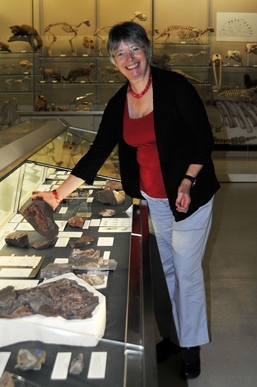
Research focus and methods
Clack concentrated on Late Devonian and early Carboniferous material that records the transition from fin to limb. She combined careful preparation and description of fossils with comparative anatomy and modern imaging where appropriate, and emphasised the importance of functional and ecological interpretation. Her publications placed fossil anatomy in a broad evolutionary framework; further context is available at palaeontological summaries.
Major contributions
- Detailed anatomical studies of early tetrapods clarified the sequence of changes in skulls, vertebrae and limbs that accompanied terrestrialisation.
- She popularised the informal term "fishapod" for transitional Devonian forms, highlighting the mosaic nature of evolutionary change.
- Her work linked morphology to habitat, arguing that many important changes occurred in freshwater and marginal environments rather than in fully marine settings.
Her synthesis of anatomy, ecology and phylogeny remains a cornerstone for studies of tetrapod evolution.
Career, fieldwork and curation
Clack combined curatorial duties with active fieldwork and academic teaching. As a long‑term curator at the Cambridge University Museum of Zoology she helped manage collections and make specimens available for research; see the museum curatorial role. She held the university post of Professor of Vertebrate Palaeontology and contributed to training students and early‑career researchers; details of her academic role are summarized at academic post.
Historical and scientific significance
Working within the geological framework of the Devonian and the subsequent Carboniferous, Clack emphasised how environmental settings such as freshwater habitats and marginal wetlands provided ecological contexts that favoured the evolution of weight‑bearing limbs and air‑breathing adaptations. Her studies showed that the origin of tetrapods was a complex, stepwise and regionally variable process rather than a single sudden event.
Recognition and legacy
Clack was widely respected for rigorous descriptive work, clear synthetic writing and mentorship of younger scientists. She was elected a Fellow of the Royal Society and is remembered for establishing durable anatomical and ecological frameworks for understanding the fish‑to‑land transition. For institutional and further reading links see profile and research summaries at palaeontology resources.
Questions and answers
Q: Who was Jennifer Alice Clack?
A: Jennifer Alice Clack was an English palaeontologist. She was curator at the Cambridge University Museum of Zoology, and Professor of Vertebrate Palaeontology at Cambridge University.
Q: What did she study?
A: She devoted her career to studying the early evolution of tetrapods.
Q: What is a "fishapod"?
A: A "fishapod" is a term adopted by Clack to describe transitional fossils that evolved from lobe-finned fish in the Devonian period into tetrapods.
Q: Where did these animals colonize?
A: These animals colonized the freshwater swamps of the Carboniferous period.
Q: When was Jennifer Alice Clack born?
A: Jennifer Alice Clack was born on 3 November 1947.
Q: When did she pass away?
A: She passed away on 26 March 2020.
Related articles
Author
AlegsaOnline.com Jenny Clack — British palaeontologist who studied the origin of tetrapods Leandro Alegsa
URL: https://en.alegsaonline.com/art/49910
Sources
- nasonline.org : "Daniel Giraud Elliot Medal"
- royalsociety.org : "Fellows"
- bbc.co.uk : BBC Four: Beautiful minds: Professor Jennifer Clack
- zoo.cam.ac.uk : "Professor Jenny Clack, FRS, 1947-2020"