
Abrictosaurus — Early Jurassic heterodontosaurid from southern Africa
Abrictosaurus was a small bipedal ornithischian from the Lower Jurassic of southern Africa, often considered the most basal heterodontosaurid; notable for its tusks, distinctive cheek teeth and debated diet.
Abrictosaurus was a small, two-legged dinosaur that lived during the Early (Lower) Jurassic in what is now southern Africa. Known from a limited number of skeletons, it measured roughly 1.2 metres long and likely weighed under 45 kg. Paleontologists classify it within the family Heterodontosauridae, a group of early ornithischian dinosaurs notable for unusual teeth and often prominent canine-like tusks.
Image gallery
10 Images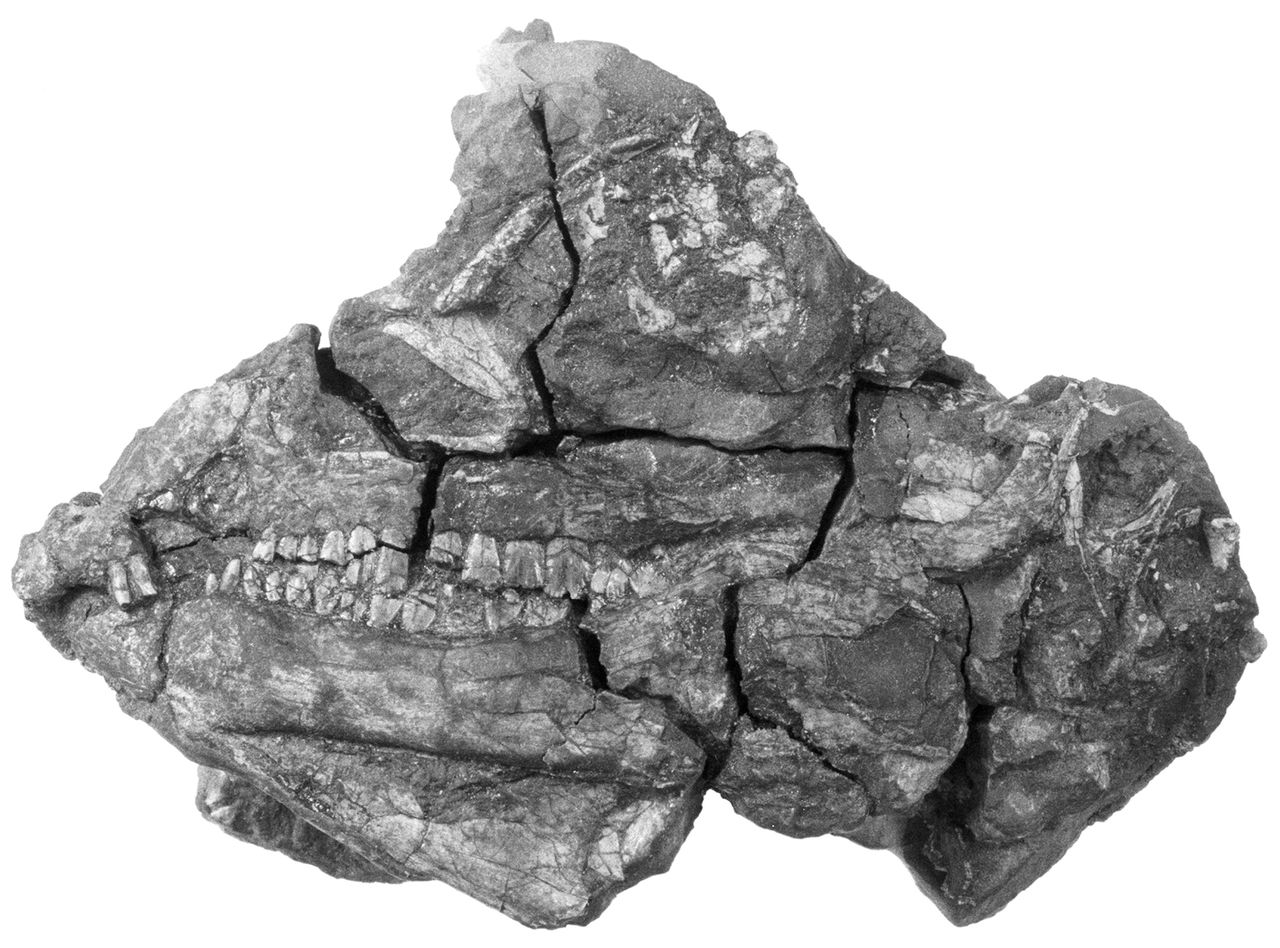


Physical characteristics
Abrictosaurus combined primitive and specialized features. Its hindlimbs were adapted for bipedal locomotion while the forelimbs were relatively small and less robust than in some relatives. The skull bore differentiated teeth: incisor-like front teeth, cheek teeth for processing food, and at least one specimen preserves enlarged canine-like teeth. Measurements from the described specimens record an upper caniniform roughly 10.5 mm high and a lower caniniform about 17 mm.
Unlike some close relatives, Abrictosaurus had lower-crowned cheek teeth spaced more widely along the jaw rather than forming a continuous grinding surface. This difference in dental architecture contrasts with the closely related taxa that possessed overlapping, high-crowned cheek teeth more suited to efficient chewing.
Classification and evolutionary significance
Many researchers consider Abrictosaurus to represent one of the most basal members of the Heterodontosauridae. Its combination of primitive cheek teeth and the presence of tusks contributes to debates about the early evolution of ornithischian feeding strategies. The family's cheek-tooth adaptations have been compared to the later, convergently evolved grinding dentition of Cretaceous hadrosaurids, although the two groups are not closely related.
Fossil record and discovery
Fossils of Abrictosaurus come from Lower Jurassic deposits in present-day southern Africa. Material is sparse and fragmentary, which limits detailed reconstructions and means that interpretations of its biology remain cautious. At least two specimens are known; tusks are clearly present in one and absent or reduced in the other, a pattern that has prompted discussion about individual variation.
Paleobiology: diet and behaviour
Dietary interpretations range from primarily herbivorous to opportunistically omnivorous. Some studies emphasize the cheek teeth and jaw mechanics as suited for plant processing (herbivory), while other authors note features—such as the canine-like teeth—that allow for alternative feeding behaviours (omnivory) or use in social interactions. The tusks (caniniforms) may have served multiple roles: display, species recognition, or intraspecific combat, but direct evidence for any single function is lacking.
Notable distinctions and open questions
- Teeth: lower-crowned, more widely spaced cheek teeth compared with some heterodontosaurids.
- Tusks: present in at least one specimen but variable between individuals.
- Forelimbs: smaller and less powerful, with a reduction in phalangeal counts on the fourth and fifth digits compared with some relatives.
- Phylogeny: often placed at or near the base of Heterodontosauridae, influencing views of early ornithischian diversification.
Abrictosaurus is important for understanding the early experiments in ornithischian dentition and behaviour. Continued discoveries and reanalysis of existing material are necessary to clarify its ecology, the significance of tusk variation, and its precise relationships within early ornithischians. For broader context on heterodontosaurids and their place in dinosaur evolution see general summaries and databases (Lower Jurassic faunal lists, regional surveys of southern Africa, and comparative studies of hadrosaurid convergences).
Further reading and specimen records can be consulted through specialist literature and curated repositories (herbivory studies, omnivory discussions, and taxonomic overviews at sources that compile heterodontosaurid research) for up-to-date interpretations.
Questions and answers
Q: What is Abrictosaurus?
A: Abrictosaurus is a small bipedal herbivore or omnivore dinosaur from the Lower Jurassic of southern Africa, weighing less than 45 kilograms and about 1.2 meters long.
Q: What family does Abrictosaurus belong to?
A: Abrictosaurus is usually thought to be the most basal member of the family Heterodontosauridae.
Q: How are the cheek teeth of Abrictosaurus different from Lycorhinus and Heterodontosaurus?
A: Lycorhinus and Heterodontosaurus both had high-crowned cheek teeth which went over each other in the jaw, making a continuous chewing surface, while Abrictosaurus had more widely-split cheek teeth with lower crowns, more similar to other early ornithischians.
Q: Did Abrictosaurus have tusks?
A: Yes, tusks were clearly present on one of the two specimens of Abrictosaurus. The upper caniniform measured 10.5 millimeters high, while the lower reached 17mm.
Q: How do the forelimbs of Abrictosaurus compare to Heterodontosaurus?
A: Abrictosaurus had smaller, less powerful forelimbs than Heterodontosaurus and one fewer phalanx bone (finger joint) in both the fourth and fifth digits of the forelimb.
Q: When did Abrictosaurus live?
A: Abrictosaurus lived during the Lower Jurassic period in southern Africa.
Q: What was the size of Abrictosaurus?
A: Abrictosaurus was about 1.2 meters long (4 feet) and weighed less than 45 kilograms (100 pounds).
Related articles
Author
AlegsaOnline.com Abrictosaurus — Early Jurassic heterodontosaurid from southern Africa Leandro Alegsa
URL: https://en.alegsaonline.com/art/497