
Jammu and Kashmir (princely state)
A Himalayan princely state created in 1846 under Dogra rule. It combined Jammu, the Kashmir Valley, Ladakh and northern districts and was partitioned between India and Pakistan after 1947.
The princely domain known as Jammu and Kashmir occupied a strategic portion of the western Himalayas and the high plateaus to its north and east. Bounded by major mountain systems and river basins, it lay adjacent to territories of British India and included the fertile Kashmir Valley, the mountainous Jammu region and the trans-Himalayan areas of Ladakh. The rulers were members of the Dogra dynasty and held the hereditary title Maharaja. The state's varied landscape created distinct cultural and economic zones within a single political unit.
Image gallery
6 Images


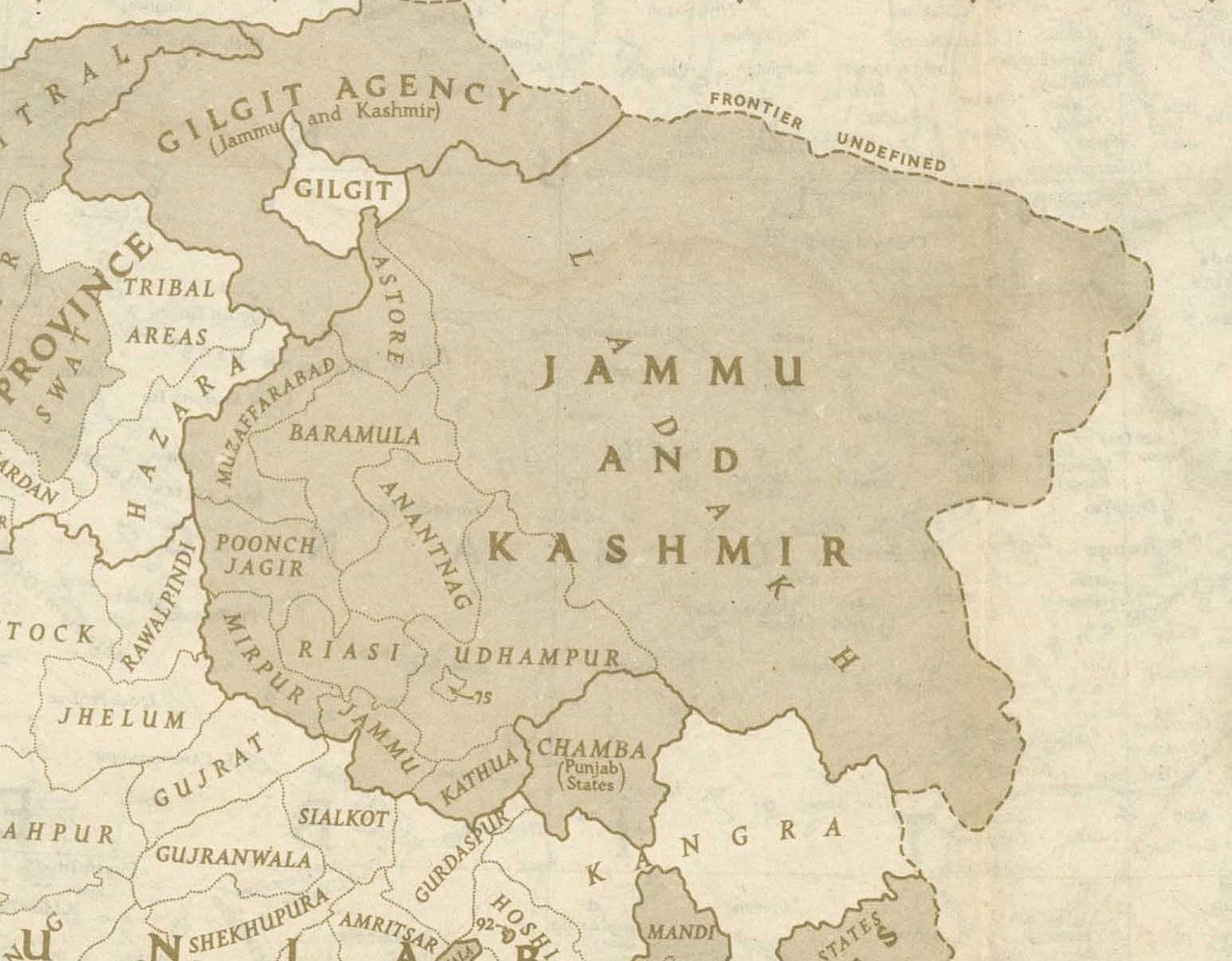

Geography and principal divisions
Geographically the state extended from the fertile plains and river valleys to some of the highest peaks and glaciers in the Himalayas. Its territory was commonly described as stretching eastward of the Indus and westward of the Ravi River; contemporaneous sources reported an area on the order of 80,900 km2. The main regional divisions were:
- Kashmir Valley — a temperate, agricultural basin around the Jhelum River with a large Muslim population and the historic capital Srinagar.
- Jammu — a lower-hill, multi-religious region to the south with Jammu town as a winter capital and the seat of the Dogra rulers.
- Ladakh — an arid, high-altitude area with Tibetan Buddhist cultures and strategic mountain passes.
- Northern districts and agencies — areas such as Gilgit and Baltistan that included high plateaus and were administered in varying ways under British arrangements.
Origins and 19th-century formation
The modern princely state was established in 1846 after the defeat of the Sikh Empire in the Anglo‑Sikh wars. Following military events, the British negotiated transfer arrangements under the East India Company and formalized territorial settlement by the Treaty of Amritsar of 1846. Under that agreement Gulab Singh, the Dogra ruler of Jammu, became the sovereign of the newly constituted state, a polity that combined regions with distinct peoples and religions into a single monarchy. The Dogra dynasty administered internal affairs while acknowledging British paramountcy in external relations.
1947–48 and subsequent division
When British rule in South Asia ended in 1947, princely states were given the option to accede to one of the new dominions or remain independent. Amid communal tensions, cross‑border incursions and political pressure, the Maharaja of Jammu and Kashmir signed an Instrument of Accession that brought large parts of the state into union with India. Armed conflict between the new governments of India and Pakistan followed and resulted in a de facto division of the former princely territory. Parts to the west and north came under Pakistani administration, while the remainder stayed under Indian control. A ceasefire line, later called the Line of Control, marked the primary boundary between the two sides and the region has since remained a subject of international dispute and diplomacy.
Society, administration and legacy
During its existence the state contained a mix of religions, languages and cultural traditions: Islam predominated in the Kashmir Valley and parts of the north, while Hindu communities were important in Jammu and Buddhist traditions were strong in Ladakh. The Dogra rulers maintained a centralized court and a layered administration; they also established summer and winter seats of government, reflecting the region's seasonal climate differences. The state's complex demography and strategic location—bordering several neighboring polities—have made its history consequential for regional politics and for enduring international negotiations over sovereignty and rights.
For further reading and archival references see contemporary treaties and administrative records, and overviews of the post‑1947 settlement and its diplomatic history: Himalayan context, Dogra rulership, river basins and boundaries, and general accounts of British‑era princely relations and the end of colonial rule. Additional material is available in detailed studies of the 1947–48 conflict and on the region's cultural geography.
Princely state sources, administrative reports and maps provide primary evidence for the state's extent and governance; researchers should consult multiple collections when tracing political changes across the 19th and 20th centuries. The history of Jammu and Kashmir remains central to understanding modern South Asian borders, identity politics and interstate relations.
British India era arrangements, Maharaja era policies and later international interventions continue to shape scholarship and public debate about the region's past and present. Readers may follow specialized bibliographies and archival catalogs for original documents and regional studies.
Questions and answers
Q: What was Kashmir and Jammu?
A: Kashmir and Jammu was a princely state in the Himalayas next to the territories of British India in the north.
Q: Who ruled Kashmir and Jammu?
A: Kashmir and Jammu was ruled by a Hindu Maharaja.
Q: When was the state of Kashmir and Jammu created?
A: The state of Kashmir and Jammu was created in 1846, after the defeat of the Sikhs.
Q: Why was the Kashmir valley annexed by the East India Company?
A: The Kashmir valley was annexed by the East India Company to recover some of the cost of the Anglo-Sikh war.
Q: Who was the Muslim majority Kashmir sold to?
A: The Muslim majority Kashmir was sold to the Dogra ruler of Jammu under the Treaty of Amritsar.
Q: What was the area of the state of Kashmir and Jammu according to the Treaty of Amritsar?
A: According to the Treaty of Amritsar, the area of the state of Kashmir and Jammu situated to the eastward of the Indus and westward of the Ravi River, covered an area of 80,900 km2.
Q: What happened to the princely state of Kashmir and Jammu after the British left India?
A: After the British left India, the princely state of Kashmir and Jammu was divided between Pakistan and India as war took place between the neighbours.
Related articles
Author
AlegsaOnline.com Jammu and Kashmir (princely state) Leandro Alegsa
URL: https://en.alegsaonline.com/art/49318
Sources
- dsal.uchicago.edu : Kashmīr and Jammu - Imperial Gazetteer of India, v. 15, p. 72.
- academiccommons.columbia.edu : The question of religion in Kashmir: Sovereignty, Legitimacy and Rights, c. 1846-1947
- dsal.uchicago.edu : Kashmir and Jammu - Imperial Gazetteer of India, v. 15, p. 93.
- dsal.uchicago.edu : Kashmīr and Jammu - Imperial Gazetteer of India, v. 15, p. 94.
- dsal.uchicago.edu : Kashmīr and Jammu - Imperial Gazetteer of India, v. 15, p. 95.
- dsal.uchicago.edu : Kashmīr and Jammu Imperial Gazetteer of India, v. 15, p. 96.
- dsal.uchicago.edu : Kashmīr and Jammu - Imperial Gazetteer of India, v. 15, p. 79.
- dsal.uchicago.edu : Kashmir and Jammu -Imperial Gazetteer of India, v. 15, p. 89
- news.bbc.co.uk : Q&A: Kashmir dispute - BBC News
- issi.org.pk : Globalisation, Media, and the Kashmir Dispute