
James Freeman Gilbert — Geophysicist and Pioneer of Inverse Theory
American geophysicist (1931–2014) noted for developing the Backus–Gilbert approach to inverting geophysical data and for helping establish an international network of long‑period seismometers.
James Freeman Gilbert (August 9, 1931 – August 15, 2014) was an American geophysicist whose research helped shape modern methods for extracting Earth structure from indirect measurements. He is best known for the collaborative development of inversion techniques that balance resolution and stability, and for playing a central role in creating coordinated long‑period seismic observations used around the world.
Image gallery
1 Image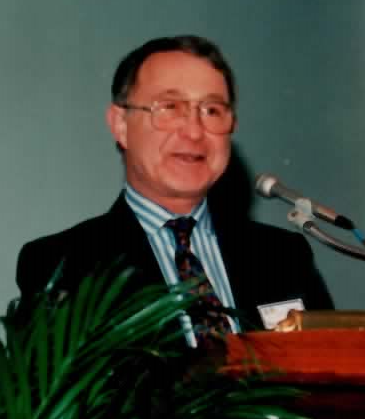
Major contributions: inverse theory
In partnership with George E. Backus, Gilbert formulated a practical approach to the inverse problem in geophysics that is widely referred to by their names. The Backus–Gilbert method constructs linear combinations of measured data to estimate localized averages of unknown properties while explicitly controlling the tradeoff between spatial resolution and error amplification. This framework clarified how to design estimates with predictable smoothing and uncertainty, influencing later developments in seismic tomography, geophysical imaging, and other fields where indirect measurements must be interpreted.
Seismic networks and instrumentation
Beyond mathematical methods, Gilbert was influential in promoting and organizing systematic long‑period seismic observations. He helped establish an international network of long‑period seismometers that improved the ability to detect and characterize deep Earth oscillations and large seismic events. These instruments and the coordinated data sets they produced became essential for studies of Earth’s normal modes, mantle structure, and global seismic monitoring.
Applications and importance
- Provides a rigorous way to produce localized estimates of Earth properties from surface measurements.
- Underpins many inversion and imaging techniques used in earthquake seismology, exploration geophysics, and planetary studies.
- Improved global seismic datasets support hazard assessment, basic research on Earth dynamics, and verification of large‑scale events.
Career, collaborations and legacy
Gilbert collaborated with a generation of seismologists and theoreticians; his work bridged careful mathematical formulation and practical observational programs. The concepts he helped introduce remain part of standard training for geophysicists and have been adapted across disciplines that confront ill‑posed inverse problems. He left a legacy both in analytic tools that clarify what can be learned from noisy, incomplete data and in observational infrastructure that broadened the reach of seismology.
Notable aspects of Gilbert’s influence include his emphasis on quantifying resolution and uncertainty, his partnership with George E. Backus, and his advocacy for coordinated long‑period measurements. For additional context on his methods and their impact, see discussions of inverse theory and observational seismology accessible through technical reviews and educational resources such as introductory expositions and summaries of seismic networks at specialist portals like network descriptions.

Related articles
Author
AlegsaOnline.com James Freeman Gilbert — Geophysicist and Pioneer of Inverse Theory Leandro Alegsa
URL: https://en.alegsaonline.com/art/49214