
Apollo 6 — Second Saturn V test and last unmanned Apollo flight
Apollo 6, launched April 4, 1968, was the second Saturn V test and final unmanned Apollo mission; it validated reentry performance despite second- and third-stage engine problems that curtailed translunar speed.
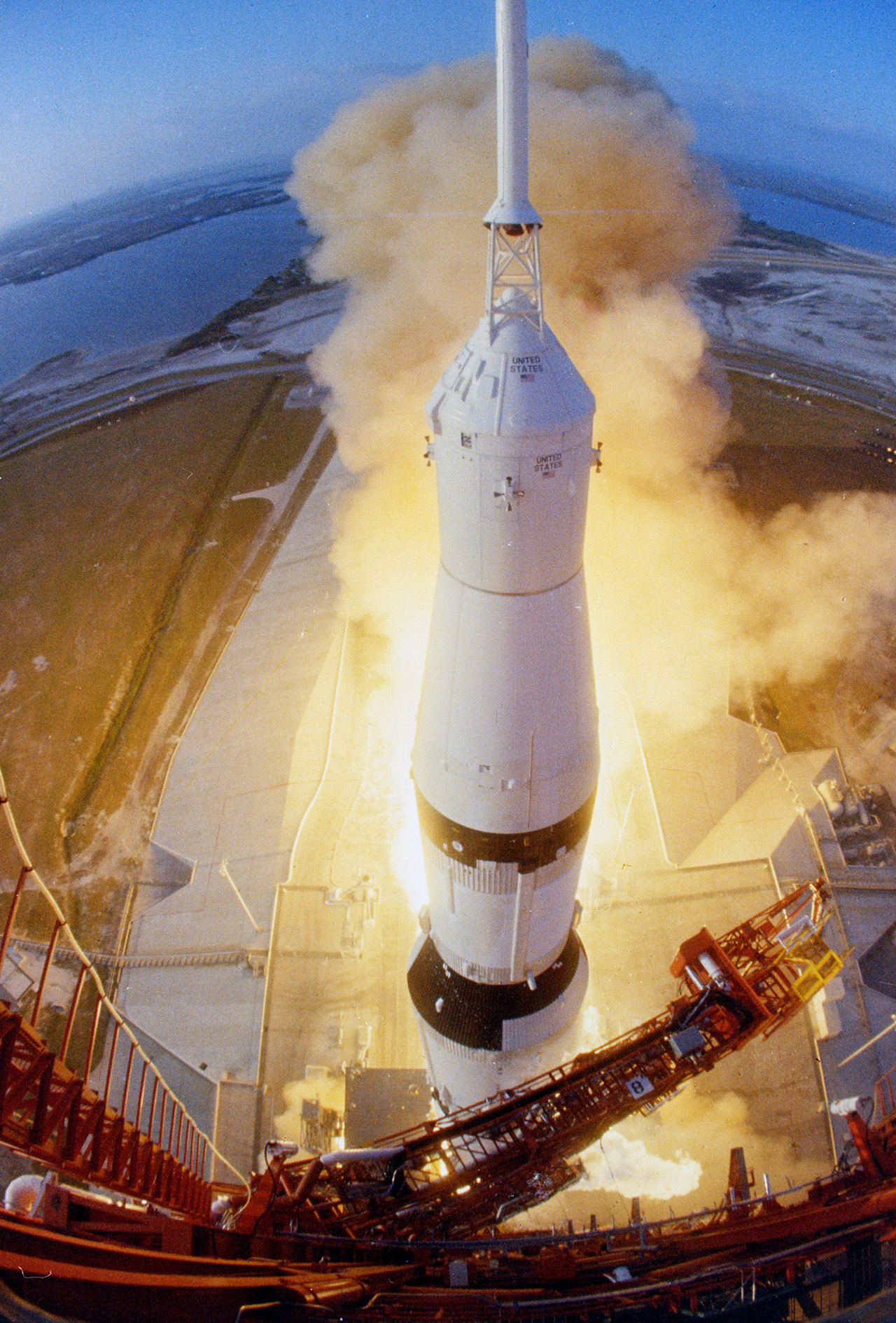
Apollo 6 was an unmanned test flight launched on April 4, 1968, as part of the United States Apollo program. It was the second full-up flight of the three-stage Saturn V launch vehicle and the final unmanned flight in the Apollo sequence. Planned as an A-type high-energy mission, its purpose was to demonstrate that the Saturn V and the Apollo spacecraft could perform the high-speed maneuvers required for a future voyage to the Moon and that the Command Module heat shield could survive a high-velocity reentry.
Image gallery
9 Images





Primary objectives
- Verify Saturn V performance under full load and ascent conditions.
- Validate structural and propulsion systems for second and third stages.
- Demonstrate Command and Service Module systems and heat-shield behavior during a high-speed return.
- Collect flight data to guide design changes before crewed missions.
The spacecraft stack included a boilerplate or test version of the Apollo Command and Service Module. The planned profile would accelerate the vehicle to speeds comparable to translunar injection, perform a high-altitude coast and simulated translunar maneuvers, and then return the Command Module to a high-energy reentry that would test thermal protection and guidance.
Flight profile and anomalies
During ascent, the Saturn V experienced unexpected problems in the propellant feed systems of the second and third stages. Those fuel-line and engine anomalies reduced thrust and caused early engine shutdowns, preventing the vehicle from reaching the full translunar velocities originally planned. The spacecraft's own propulsion systems were then used to partially make up for lost performance: the Service Module engine performed burns that allowed mission controllers to reproduce high-speed reentry conditions so the Command Module heat shield could still be tested.
The flight also recorded strong longitudinal vibrations — a phenomenon that engineers had begun to recognize in large liquid-propelled rockets — which contributed to the propulsion problems. Although the mission did not meet every technical target, the data returned were extensive and invaluable for diagnosing the causes of the failures and for planning corrective measures.
Outcomes, fixes and program decisions
- Despite the propulsion anomalies, the Command Module survived the high-energy reentry, confirming heat-shield performance under the expected thermal loads.
- Analysis of telemetry led to engineering changes to the Saturn V, including modifications to propellant feed systems, structural damping, and engine safeguards to reduce the risk of similar failures.
- Because Apollo 4 had already demonstrated a full-speed reentry and, combined with the data from Apollo 6, confidence in the vehicle and spacecraft grew; a planned third unmanned Saturn V test was cancelled in favor of moving to crewed flights.
The mission's outcomes allowed NASA to proceed toward crewed Apollo missions later that year. Lessons learned from Apollo 6 were applied to ground hardware and operational procedures, strengthening the launch vehicle and spacecraft designs used in subsequent flights.
Legacy and notable facts
- Apollo 6 was the last unmanned Apollo flight and the second full test of the Saturn V family.
- Its telemetry and post-flight investigations directly influenced corrective engineering work on the rocket stages and on vibration damping systems.
- Although it fell short of all translunar objectives, Apollo 6 proved that critical systems — most notably the heat shield — could withstand lunar-return conditions, helping to justify the shift to manned missions.
For further reading on the Apollo program and technical reports from the test series, see program histories and archived mission overviews provided by official sources and technical summaries such as those cataloged by NASA, historical compilations of the Apollo program, and comparative material that references the earlier test flight Apollo 4 and later mission analyses of the program.
Questions and answers
Q: When was Apollo 6 launched?
A: Apollo 6 was launched on April 4, 1968.
Q: What was the purpose of Apollo 6?
A: The purpose of Apollo 6 was to test whether the Saturn V launch vehicle could carry the weight of the Apollo fast and far enough into space to make a flight to the Moon possible. It was also designed to test the Apollo Command Module's heat shield survival during high speed re-entry into the Earth's atmosphere.
Q: Was Apollo 6 a manned or unmanned mission?
A: Apollo 6 was an unmanned mission.
Q: How many missions were there in the United States Apollo program before Apollo 6?
A: There was only one mission before Apollo 6 in the United States Apollo program, which was Apollo 5.
Q: What was the result of the fuel line problems in Apollo 6?
A: The fuel line problems in several Saturn V second and third stage engines stopped Apollo 6 from reaching the speeds necessary to reach the Moon.
Q: How did the Apollo 6 mission benefit the Apollo program?
A: Despite the engine failures, the Apollo 6 mission gave NASA enough confidence in the Saturn V to use it for manned launches. Additionally, because the heat shield had been tested at a full speed re-entry during Apollo 4, a third unmanned flight was canceled.
Q: How long was Apollo 6 supposed to be in space?
A: Apollo 6 was designed to fly into space at the necessary speeds, turn around, and return in about 10 hours.
Related articles
Author
AlegsaOnline.com Apollo 6 — Second Saturn V test and last unmanned Apollo flight Leandro Alegsa
URL: https://en.alegsaonline.com/art/4912
Sources
- planet4589.org : "SATCAT"
- klabs.org : Saturn V Launch Vehicle Evaluation Report--AS-502 Apollo 6 Mission
- fsc.fernbank.edu : "Celebrate Astronomy Today"