
Jack Hills (Western Australia) — source of Earth's oldest known terrestrial zircons
Range in Western Australia whose metamorphosed sedimentary rocks contain detrital zircons up to about 4.4 billion years old, used to study Hadean Earth conditions and early crustal processes.
Jack Hills is a low, rocky range in Western Australia known to geologists worldwide for preserving some of the oldest identifiable terrestrial minerals. Tiny zircon crystals recovered from ancient metasedimentary rocks there have yielded ages approaching 4.4 billion years, making them key physical evidence about the planet’s first half‑billion years.
Image gallery
5 Images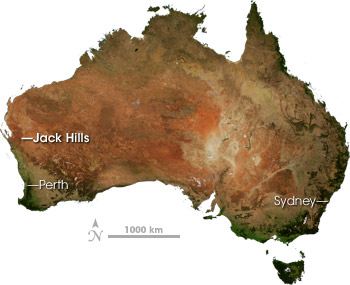


Geological setting
The zircons occur as detrital grains within a metamorphosed conglomerate and associated metasedimentary packages. These host rocks were deposited long after the zircons crystallized and were later altered by metamorphism. Because the grains are detrital, they record earlier crustal events and were transported from older sources before being buried in sediment.
Ages and dating
Uranium–lead isotopic dating of individual Jack Hills zircons has produced ages up to about 4.4 billion years, with a concentration of reliable measurements near 4.35 billion years. The enclosing sedimentary deposit is significantly younger; the youngest detrital zircon in the unit gives a minimum deposition age near 3.06 billion years, after which metamorphic overprinting affected the rock.
Scientific significance
Because zircons are exceptionally durable and can retain chemical and isotopic signatures for billions of years, Jack Hills zircons act as time capsules for the Hadean eon. Analyses of oxygen isotopes and trace elements in these grains have been interpreted as evidence that some crustal material interacted with liquid water very early in Earth history, and that processes of continental‑type crust formation were already occurring. Such interpretations remain subject to careful testing and debate, but the zircons are central to reconstructions of early surface conditions, crustal evolution, and the timing of events that led toward habitability.
Research methods and limitations
Scientists extract zircons from host rocks by crushing and separating mineral fractions, then study single grains with microbeam techniques to measure isotopes and tiny inclusions. While many results are robust, researchers exercise caution because later metamorphism, lead loss, or recrystallization can complicate interpretations. Debates continue over the precise implications of certain isotope ratios and the original geological settings of the grains' source rocks.
Key points
- The Jack Hills contain some of the oldest known terrestrial minerals, zircon grains dated to about 4.4 billion years.
- The zircons are found within a metamorphosed conglomerate and related sediments; the host rocks were deposited later, constrained by the youngest detrital grains.
- Studies of these zircons have informed hypotheses about early crust formation, the presence of surface water, and Hadean conditions, though interpretations are carefully qualified by methodological limits.
Because of their age and resilience, Jack Hills zircons remain among the most important natural archives for understanding Earth's earliest history and the processes that set the stage for subsequent geological and biological evolution.
Further information and updates on ongoing work at Jack Hills are available through geological surveys and peer‑reviewed studies; for general reference see resources about the Jack Hills and specialized literature on zircon geochronology.
Questions and answers
Q: Where are the Jack Hills located?
A: The Jack Hills are located in Western Australia.
Q: What is the significance of the zircons found in the Jack Hills?
A: The zircons found in the Jack Hills are the oldest material of terrestrial origin found on Earth.
Q: How old are the zircons found in the Jack Hills?
A: The zircons found in the Jack Hills formed about 4.4 billion years ago (bya).
Q: What is the age of the oldest zircon with the most consistent date found in the Jack Hills?
A: The oldest zircon with the most consistent date found in the Jack Hills is closer to 4.35 bya.
Q: What is the age of the youngest detrital zircon found in the rock in the Jack Hills?
A: The youngest detrital zircon found in the rock in the Jack Hills is about 3.060 bya.
Q: What is the significance of the zircons found in the Jack Hills for research?
A: The zircons found in the Jack Hills are used in research on the conditions on Earth in the Hadean eon.
Q: What kind of rock are the zircons found in the Jack Hills part of?
A: The zircon found in the Jack Hills are part of the metamorphosed conglomerate.
Related articles
Author
AlegsaOnline.com Jack Hills (Western Australia) — source of Earth's oldest known terrestrial zircons Leandro Alegsa
URL: https://en.alegsaonline.com/art/48880
Sources
- geology.wisc.edu : geology.wisc.edu/~valley/zircons/Wilde2001Nature.pdf
- psrd.hawaii.edu : Summary
- ui.adsabs.harvard.edu : 1996LPI....27..971N
- ui.adsabs.harvard.edu : 1999Sci...286...90B
- doi.org : 10.1126/science.286.5437.90
- pubmed.ncbi.nlm.nih.gov : 10506566