
Jabberwocky: Lewis Carroll’s Nonsense Poem and Its Influence
A concise encyclopedia entry on Lewis Carroll’s poem "Jabberwocky": its place in Through the Looking-Glass, playful language and portmanteau coinages, challenges of translation, and cultural influence.
Overview
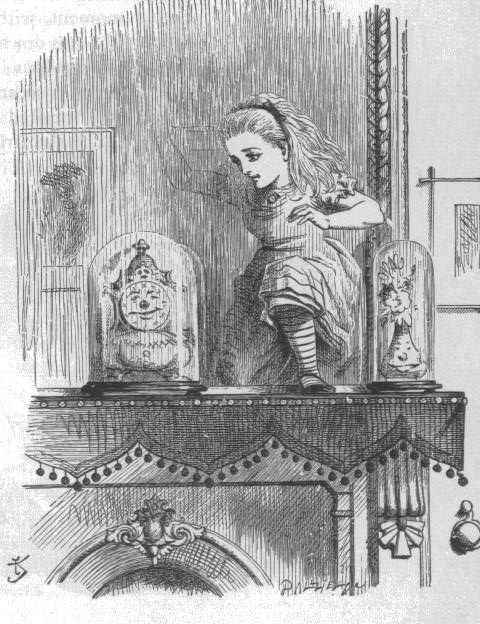
Jabberwocky is a celebrated English nonsense poem by Lewis Carroll, first published in 1871 as part of the novel Through the Looking-Glass. It is presented in the book as a found verse that the child protagonist reads and tries to understand. The poem opens with familiar-sounding but invented words, an approach that invites readers to supply meaning from rhythm, syntax and context. Within the narrative, another character offers a whimsical gloss on several odd terms, an example of how Carroll both toys with and annotates his own linguistic inventions.
Image gallery
4 Images

Form and language
Carroll combines conventional English grammatical structures with nonce vocabulary to produce lines that feel intelligible despite containing many made-up words. The poem echoes the tone and metre of traditional ballads and fairy-tale verse, which helps the reader infer a simple heroic tale: the awakening of alarm, the slaying of the strange creature called the Jabberwock, and the triumphant return. Carroll coined the term portmanteau for a kind of blended word he used in the poem; examples that became part of everyday English include chortle and galumphing, now often cited in discussions of creative word formation. These invented items show how sound, morphology and context guide comprehension even when single words are unfamiliar.
Publication, illustration and reception
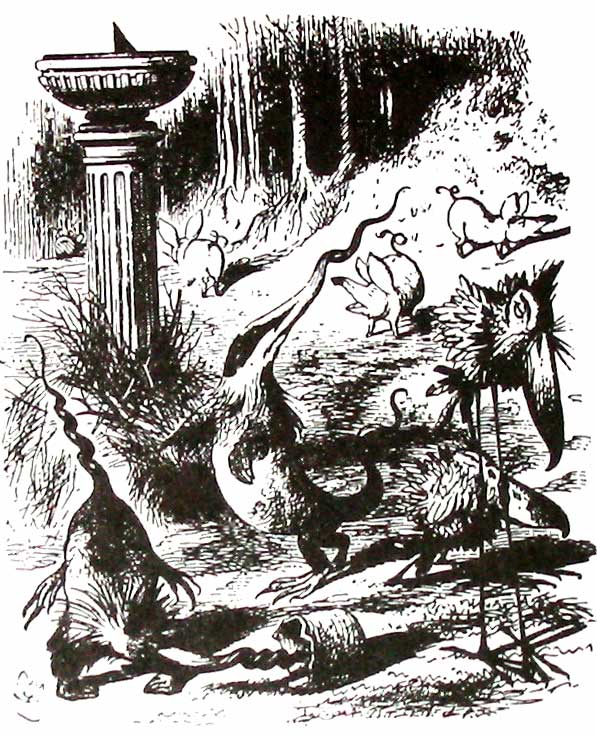
The poem appeared with illustrations in its parent novel and has been widely anthologized. Early illustrations by John Tenniel and later artists have helped fix its imagery in the public imagination. Critics and readers have long praised the piece for its ingenuity: it is frequently described as one of the finest examples of literary nonsense in English and as a playful demonstration of how language produces meaning.
Translation, scholarship and cultural influence
Translators face a notorious challenge when rendering the poem, because they must recreate the sound, rhythm and sense of coinages in other tongues, often inventing comparable nonce-words. Linguists, educators and psychologists study Jabberwocky to explore lexical processing, the role of syntax, and how readers construct scenario from limited vocabulary. The poem has inspired musical settings, dramatic adaptations and references across literature, film and games, and several of Carroll’s coinages are now established neologisms in English. Its enduring appeal lies in demonstrating that poetic form, phonology and imagination together can make the unfamiliar feel meaningful.
Notable points
- Presented inside a novel, the poem functions as both playful experiment and narrative object.
- Carroll’s explanation of blended words popularized the label portmanteau, now used in linguistics and popular discourse.
- Because it relies heavily on sound and structure, Jabberwocky is a frequent subject in translation studies and psycholinguistics.
- Its vivid creature and memorable coinages continue to appear in popular culture and scholarly discussion.
Questions and answers
Q: Who wrote the nonsense poem called "Jabberwocky"?
A: Lewis Carroll wrote the nonsense poem called "Jabberwocky".
Q: In which novel did Lewis Carroll write the poem "Jabberwocky"?
A: Lewis Carroll wrote the poem "Jabberwocky" in his 1871 novel called "Through the Looking-Glass".
Q: How does Alice describe the poem Jabberwocky when she finds it in an early scene of Alice in Wonderland?
A: Alice describes the poem Jabberwocky as something that fills her head with ideas, but she doesn't exactly know what those ideas are.
Q: Why is Jabberwocky considered to be one of the greatest nonsense poems written in English?
A: Jabberwocky is considered to be one of the greatest nonsense poems written in English because of its playful and whimsical language that gave rise to many new words such as "galumphing" and "chortle".
Q: What kind of poem is Jabberwocky?
A: Jabberwocky is a nonsense poem.
Q: What are some examples of words that were coined by Lewis Carroll in Jabberwocky?
A: Some examples of words that were coined by Lewis Carroll in Jabberwocky are "galumphing" and "chortle".
Q: Does Jabberwocky make any sense?
A: Although Jabberwocky is a nonsense poem, it does strangely make a kind of sense.
Related articles
Author
AlegsaOnline.com Jabberwocky: Lewis Carroll’s Nonsense Poem and Its Influence Leandro Alegsa
URL: https://en.alegsaonline.com/art/48829
Sources
- doi.org : 10.2307/812632
- jstor.org : 812632