
Itanium: Intel–HP 64-bit server processor family
Itanium is a 64-bit server microprocessor family developed by HP and manufactured by Intel, notable for its EPIC architecture, limited adoption, and official discontinuation announced in 2019.
Itanium (pronounced eye-TAY-nee-əm) is a family of 64-bit microprocessors originally developed by Hewlett-Packard and implemented by Intel for high-end servers and enterprise systems. Designed around a radically different approach to instruction execution than conventional x86 processors, Itanium aimed to deliver high instruction-level parallelism through a compiler-driven architecture. Although it found use in mission‑critical installations and influenced processor and compiler research, Itanium never achieved the broad market penetration its designers expected.
Image gallery
10 Images




Architecture and distinguishing features
Itanium implements an Explicitly Parallel Instruction Computing (EPIC) style architecture intended to expose parallelism to the compiler rather than rely on complex hardware scheduling. Key characteristics include wide instruction bundles, large register files, predicate registers for conditional execution, and explicit templates that indicate parallelism to the processor. This approach differs fundamentally from the out-of-order, hardware-scheduled execution used in mainstream x86 designs.
- 64-bit address and data paths intended for large server workloads.
- Compiler responsibility for instruction scheduling and parallelism.
- Complex ISA not directly binary-compatible with x86; some systems used emulation to run legacy software.
- Targeted at enterprise servers, database and transaction systems where high throughput and reliability were priorities.
History and development
The Itanium project began as a collaboration between HP and Intel to produce a next-generation architecture for enterprise computing. The first Itanium processors were shipped in the early 2000s. Initially positioned as a successor to several established server ISAs, the platform faced challenges from evolving alternatives and a slower-than-expected software ecosystem build-out.
Uses, ecosystem and software
Itanium was primarily deployed in servers running operating systems and applications that were ported or optimized for its architecture. Commercial ecosystems included HP-UX, certain versions of OpenVMS, specialized Linux distributions, and for a time, Windows Server releases tailored to the platform. Because Itanium was not natively compatible with the dominant x86 binary format, vendors and integrators employed emulation or provided native ports for key server software to enable adoption.
Decline and discontinuation
Several factors contributed to Itanium's declining market share: the rapid acceptance of 64-bit extensions to the x86 architecture (which preserved backward compatibility), the difficulty of generating highly tuned code for EPIC architectures, and the rising performance and cost-effectiveness of x86‑64 server processors. Intel announced the end of life and product discontinuance for the Itanium family on January 30, 2019. After that announcement, hardware vendors and software maintainers gradually reduced active development and focused support on existing installations.
Legacy and notable points
Although Itanium did not dominate the server market, it had lasting influence on compiler technology, research into instruction-level parallelism, and the design trade-offs between hardware complexity and compiler responsibility. HP remained the chief commercial backer of Itanium-based systems for many years, and a number of enterprises continued to run legacy workloads on those platforms well after mainstream vendors moved to x86-64 systems.
For further technical and historical context see manufacturer materials and processor references from Intel, general overviews of 64-bit microprocessors, and discussions of enterprise servers.
Questions and answers
Q: What is Itanium?
A: Itanium is a type of microprocessor made by Intel with 64-bit chip architecture that is sometimes used for servers.
Q: Is Itanium related to the mainstream 64-bit CPUs made by Intel and others?
A: No, Itanium is not related to the mainstream 64-bit CPUs made by Intel and others.
Q: Who originally designed Itanium processors?
A: HP and Intel originally designed Itanium processors, with Intel producing them.
Q: Were Itanium processors popular?
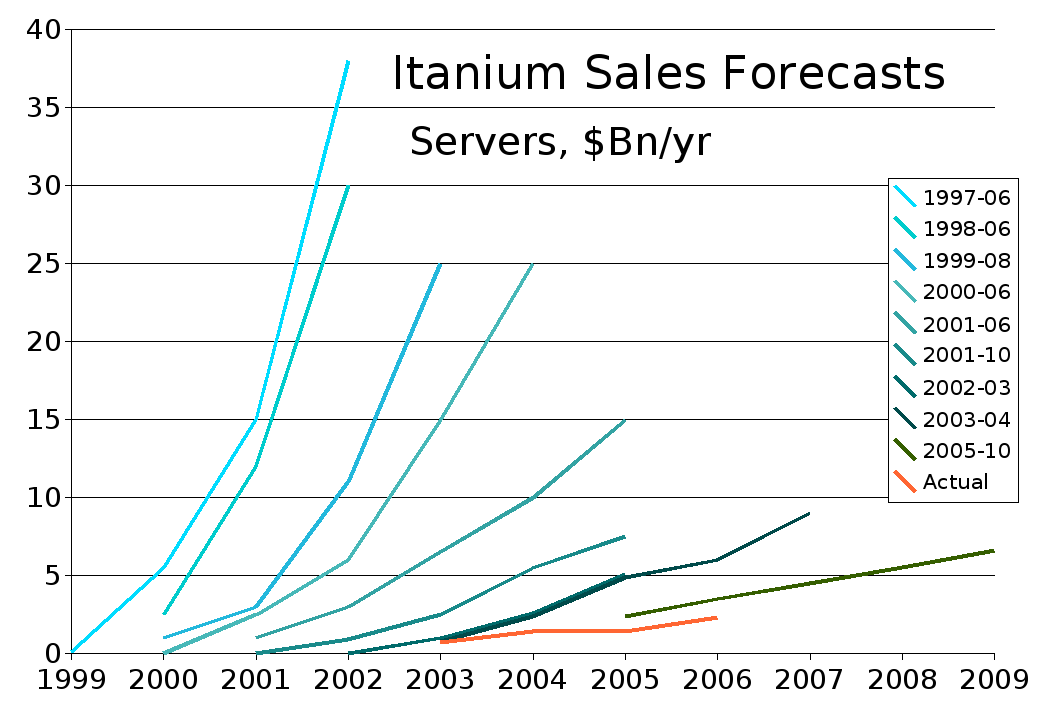
A: No, not as many systems used Itanium processors as originally hoped for.
Q: Who still supports systems using Itanium chips?
A: Mostly, HP still supports systems using Itanium chips.
Q: When did Intel announce the end of life for the Itanium CPU family?
A: Intel officially announced the end of life and product discontinuance of the Itanium CPU family on January 30, 2019.
Q: Are Itanium processors still being produced by Intel?
A: No, Intel has officially announced the end of life and product discontinuance of the Itanium CPU family.
Related articles
Author
AlegsaOnline.com Itanium: Intel–HP 64-bit server processor family Leandro Alegsa
URL: https://en.alegsaonline.com/art/48624
Sources
- qdms.intel.com : "Select Intel Itanium Processors and Intel Scalable Memory Buffer, PCN 116733-00, Product Discontinuance, End of Life"
- anandtech.com : "Itanium–Is there light at the end of the tunnel?"
- venturebeat.com : "Exit interview: Retiring Intel chairman Craig Barrett on the industry's unfinished business"
- theregister.co.uk : "Benchmarks – Itanic 32bit emulation is 'unusable'. No kidding — slower than a P100"
- pcmag.com : "How the Itanium Killed the Computer Industry"
- bits.blogs.nytimes.com : "Ten Years After First Delay, Intel's Itanium Is Still Late"
- informit.com : "Interview with Donald Knuth"
- cloudblogs.microsoft.com : "Windows Server 2008 R2 to Phase Out Itanium"
- theregister.co.uk : "Red Hat pulls plug on Itanium with RHEL 6"
- pcworld.com : "Oracle stops developing software for Intel's Itanium Chips"
- support.oracle.com : Oracle Database 12.1.0.1.0 is planned for certification on HP-UX Itanium 11.31
- bits.blogs.nytimes.com : "A Decade Later, Intel's Itanium Chip Makes a Profit"
- newsroom.intel.com : "Intel Reaffirms Commitment to Itanium"
- features.techworld.com : "Will Intel abandon the Itanium?"