
Italian Social Republic (Repubblica Sociale Italiana) — Salò Republic, 1943–1945
A short-lived fascist state in German-occupied northern Italy led by Benito Mussolini and dependent on Nazi Germany; established 1943, collapsed in 1945 amid partisan resistance and Allied advance.
The Italian Social Republic, known in Italian as Repubblica Sociale Italiana and commonly called the Salò Republic, was a short-lived regime that existed in the last phase of World War II. It was proclaimed after the fall of the Fascist Grand Council and Mussolini's ousting, when German forces re-established him as head of a new government in territory nominally covering northern Italy. In practice the RSI was created and sustained with the support of Nazi Germany, and its political independence was heavily circumscribed by German military control.
Image gallery
10 Images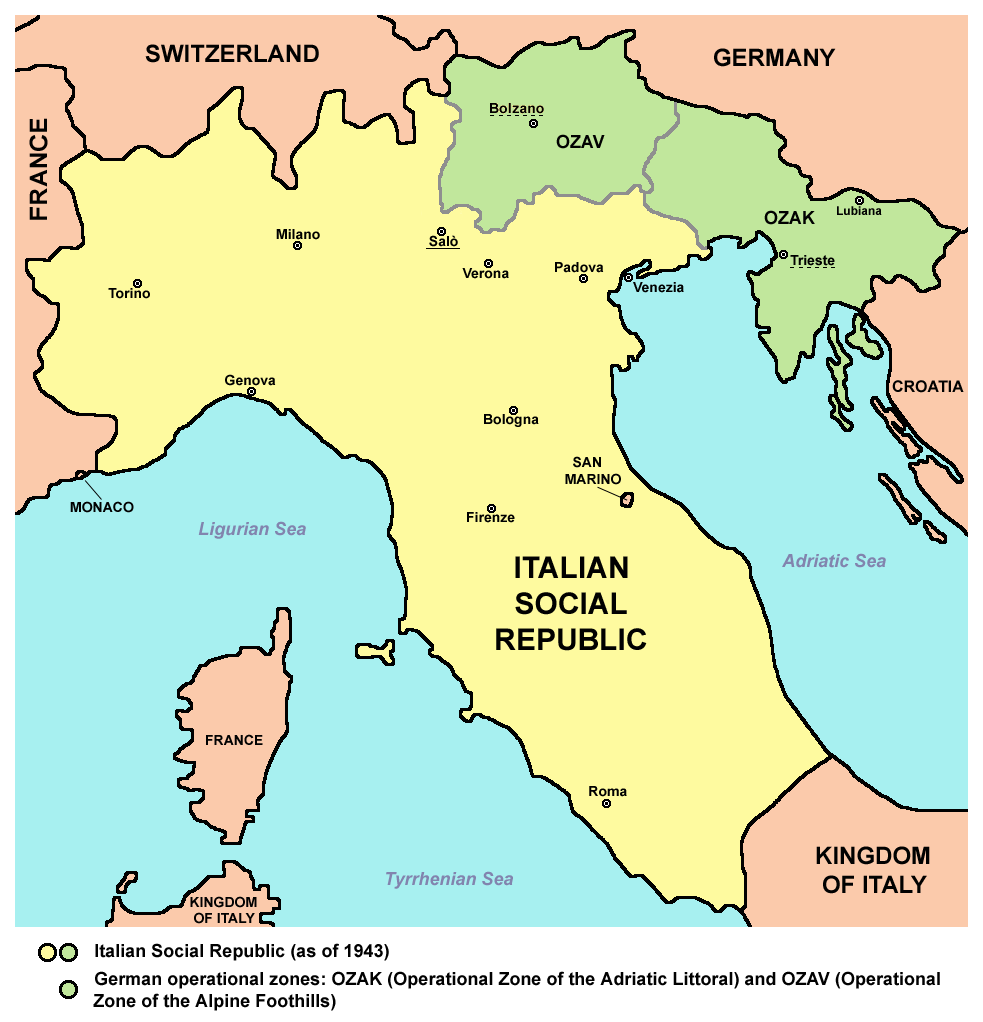


Origins and context
The RSI emerged in the aftermath of Italy's armistice with the Allies and the subsequent German occupation of much of the peninsula. After his arrest and removal from power, Benito Mussolini was rescued by German commandos and put in charge of the new entity; he led the movement as head of the Republican Fascist Party. The government located its de facto seat in the lakeside town of Salò, hence the alternative name Repubblica di Salò. It claimed continuity with earlier Fascist institutions but functioned under the practical authority of occupying forces and local collaborationists.
Structure, forces and policies
Formally described by its leaders as a state rejuvenated by revolutionary fascism, the RSI established its own institutions and armed units but relied on German logistical, military and economic support. Key features included:
- Political leadership by Mussolini and the Republican Fascist Party.
- Creation of military and paramilitary formations such as the National Republican Army and the Black Brigades, intended to fight alongside German units and suppress resistance.
- Resumption of repressive measures, including intensified anti-partisan campaigns and collaboration in the deportation of Jews and political dissidents to German custody.
Conflict and collapse
The RSI existed amid growing armed opposition from Italian partisans and advancing Allied armies. It had only limited international recognition and depended on German protection for survival. As the war turned decisively against the Axis in 1944–1945, its territory shrank. In April 1945, with German forces in retreat and partisan operations widespread, the regime disintegrated. Mussolini was captured while attempting to flee and was executed; the collapse marked the end of Italy's wartime fascist governments.
Legacy and historical significance
The Italian Social Republic is remembered as the last organised manifestation of Italian Fascism and as a period of intensified repression and civil conflict. It deepened wartime divisions within Italy, contributed to postwar trials and the reconstruction of Italian democracy, and shaped collective memory through debates about collaboration, resistance and accountability. Scholars study the RSI to understand collaborationist regimes, occupation dynamics and the final phase of the European war.
For further reading on official terminology and institutions, see references to the movement as the provisional government or by alternate historic names. Background on the geographic and military setting of the regime can be found through sources covering northern Italy and the Salò headquarters location. Broader studies of the period examine relations with Germany, Mussolini's role then, and the Italian language designations used contemporaneously.
Questions and answers
Q: What was the Italian Social Republic?
A: The Italian Social Republic was a provisional government sponsored by and allied with Nazi Germany in northern Italy during World War II.
Q: Who was the leader of the Italian Social Republic?
A: Benito Mussolini was the leader of the Italian Social Republic.
Q: What political party did Mussolini belong to?
A: Mussolini belonged to the Republican Fascist Party.
Q: Was the Italian Social Republic a fully independent state?
A: No, the land controlled by the Italian Social Republic was actually under German military control.
Q: What was the informal name for the Italian Social Republic and why was it called that?
A: The informal name for the Italian Social Republic was the Salò Republic, named after the town where their headquarters was located.
Q: What was the official name of the Italian Social Republic before 25 November 1943?
A: Before 25 November 1943, the official name of the Italian Social Republic was widely called Republican State of Italy and Republican National State.
Q: Was the Italian Social Republic the first or last Fascist Italian state?
A: The Italian Social Republic was the second and last Fascist Italian state.
Related articles
Author
AlegsaOnline.com Italian Social Republic (Repubblica Sociale Italiana) — Salò Republic, 1943–1945 Leandro Alegsa
URL: https://en.alegsaonline.com/art/48608
Sources
- nationalanthems.info : "Italy 1922-1943"