
Isurus — the mako sharks
Isurus is the genus of mako sharks (family Lamnidae): streamlined, fast pelagic predators with two living species, a long fossil record, and growing conservation concerns from fishing and bycatch.
Isurus is the scientific genus commonly called mako sharks or mackerel sharks. These oceanic predators belong to the family Lamnidae, the same family that includes the great white shark (great white). Makos are noted for their slender, torpedo-shaped bodies, very high swimming ability and a cosmopolitan distribution in warm and temperate seas.
Image gallery
2 Images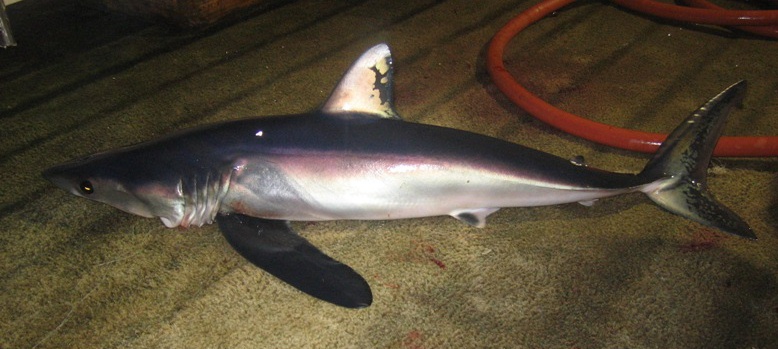

Characteristics
Mako sharks are built for speed. Typical adult lengths range from about 2.5 to 4.5 metres and larger individuals may be quite heavy. Distinctive features include a pointed snout, long gill slits, large crescent-shaped caudal (tail) fins and narrow, smooth-edged teeth suited for grasping fish. Like other members of Lamnidae, makos have the physiological ability to keep parts of their body warmer than the surrounding water, a trait that supports sustained high activity.
Species and distribution
The genus contains two living species: the shortfin mako and the longfin mako. The shortfin mako is the better-known and more widely encountered of the two; the longfin mako is rarer and typically found in more tropical or subtropical waters. Both species are pelagic, occupying open-ocean habitats, and they feed mainly on fast-moving fish and cephalopods. Reproduction is by internal gestation, resulting in relatively small litters of live young compared with many bony fishes.
Evolution and fossil history
Isurus has a long fossil record that documents its presence in ancient oceans and shows morphological continuity with earlier lamnid sharks. Fossil teeth similar to modern makos are commonly encountered in marine deposits, and these remains have helped scientists trace the genus’s development and its relationships with other large, predatory sharks.
Human interactions and conservation
Mako sharks are valued in recreational sport fishing for their speed and acrobatic behaviour when hooked. They are also taken in commercial fisheries, sometimes deliberately and often as bycatch on longlines and in gillnets. These pressures, together with their relatively slow reproductive rates, have led to population declines in many regions. Conservation measures and fishery regulations have been proposed or implemented in various jurisdictions to reduce mortality and allow stocks to recover.
Notable facts and distinctions
- Makos are among the fastest-swimming sharks, adapted for active predation in open water.
- Their teeth are slender and smooth-edged, unlike the serrated teeth of some other lamnids.
- There are only two extant species; more detailed species and population information can be found through resources that list the recognized species.
Questions and answers
Q: What is Isurus?
A: Isurus is a genus of fast-swimming sharks, specifically the mako shark or mackeral shark.
Q: What family does Isurus belong to?
A: Isurus belongs to the Lamnidae family, which includes the great white shark.
Q: How fast can Isurus swim?
A: Isurus is the fastest-swimming shark, but there is no specific speed given in the text.
Q: What is the size range for Isurus?
A: Isurus ranges in length from 2.5 to 4.5 metres (8 to 15 ft) and can grow to about 800 kilograms (1,760 lb).
Q: How long has the genus Isurus existed?
A: The genus Isurus has a long fossil history.
Q: How many living species are there in the Isurus genus?
A: There are two living species in the Isurus genus: the common shortfin mako shark and the rare longfin mako shark.
Q: Which type of mako shark is more common?
A: The common shortfin mako shark is more common than the rare longfin mako shark.
Related articles
Author
AlegsaOnline.com Isurus — the mako sharks Leandro Alegsa
URL: https://en.alegsaonline.com/art/48558
Sources
- strata.ummp.lsa.umich.edu : "A compendium of fossil marine animal genera (Chondrichthyes entry)"
- flmnh.ufl.edu : "FLMNH Ichthyology Department"
- elasmo-research.org : "Biology of the Shortfin Mako"
- nzetc.org : "A pattern of islands; Ch. 5 Lagoon days"