
Island of Stability (nuclear physics)
Hypothesized region of relatively long-lived superheavy nuclei predicted by the nuclear shell model, its candidate magic numbers, experimental searches, and potential significance.
Overview
The "island of stability" is a theoretical region in the chart of nuclides where certain superheavy atomic nuclei are expected to have comparatively long lifetimes. Most elements heavier than chemical elements beyond lead (Pb) are radioactive and lack truly stable isotopes, decaying by alpha, beta or spontaneous fission. Nonetheless, nuclear-structure theory suggests that particular combinations of neutrons and protons can produce closed shells inside the atomic nucleus that greatly increase binding energy and slow decay. This projected concentration of long-lived species is what researchers call the island of stability.
Image gallery
1 Image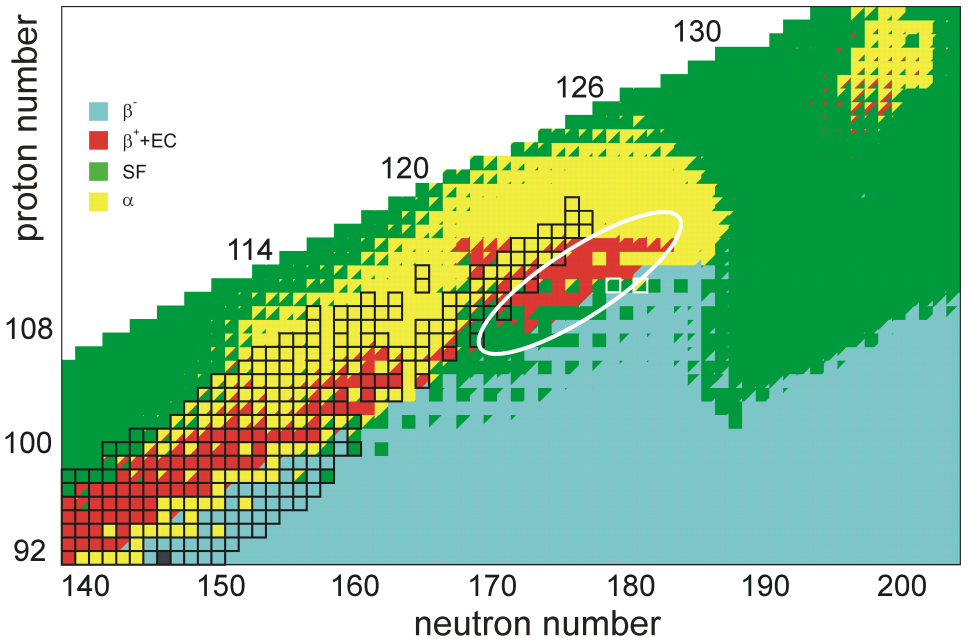
How the nuclear shell model leads to stability
In the nuclear shell model, protons and neutrons occupy discrete energy levels grouped into shells. When a shell is filled, the configuration attains a local maximum in binding energy per nucleon, producing relative stability analogous to the noble gases in electronic shells. The filling depends on the numbers of neutrons and protons, and certain integer values called "magic numbers" mark shell closures. The idea that closed shells could yield longer nuclear half-lives for superheavy nuclei underpins the island concept; this notion is supported but refined by more advanced calculations that include effects such as deformation and pairing.
Predicted islands and candidate nuclei
Early theoretical work proposed neutron magic numbers near 184 and several possible proton closures around 114, 120 and 126. These predictions imply candidate long-lived isotopes such as flerovium-298, element 120 (unbinilium-304) and hypothetical isotopes of element 126. A particularly interesting hypothetical species is the nucleus with about 126 protons and 184 neutrons; because both numbers would correspond to closed shells, it is sometimes described as "doubly magic" and could be among the most stable superheavy nuclei if it exists.
- Magic-number candidates: N ≈ 184, Z ≈ 114, 120, 126.
- Examples discussed in literature: flerovium-298; element-120 isotopes; proposed unbihexium isotopes.
Refinements: deformation and shifted magic numbers
More recent work shows that very heavy nuclei often adopt deformed shapes rather than remaining spherical, and deformation changes the single-particle energy spectrum so that the most favorable magic numbers can shift. For example, some models identify a deformed doubly-magic configuration near element 108 with about 162 neutrons; hassium-270 has been discussed in this context, although its observed half-life is still only a few seconds. The shifting of shell closures means the island may be more of a region or archipelago with multiple local maxima in stability rather than a single well-defined spot.
Experimental progress and challenges
Laboratories produce superheavy nuclei by fusing lighter projectiles and targets in particle accelerators, but synthesised isotopes frequently lie on the neutron-poor side of predicted islands. Researchers have created isotopes that move toward the island's "shores" but often lack enough neutrons to reach the putative stable centers. Detection relies on rapid separation and decay-chain analysis, and synthesizing neutron-richer isotopes is difficult because suitable target-projectile combinations are limited. As methods improve, experiments aim to cross from short-lived nuclides into regions with substantially longer lifetimes.
Importance and potential applications
Finding isotopes with significantly extended lifetimes would be important for nuclear physics, chemistry and practical use. Longer-lived superheavy nuclei would permit direct chemical studies of their properties, testing how extreme relativistic and quantum effects influence periodic trends. If sufficiently long-lived isotopes could be produced in useful quantities, they might serve as special research targets, neutron sources or even enable novel materials research. For now, these possibilities remain speculative and contingent on successful synthesis and verification of the predicted nuclei.
Notable distinctions and cautious points
The island of stability is a predictive framework grounded in the shell model and more sophisticated mean-field and microscopic approaches, but precise magic numbers and lifetimes depend on model details. Some heavy nuclei known experimentally, like certain isotopes of plutonium, have long half-lives relative to many transuranics, yet the truly superheavy region remains dominated by rapid decay. Continued theoretical refinement and experimental advances are required to map the island's extent, discover any especially long-lived nuclei, and determine how nuclear shape, shell effects and decay channels combine to produce enhanced stability.
For introductions and current experimental summaries see general reviews and laboratory pages at national and international research centers: chemical elements, lead, stable isotopes, plutonium, half-life, hypothesis, atomic nucleus, energy levels, neutrons, protons, flerovium, unbinilium, hassium.
Questions and answers
Q: What elements are beyond lead?
A: The elements beyond lead are radioactive and do not have stable isotopes.
Q: What is the theory in physics that explains why some elements have longer half lives?
A: The theory in physics states that after a number of elements with short half lives, there will be others with longer half lives, known as Islands of Stability. This is because when the number of neutrons and protons completely fill the energy levels of a given shell in the nucleus, the binding energy per nucleon will reach a local maximum and thus that particular configuration will have a longer lifetime than nearby isotopes.
Q: What are magic numbers for spherical nuclei?
A: Magic numbers for spherical nuclei are neutron numbers of 184 and proton numbers of 114, 120 and 126. These would mean that the most stable spherical isotopes would be flerovium-298, unbinilium-304 and unbihexium-310.
Q: Is Hassium-270 believed to be doubly magic?
A: Yes, Hassium-270 is believed to be a doubly magic deformed nucleus, with deformed magic numbers 108 and 162.
Q: How long is its half life?
A: Its half life is 3.6 seconds.
Q: Are there any practical applications for these elements?
A: Yes, if they have isotopes with adequate lifespans they could potentially be used for various practical applications such as particle accelerator targets or as neutron sources.
Related articles
Author
AlegsaOnline.com Island of Stability (nuclear physics) Leandro Alegsa
URL: https://en.alegsaonline.com/art/48426
Sources
- hyperphysics.phy-astr.gsu.edu : "Shell Model of Nucleus"
- deposit.ddb.de : "PhD. Thesis: Decay properties of nuclei close to Z = 108 and N = 162"
- ui.adsabs.harvard.edu : 2006PhRvL..97x2501D
- doi.org : 10.1103/PhysRevLett.97.242501
- pubmed.ncbi.nlm.nih.gov : 17280272