
Isaac Watts (1674–1748): English hymn writer and pastor
English Nonconformist minister and prolific hymn writer often called the “Father of English hymnody”; composed about 600 hymns including Joy to the World and When I Survey the Wondrous Cross.
Isaac Watts (17 July 1674 – 25 November 1748) was an English Nonconformist pastor, poet, and pioneering hymn writer. He is widely regarded as the "Father of English Hymnody" for introducing original, congregational songs that moved beyond direct psalm paraphrase. Over the course of his life he is credited with composing roughly six hundred hymns and numerous prose works that were used in both religious and educational settings.
Image gallery
8 Images



Life and early context
Watts was born into a family of Nonconformists during a period when dissent from the established Church of England carried legal and social penalties. His father, a minister, suffered imprisonment for his dissenting preaching, and Isaac’s childhood was shaped by the restrictions placed on dissenting Christians. At the time, small groups of worshippers often met covertly in fields and barns or private houses to avoid fines and persecution, and that underground culture influenced the language and urgency of Watts’s devotional writing. His faith and pastoral concern for ordinary worshippers remained central to his work throughout his life, and he frequently wrote to encourage belief in Christ and practical devotion.
Education, ministry and publications
Rather than conforming to the established church, Watts pursued learning within Nonconformist circles and served in roles that combined preaching, teaching and writing. He published collections of hymns and spiritual songs that provided texts suitable for congregational singing and private devotion. His early collection brought many new forms of lyric address—personal reflection, direct prayer, and doctrinal instruction—into English hymnody, making devotional language more accessible to ordinary churchgoers.
Major works and musical legacy
Watts’s surviving hymns include some of the most enduring pieces in English-language worship:
- When I Survey the Wondrous Cross
- Joy to the World
- Am I a Soldier of the Cross
Style, influence and notable facts
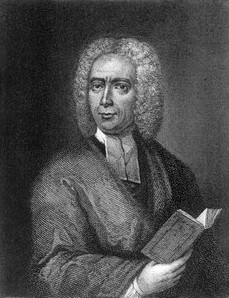
Watts combined clear, didactic language with intense personal feeling. His hymns frequently use direct address, scriptural themes, and vivid metaphors to foster participatory worship. In addition to hymns, he produced essays and instructional texts that influenced eighteenth-century religious education. He remained a figure of public interest after his death; portraits of Watts often highlight a characteristic appearance—he is depicted in a long gown, an anecdote sometimes explained by contemporaries’ remarks about his relatively short stature and large head, an image that appears in several portraits and accounts (see remarks on appearance).
Burial and legacy
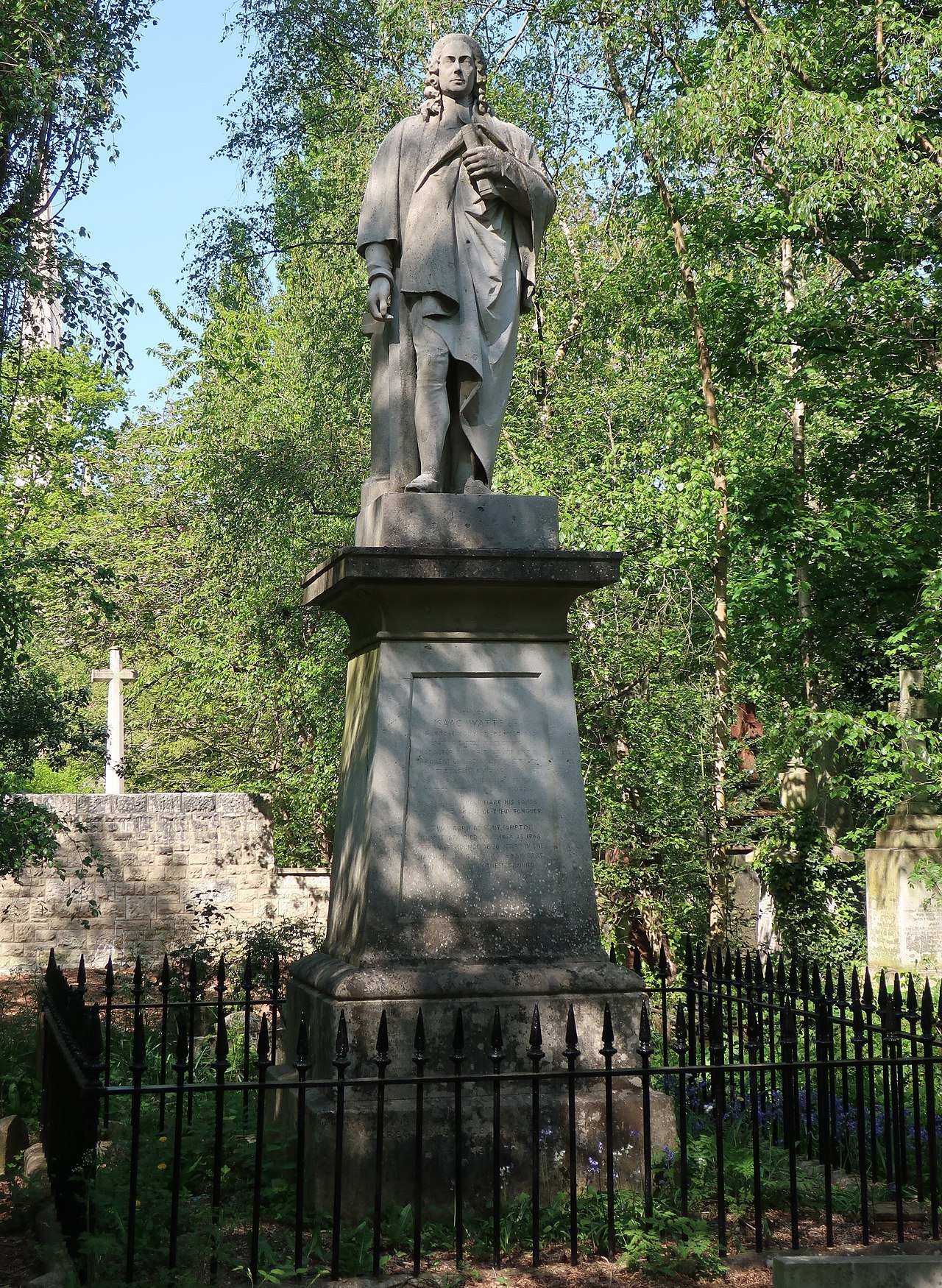
Isaac Watts died in 1748 and was buried in Bunhill Fields cemetery in London. His hymns have outlived many of the institutions of his own time, continuing to appear in modern hymnals and to influence both popular and scholarly understandings of congregational song. For readers seeking primary texts or further study, collections of his hymns and biographical treatments remain readily available and are often cited in histories of English sacred music (ministerial studies, poetic studies and hymnology resources).
- Often called the "Father of English Hymnody" for his role in creating original congregational lyrics (hymn collections).
- Composed about 600 hymns that continue in use internationally.
- Born into a dissenting family; his father endured imprisonment for preaching (father imprisoned).
- Works bridged devotional poetry and teaching, affecting both worship and education.
Questions and answers
Q: Who was Isaac Watts?
A: Isaac Watts was an English pastor, preacher, poet, and hymn writer, often referred to as the "Father of English Hymnody".
Q: Why is Isaac Watts often called the "Father of English Hymnody"?
A: Isaac Watts was the first popular English hymn writer, having written about 600 hymns including well-known hymns such as When I Survey the Wondrous Cross, Am I a Soldier of the Cross, and Joy to the World.
Q: What was Isaac Watts known for wearing in all his portraits?
A: Due to his short height and large head, Isaac Watts was known for wearing a large gown in all his portraits.
Q: Where is Isaac Watts buried?
A: Today, Isaac Watts is buried in Bunhill Fields Cemetary in London, England.
Q: What was Isaac Watts' upbringing like?
A: Isaac Watts was born in 1674 as a small and sickly child. At the time, his father was in prison for being a nonconformist preacher. His upbringing was thus influenced by the hardships faced by dissenters during that time in England.
Q: Why were dissenters like Isaac Watts' father imprisoned in England during his upbringing?
A: Dissenters were imprisoned in England during Isaac Watts' upbringing for preaching in a way that was not aligned with the teachings of the Church of England.
Q: What did Isaac Watts do to inspire people to continue believing in Christ during his time?
A: Isaac Watts gave much encouragement for people to continue believing in Christ, despite the persecution faced by dissenters during his time in England.
Related articles
Author
AlegsaOnline.com Isaac Watts (1674–1748): English hymn writer and pastor Leandro Alegsa
URL: https://en.alegsaonline.com/art/48311
Sources
- victorshepherd.on.ca : "Isaac Watts"
- hymntime.com : "Isaac Watts"
- isaacwatts.net : "isaacwatts.net"