
Irish Republic (1916–1922): declaration, war and legacy
The Irish Republic was a revolutionary state proclaimed in 1916 and again asserted by the First Dáil from 1919; it fought the War of Independence and its institutions influenced the later Irish Free State and Republic of Ireland.
The term Irish Republic denotes a revolutionary state proclaimed during the 20th-century struggle for Irish independence. Its name was used in the 1916 Easter Rising and again by the republican parliament that assembled as the First Dáil in 1919. The entity was never accepted by the British government and existed chiefly as the political and military project of Irish republicans during the period of the Irish War of Independence.
Image gallery
9 Images




Key characteristics and institutions
Supporters of the Irish Republic sought to create independent, republican governance on the island of Ireland. The republican movement established parallel institutions to those of the British administration: a revolutionary parliament, ministries, a system of courts and local administrative bodies. The armed force associated with the Republic was the Irish Republican Army, regarded by its backers as the Republic's army. These developments gave the movement both political legitimacy among its supporters and practical means to challenge state authority.
Sequence of events
- The 1916 Easter Rising produced a short-lived proclamation of an Irish Republic and raised the profile of republican aims.
- In 1918–1919 Sinn Féin representatives elected to Westminster instead convened the First Dáil and declared an independent Irish Republic; this Dáil provided a focal point for nationalist governance.
- From 1919 the conflict known as the Irish War of Independence saw republican forces (the Irish Republican Army) contesting the authority of the United Kingdom across much of Ireland.
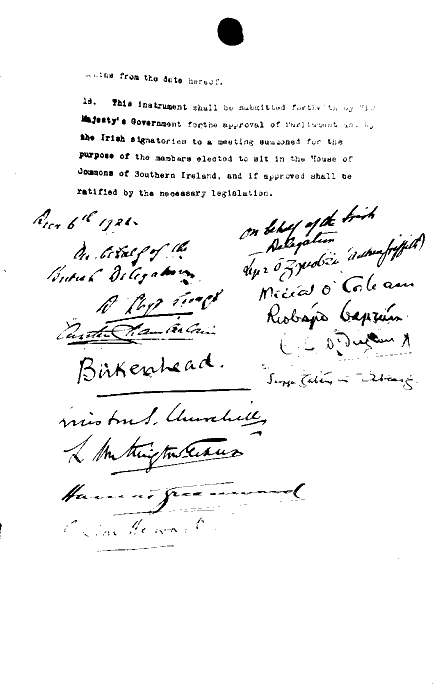
- The 1921 negotiations and the subsequent Anglo‑Irish Treaty produced a settlement that led to the creation of the Irish Free State and recognized the partition of six counties that remained as Northern Ireland within the United Kingdom.
End of the revolutionary republic and immediate consequences
Although the republican claim to an all‑island Irish Republic continued in political rhetoric after the treaty, the formal revolutionary structures ceased to operate once the treaty institutions were put in place and the Irish Free State came into existence. The treaty divided the republican movement: some accepted the compromise that created a dominion-style Free State, while others rejected it because it fell short of the full republic they had declared. That division triggered a civil conflict among Irish nationalists and shaped Irish politics for decades.
Legacy and notable distinctions
The Irish Republic of 1916–1922 left a durable legacy. Its political claims and institutions influenced the later constitutional development that produced modern Irish statehood. The later constitutional state adopted different names and legal frameworks—the Irish Free State, then Éire/Ireland under the 1937 constitution, and finally the Republic of Ireland as declared in 1949—while republican ideals continued to inform political movements. It is also important to distinguish the republican proclamation (commonly associated with the Irish-language phrase Poblacht na hÉireann) from the official title Saorstát Éireann, which was the Irish-language form used for the Free State created by the treaty.
Further notes
- The Irish Republic was not widely recognized internationally, but it functioned through elected representatives and grassroots institutions.
- Abstentionism—refusing to sit in the United Kingdom's parliament—was a longstanding republican practice and was later extended by some to the Free State's institutions by opponents of the treaty.
- For introductions and primary documents related to the proclamations and institutions mentioned here consult general reference material and archives: language and names, historical overviews at IRA history and summaries of the Easter Rising and subsequent negotiations at Free State and Northern Ireland resources.
Questions and answers
Q: What was the Irish Republic?
A: The Irish Republic was a declared independent state of the United Kingdom in the Easter Rising of 1916 and established in 1919 by the First Dáil.
Q: When did the Irish Republic exist?
A: The Irish Republic only existed during the Irish War of Independence of 1919-1922.
Q: When did the Irish Republic formally cease to exist?
A: The Irish Republic formally ceased to exist in 1922 with the ratification of the Anglo-Irish Treaty that ended the war.
Q: What was the result of the Anglo-Irish Treaty?
A: The result of the Anglo-Irish Treaty was that 26 of the country's 32 counties became the Irish Free State and the other six remained within the United Kingdom as Northern Ireland.
Q: Did Sinn Féin accept the Anglo-Irish Treaty?
A: Sinn Féin refused to accept the treaty, said that the Irish Republic existed, even if it did not control any territory.
Q: Did elected Sinn Féin TDs take their seats in the parliaments of the Irish Free State or the United Kingdom?
A: No, elected Sinn Féin TDs never took their seats in the parliaments of the Irish Free State or the United Kingdom.
Q: Why did Sinn Féin refuse to accept the Anglo-Irish Treaty?
A: Sinn Féin refused to accept the treaty because they believed that it did not fully establish Ireland's independence and that the Irish Republic already existed.
Related articles
Author
AlegsaOnline.com Irish Republic (1916–1922): declaration, war and legacy Leandro Alegsa
URL: https://en.alegsaonline.com/art/48182