
Irish elk (Megaloceros giganteus) — giant deer of Eurasia
Extinct giant deer known for enormous palmate antlers. Lived across Eurasia until the early Holocene; many well-preserved skeletons come from Irish bogs. Extinction likely from combined environmental and human pressures.
Overview
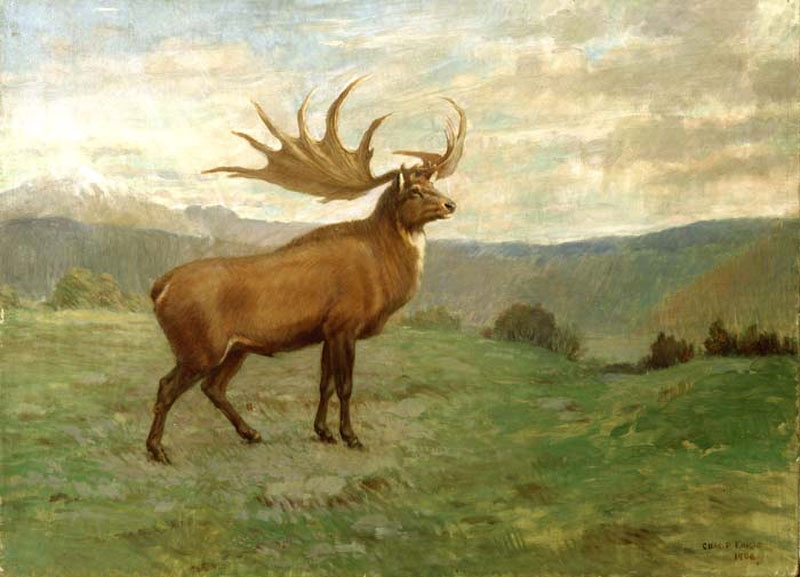
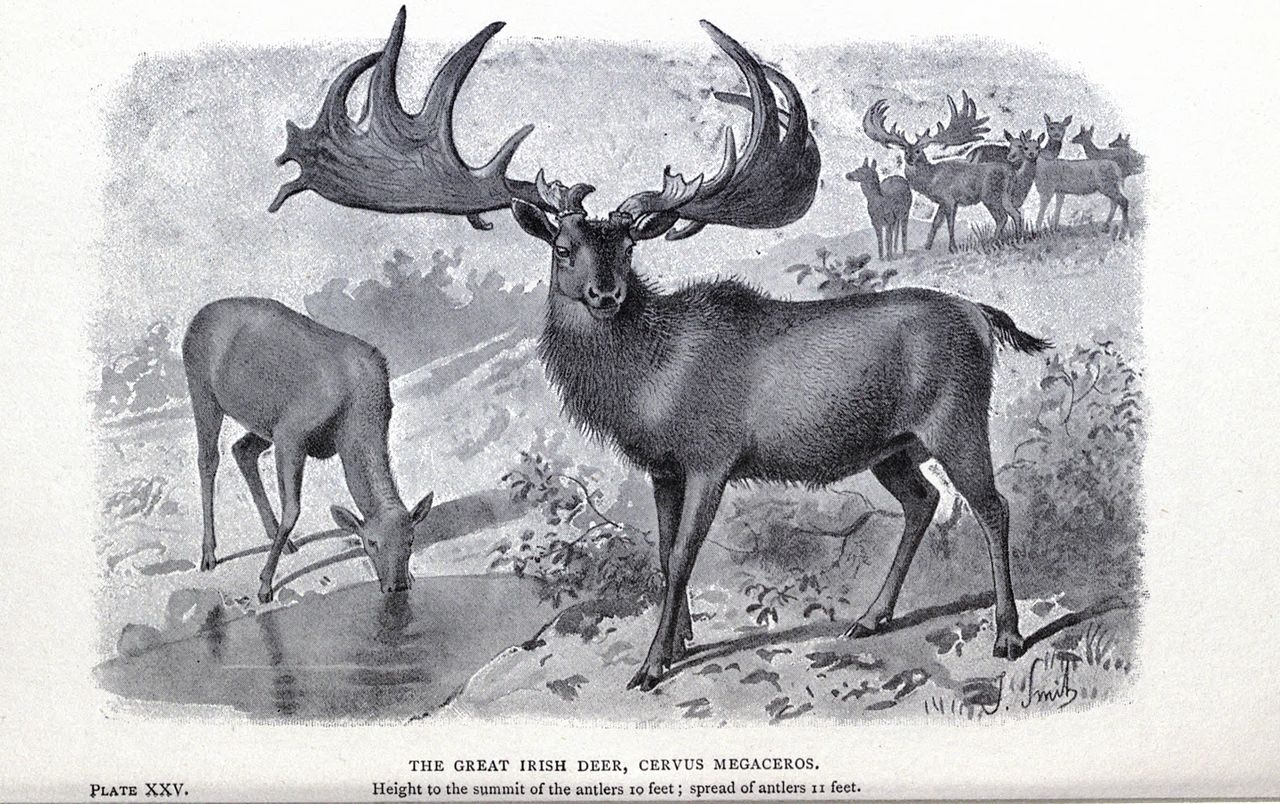
The Irish elk, Megaloceros giganteus, was one of the largest deer to have lived and is most famous for its vast, palmated antlers. It ranged across much of Eurasia, from parts of western Europe including Ireland eastwards to near Lake Baikal and into regions of China. Despite its common name, it was not confined to Ireland; the island has yielded many exceptionally complete specimens because of the preservational qualities of peat bogs.
Image gallery
10 Images






Anatomy and notable features
The species combined a large, robust body with proportionally long legs and an impressive antler span, frequently emphasized in popular reconstructions. Antlers were broad and palmated, and in adult males they could be extremely large relative to body size. Sexual dimorphism is inferred from the fossil record: males are known for the oversized antlers while females were smaller and lacked such extreme racks. Teeth and limb bones indicate adaptations for grazing and mixed feeding in open to semi-open habitats.
Diet, behavior and ecology
Dental wear patterns and isotopic evidence suggest the Irish elk fed largely on grasses and other low vegetation typical of open steppe and parkland environments. Its anatomy implies it was a good walker adapted to ranging across open landscapes rather than dense forest. Antlers were likely used in sexual display and male–male competition, as in many living deer, and their maintenance would have required significant nutritional resources.
Fossils, preservation and sites
Many of the most complete skeletons have been recovered from waterlogged peat bogs and wetland deposits where acidic, low-oxygen conditions limited decay and scavenging. Irish bogs are especially famous for well-preserved subfossils, but remains are also found in caves, river gravels and open-air sites across the species' broad range. Bog and wetland contexts have allowed detailed study of bone condition, age profiles and sometimes soft-tissue impressions.
Extinction and chronology
Radiocarbon dates place the youngest reliably dated remains in the early Holocene, around several thousand years after the Last Glacial Maximum. The causes of extinction remain debated. Leading hypotheses emphasize a combination of factors: climatic warming and resulting habitat change that reduced the extent of open grazing areas; increased nutritional stress related to the energetic costs of growing very large antlers; and growing pressure from human hunters and changing land use. Most researchers favour a multifactorial scenario rather than a single simple cause.
Taxonomy and relationships
The Irish elk belongs to the deer family Cervidae but is not closely related to the living species commonly called "elk" such as Alces alces (the European elk or moose) or to the North American wapiti. For clarity, it is often referred to as the "giant deer" in scientific and popular literature. Comparative anatomical and genetic work places it within the broader evolutionary context of late Quaternary cervids but as a distinct lineage adapted to open environments.
Scientific and cultural significance
Specimens of the Irish elk have informed studies of late Quaternary ecosystems, megafaunal extinctions and human-prey relationships. Their dramatic antlers have made them a popular feature in museums and in cultural reconstructions of Pleistocene and early Holocene landscapes. Ongoing research uses radiocarbon dating, isotopic analysis and biomechanical study to refine understanding of their life history and the timing and processes of their decline.
See also: largest deer, bog preservation, Eurasian range, Baikal region, East Asian records.
Questions and answers
Q: What was the Irish elk?
A: The Irish elk (Megaloceros giganteus) was one of the largest deer that ever lived.
Q: What was the range of the Irish elk?
A: The Irish elk's range extended across Eurasia, from Ireland to east of Lake Baikal and China.
Q: When were the last known remains of the Irish elk carbon dated to?
A: The last known remains of the Irish elk species have been carbon dated to about 7,700 years ago.
Q: Where have most skeletons of the Irish elk been found?
A: Most skeletons of the Irish elk have been found in Irish bogs.
Q: Are the living species currently called elk closely related to the Irish elk?
A: No, the living species currently called elk, Alces alces (the European elk, or moose) or Cervus canadensis (the North American elk or wapiti), are not closely related to the Irish elk.
Q: What is another name sometimes used for the Irish elk?
A: Another name sometimes used for the Irish elk is "Giant Deer".
Q: When did the Irish elk go extinct?
A: The Irish elk went extinct about 7,700 years ago.
Related articles
Author
AlegsaOnline.com Irish elk (Megaloceros giganteus) — giant deer of Eurasia Leandro Alegsa
URL: https://en.alegsaonline.com/art/48168
Sources
- ncbi.nlm.nih.gov : PMID 15470427
- dx.doi.org : 10.1038/nature02890
- courses.rochester.edu : PDF fulltext
- nature.com : Supplementary information
- dx.doi.org : 10.1038/nature03413
- duluth.umn.edu : duluth.umn.edu
- books.google.com : A View to a Kill: Investigating Middle Palaeolithic Subsistence Using an Optimal Foraging Perspective
- dx.doi.org : 10.2307/2407322
- dx.doi.org : 10.1016/j.ympev.2006.02.004
- serv-umr5023.univ-lyon1.fr : PDF fulltext
- sciencedirect.com : Supplementary data 1, DOC fulltext
- sciencedirect.com : Supplementary data 2, DOC fulltext
- sciencedirect.com : Supplementary data 3, DOC fulltext