
Iocaste (Jupiter XXIV) — a small irregular moon of Jupiter
Iocaste is a roughly 5 km, retrograde irregular satellite of Jupiter discovered in 2000. It belongs to the Ananke group and follows a distant, inclined, and eccentric orbit, likely from a captured and fragmented asteroid.
Overview
Iocaste, also designated Jupiter XXIV and initially S/2000 J 3, is a small, irregular moon of Jupiter. It is not spherical and rotates or orbits in a manner typical of irregular satellites rather than the larger regular moons. Observations indicate a diameter of roughly 5 kilometres and a generally grey surface appearance that resembles certain primitive asteroids. Because of its size and surface properties it is too faint for casual telescopic viewing and is known mainly from targeted surveys of the Jovian system.
Image gallery
1 Image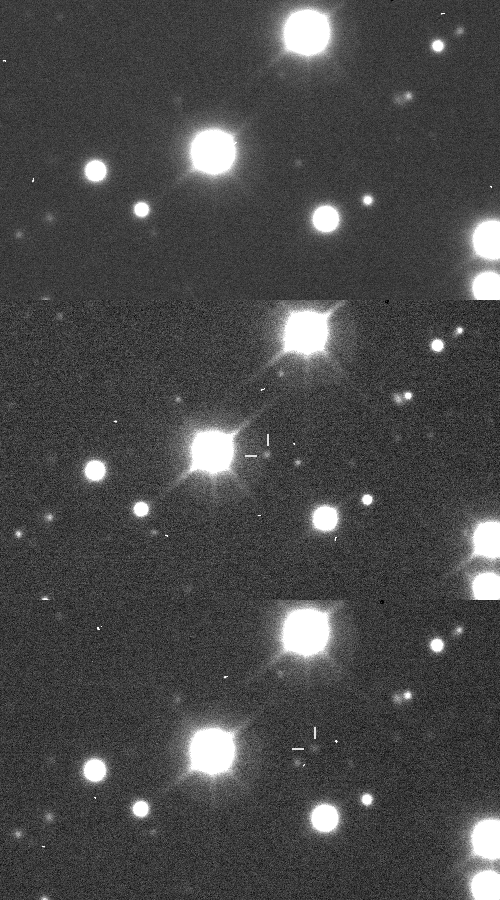
Physical characteristics
The body is small and non-spherical, implying a shape governed by material strength rather than self-gravity; this is common among minor irregular moons. Photometric and color measurements show a neutral to slightly grey spectrum similar to carbonaceous objects. Such characteristics are often compared to C-type asteroids, which are dark and carbon-rich. Physical knowledge of Iocaste — rotation period, detailed composition and surface geology — remains limited because of its diminutive size and distance from Earth.
Orbit and dynamical group
Iocaste orbits far from Jupiter at an average distance near 20.7 million kilometres and completes one orbit in about 609 days. Its path is strongly inclined and retrograde relative to Jupiter’s equator, with an inclination around 147° to the ecliptic (roughly 146° to Jupiter’s equator). The orbit is noticeably elliptical, with an eccentricity of about 0.2874. These orbital properties place Iocaste within the Ananke group, a cluster of retrograde, similarly distant moons that share comparable inclinations and eccentricities and are thought to form a collisional family.
Discovery and name
Iocaste was discovered in 2000 by a team from the University of Hawaii led by astronomer Scott S. Sheppard during ground-based searches for faint Jovian satellites; it was provisionally designated S/2000 J 3 at the time of discovery. In October 2002 the satellite received the name Iocaste, drawn from classical myth: she is the figure Jocasta, known from Greek legend as the mother and later wife of Oedipus. For more on the mythic source see Jocasta in Greek mythology.
Origin and significance
Like other members of the Ananke group, Iocaste is believed to be a fragment of a larger captured asteroid that underwent a collisional breakup after becoming bound to Jupiter. This capture-and-fragmentation scenario explains the shared orbital elements and similar spectral characteristics across the group. Studying such small irregular moons helps astronomers reconstruct the collisional history of the Jovian system and provides constraints on the processes of capture, disruption, and long-term dynamical evolution of satellites around giant planets.
Observational notes and notable facts
- Iocaste is faint and requires large ground-based telescopes and sensitive detectors to measure its motion and brightness.
- Its classification as an irregular, retrograde satellite distinguishes it from Jupiter’s larger, regular moons (such as the Galilean satellites) that orbit much closer and in the planet’s equatorial plane.
- Because of its size and distance, detailed physical studies (surface mapping, spectroscopy at high signal-to-noise) are challenging; most information comes from orbital tracking and broadband photometry.
- References and additional data are recorded in astronomical catalogs and survey publications; related resources can be explored via general astronomical databases and mission archives (satellite catalogues, observatory releases, researcher pages, discovery announcements, orbital element listings, eccentricity summaries, nomenclature histories, mythology notes, group descriptions, spectral comparisons).
Because Iocaste is representative of a collisional family rather than an isolated formation, it remains a useful object for studies that aim to link small body populations, capture processes, and the long-term dynamics of satellites in the outer Solar System.
Questions and answers
Q: What is Iocaste?
A: Iocaste is a moon of Jupiter.
Q: Who discovered Iocaste and when?
A: Iocaste was discovered by a team of astronomers from the University of Hawaii led by Scott S. Sheppard in 2000.
Q: What is the average distance at which Iocaste orbits Jupiter?
A: Iocaste orbits Jupiter at an average distance of 20,723,000 km.
Q: What is the name of the group that Iocaste belongs to and what is it believed to be?
A: Iocaste belongs to the Ananke group, which is believed to be the remnants of a break-up of a captured asteroid.
Q: How long does it take for Iocaste to orbit Jupiter?
A: It takes Iocaste 609.427 days to orbit Jupiter.
Q: Why was Iocaste named after Jocasta?
A: Iocaste was named after Jocasta, the mother/wife of Oedipus in Greek mythology.
Q: What is the size of Iocaste and what does it look like?
A: Iocaste is about 5 kilometres in diameter and appears grey, similar to C-type asteroids.
Related articles
Author
AlegsaOnline.com Iocaste (Jupiter XXIV) — a small irregular moon of Jupiter Leandro Alegsa
URL: https://en.alegsaonline.com/art/47951
Sources
- cfa-www.harvard.edu : IAUC 7555: Satellites of Jupiter
- cfa-www.harvard.edu : MPEC 2001-A28: S/2000 J 2, S/2000 J 3, S/2000 J 4, S/2000 J 5, S/2000 J 6
- cfa-www.harvard.edu : IAUC 7998: Satellites of Jupiter
- ifa.hawaii.edu : An Abundant Population of Small Irregular Satellites Around Jupiter
- journals.uchicago.edu : Orbital and Collisional Evolution of the Irregular Satellites
- ifa.hawaii.edu : Jupiter's Outer Satellites and Trojans
- arxiv.org : Photometric survey of the irregular satellites
- cfa-www.harvard.edu : IAU-MPC NSES
- ssd.jpl.nasa.gov : NASA JPL