
Inuktitut: the Inuit language of the eastern Arctic
Inuktitut is an Inuit language spoken across the eastern Arctic. This article explains its distribution, structure, writing systems, history, cultural role, and relationship to other Inuit dialects.
Inuktitut is one of the Inuit languages spoken across the Arctic regions of Canada and Greenland. It is used by Inuit communities in Nunavut, the Northwest Territories and other northern areas, and is closely related to other Inuit varieties such as Inuinnaqtun and Greenlandic (Kalaallisut). Inuktitut functions as a living language of daily life, traditional knowledge and public institutions in many parts of the Canadian Arctic, and is known internationally through a few widely borrowed words in English such as "anorak," "igloo," and "kayak".
Image gallery
9 Images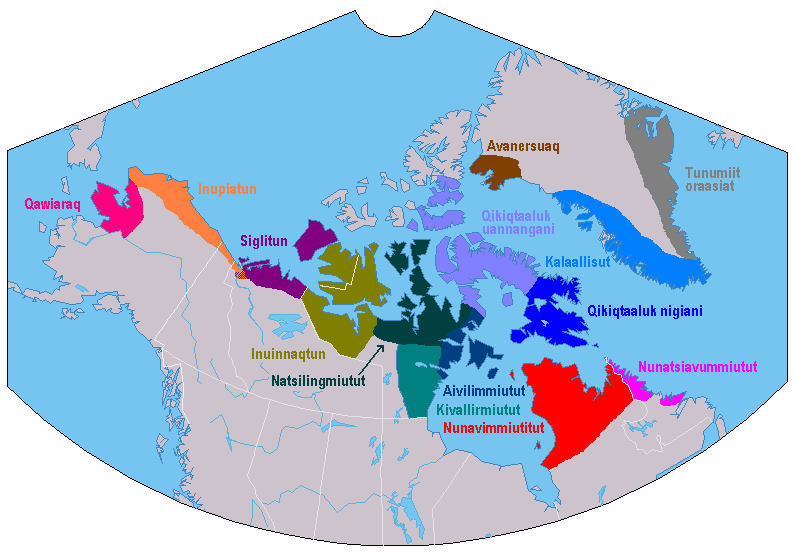


Overview and geographic distribution
Rather than a single uniform language, Inuktitut forms part of an Inuit dialect continuum that stretches across the circumpolar Arctic. Different communities use local varieties with their own names and phonological features. In Canada, Inuktitut and related varieties are spoken in Nunavut, the Northwest Territories, Nunavik (northern Quebec), and Labrador; Greenland uses a related but distinct variety commonly called Kalaallisut. In Canada, Inuktitut has official status in Nunavut and is recognized in the Northwest Territories, where it is used in government, schools and media.
Structure and linguistic characteristics
Inuktitut is typically described as polysynthetic and highly agglutinative: words often consist of a root plus a sequence of affixes that encode tense, mood, person, number and relational meanings. This allows long, information-dense word forms that in English would require whole phrases or sentences. The language exhibits features often summarized as ergative–absolutive tendencies in its case and agreement patterns, and distinguishes consonants such as uvulars and velars that affect pronunciation across dialects. Vowel length and consonant clusters are phonemically important.
Writing systems and orthography
Inuktitut is written in two principal ways. In much of the eastern Arctic a syllabary—an abugida-style system derived from the Unified Canadian Aboriginal Syllabics—represents syllables with distinct characters. In other areas, and in Greenland, the Latin (Roman) alphabet is used with orthographies adapted to local phonology. The choice of script often reflects historical contact, missionary activity, regional education policies and community preference. Both syllabics and Roman orthographies are used today for signage, publications and digital communication.
History, development and modern roles
The Inuit languages descend from a common Proto-Inuit ancestor and spread eastward across the Arctic over centuries. Contact with European languages brought new vocabulary and orthographic systems; missionary translations and colonial administration shaped literacy practices. In recent decades there has been a strong movement to revitalize and institutionalize Inuktitut in education, broadcasting and public life. Efforts focus on teacher training, curriculum development, media production and technology support to ensure intergenerational transmission.
Uses, cultural importance and distinctions
Inuktitut carries traditional knowledge, oral literature, place names and social identity. It is used for storytelling, hunting terminology, ceremonial expressions and contemporary arts. Distinctions among Inuit varieties reflect local identities: for example, Inuinnaqtun is closer to some mainland western dialects, while Kalaallisut in Greenland is a separate standard with its own orthography. The variety of names—Inuktitut, Inuktut, Inuit language—often depends on political and regional preferences.
Further reading and resources
- General overview of Inuktitut and Inuit languages
- Arctic linguistics and regional studies
- Inuit culture and language resources
- Language policy in Canada
- Greenlandic language information
- Nunavut government language resources
- Northwest Territories language programs
- Syllabics and abugida writing systems
- Loanwords from Inuit languages into English
- Comparative Inuit dialect maps and studies
Note: Because Inuktitut varieties vary widely, the terms and spellings used by speakers and governments differ by region. For concise introductions and community-specific guidance consult local educational authorities or cultural organizations listed above.
Questions and answers
Q: What is Inuktitut?
A: Inuktitut is a language spoken by Inuits in Canada and Greenland.
Q: Is Inuktitut an official language?
A: Yes, Inuktitut is an official language in Nunavut and the Northwest Territories.
Q: How is Inuktitut written?
A: Inuktitut can be written in two ways: using the Roman alphabet and using an abugida, a kind of alphabet based on syllables.
Q: What is an abugida?
A: An abugida is a kind of alphabet based on syllables.
Q: What is the Inuktitut syllabary?
A: The Inuktitut syllabary is a small part of the Unified Canadian Aboriginal Syllabics, a set of letters created for many First Nations languages in Canada.
Q: Are there any English words derived from Inuktitut?
A: Yes, some English words like anorak, igloo, and kayak are derived from Inuktitut or another Inuit language.
Q: Is Inuktitut an easy language to learn?
A: Inuktitut is a very complex language.
Related articles
Author
AlegsaOnline.com Inuktitut: the Inuit language of the eastern Arctic Leandro Alegsa
URL: https://en.alegsaonline.com/art/47887
Sources
- www12.statcan.gc.ca : "Census in Brief: The Aboriginal languages of First Nations people, Métis and Inuit"
- glottolog.org : "Eastern Canadian Inuktitut"