
Insertion device (magnet assembly for synchrotron light sources)
A magnetic assembly installed in a straight section of a particle accelerator that forces charged particles to oscillate and emit synchrotron radiation; includes undulators and wigglers.
An insertion device is a deliberate arrangement of magnets placed in a straight section of a particle accelerator to force a stored, relativistic charged-particle beam into a controlled oscillation and thereby produce intense electromagnetic radiation. In basic terms, an insertion device replaces a length of beam pipe that would otherwise provide the vacuum environment for the beam, and it uses arrays of magnets to steer the particles. These devices are commonly installed in the straight sections of a particle accelerator such as a storage ring to serve as a dedicated synchrotron light source.
Image gallery
1 Image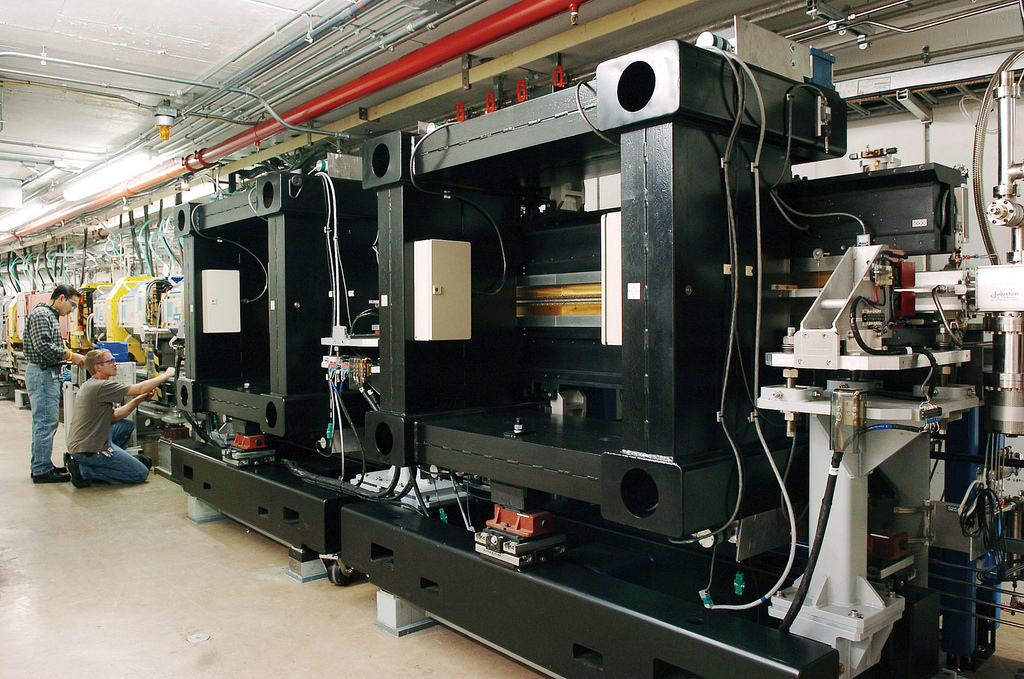
Characteristics and design
Insertion devices are characterized by a repeating magnetic field with a fixed period and an adjustable gap or strength. Key design elements include:
- Magnetic array: alternating-pole magnets produce a periodic transverse field that makes the beam oscillate.
- Period length and gap: the spatial period and the gap between magnet arrays set the wavelength and intensity of emitted light.
- Deflection parameter (K): a dimensionless quantity that distinguishes operational regimes; roughly, small K favors narrow spectral features while large K yields broadband emission.
- Vacuum and supports: the device surrounds the beam vacuum chamber and includes precision motion systems to control gap and alignment.
- Variants: ordinary permanent-magnet devices, superconducting undulators, and hybrid designs that increase field strength or reduce period.
Types: undulators and wigglers
Two broad categories are in routine use. Undulators operate with relatively small deflections so that radiation emitted at successive poles interferes coherently, producing a spectrum with sharp, tunable peaks and high brightness. By contrast, wigglers produce larger angular deflections so the emissions from each bend add incoherently, yielding a broader continuum of electromagnetic radiation across many harmonics. Both types increase the flux available to experiments compared with the simpler bending magnets that also exist around a ring.
Because of their tunability and brightness, insertion devices are central components of modern light-source facilities. They enable high-resolution X-ray diffraction, protein crystallography, spectroscopy, X-ray imaging and tomography, studies of electronic structure, and time-resolved experiments. In free-electron lasers, undulator arrays are used in conjunction with optical feedback and microbunching to reach extremely high peak brightness and coherence.
Historically, insertion devices evolved as storage-ring facilities were adapted to serve scientific communities that require bright, tunable radiation. Over the late 20th century, magnet technology and precision engineering improved spectral control and peak brightness. Contemporary developments focus on shorter periods, higher fields (including superconducting magnets), variable-polarization devices, and integration with accelerator optics to tailor beam properties for specialized beamlines.
Notable distinctions to bear in mind: insertion devices are designed for the straight sections and differ from bending magnets that curve the beam around the ring; undulators rely on interference to produce narrow spectral lines while wigglers act like a series of strong bends producing broadband output. Practical choices between device types depend on the desired photon energy range, bandwidth, coherence, and the experimental requirements of downstream instruments.
For further technical introductions and facility-specific descriptions see general references in the field: physics overview, magnet technologies, accelerator components, synchrotron facilities, vacuum systems, storage ring basics, undulator theory, radiation properties, and wiggler comparisons.
Questions and answers
Q: What is an insertion device?
A: An insertion device is a group of magnets that can be placed on a straight segment of a particle accelerator to be a synchrotron light source.
Q: Why are they called insertion devices?
A: They are called insertion devices because they replace a pipe that otherwise would hold the vacuum needed to maintain the particle beam path.
Q: Where are insertion devices used?
A: Insertion devices are used many times on the circular path of a synchrotron or a storage ring.
Q: How many types of insertion devices are there?
A: There are two types of insertion devices.
Q: What are undulators?
A: Undulators make electromagnetic radiation that is tuned to a narrow frequency range.
Q: What are wigglers?
A: Wigglers make a wide range of electromagnetic radiation frequencies.
Q: What is the purpose of insertion devices?
A: The purpose of an insertion device is to be a synchrotron light source.
Related articles
Author
AlegsaOnline.com Insertion device (magnet assembly for synchrotron light sources) Leandro Alegsa
URL: https://en.alegsaonline.com/art/47442
Sources
- xdb.lbl.gov : "History of Synchrotron Radiation Sources"