
Innsbruck-Land District (Tyrol, Austria)
A ring-shaped district surrounding the city of Innsbruck in Tyrol, Austria, known for its alpine landscape, valley settlements, cross-border links to Germany and Italy, and a mixed economy of tourism and services.
Overview
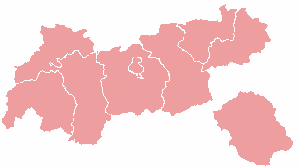
The Innsbruck-Land District (Innsbruck-Land) is an administrative district in the federal state of Tyrol, in western Austria. It uniquely surrounds but does not include the statutory city of Innsbruck, which serves as the district's administrative seat. The district combines densely populated valley areas with extensive high-alpine terrain and is part of a transalpine region linking Central Europe to northern Italy.
Image gallery
3 Images

Geography and natural features
Covering an area of 1,990.17 km², the district follows the course of the Inn River through its main valley and stretches into several side valleys and mountain ranges. Elevation and climate vary widely: lower valley floors have temperate conditions and agricultural land, while higher zones are characterized by alpine pastures, forests, and glacier-fed landscapes. Its position gives it direct contacts with neighboring regions to the north and south.
Borders and neighbouring territories
The district borders the German region of Bavaria (Germany) to the north, the Schwaz District to the east (Schwaz), the Italian province of South Tyrol (Italy) to the south, and the Imst District to the west (Imst). These cross-border and inter-district connections have shaped trade, transport corridors and cultural exchange for centuries.
History, transport and development
Historically the valleys around Innsbruck were part of major north–south alpine routes. Over time these corridors developed into modern roads and railways that facilitate freight and passenger movement across the Alps. The region has balanced preservation of alpine landscapes with infrastructure for year-round mobility and access to the city of Innsbruck.
Economy, population and tourism
As of 2021 the district population was 181,698. Economic activity is diverse: valley communities maintain agriculture and crafts, many people commute to Innsbruck for services and education, and mountain areas support tourism focused on hiking, skiing and outdoor recreation. Local economies also benefit from cross-border commerce due to proximity to Germany and Italy.
Administration and notable characteristics
- Administrative seat: Innsbruck (statutory city, not part of the district).
- Area: 1,990.17 km².
- Population (2021): 181,698.
- Landscape: Inn valley, multiple side valleys and alpine ranges.
The district is frequently described as a ring or collar around Innsbruck: it provides the rural and mountain complement to the urban core, combines year-round recreation with everyday life, and plays a strategic role in alpine transit and cross-border relations.
Questions and answers
Q: Where is the Innsbruck-Land District located?
A: The Innsbruck-Land District is located in Tyrol, Austria.
Q: What is the area of the Innsbruck-Land District?
A: The area of the Innsbruck-Land District is 1,990.17 km².
Q: What is the population of the Innsbruck-Land District as of 2021?
A: As of 2021, the population of the Innsbruck-Land District is 181,698 people.
Q: What borders the Innsbruck-Land District to the north?
A: The Innsbruck-Land District borders Bavaria (Germany) to the north.
Q: What is the administrative center of the Innsbruck-Land District?
A: The administrative center of the Innsbruck-Land District is Innsbruck.
Q: What is the district in the east of the Innsbruck-Land District?
A: The district in the east of the Innsbruck-Land District is Schwaz.
Q: What is the district in the west of the Innsbruck-Land District?
A: The district in the west of the Innsbruck-Land District is Imst.
Related articles
Author
AlegsaOnline.com Innsbruck-Land District (Tyrol, Austria) Leandro Alegsa
URL: https://en.alegsaonline.com/art/47413