
Inferno (operating system)
Inferno is a portable distributed operating system from Bell Labs that treats resources as files, provides per-process namespaces, uses a 9P-derived protocol, and runs Limbo programs on the Dis VM.
Overview
Inferno is a compact, network-oriented operating environment originally developed at Bell Labs and later maintained by Vita Nuova Holdings. It implements the idea of a single coherent view of resources across machines and networks: devices, services and remote data appear to applications as part of a hierarchical file-like namespace. Inferno was developed from many of the same ideas that motivated Plan 9 and is intended to be highly portable, able to run directly on hardware or hosted on top of other systems such as Microsoft Windows or on operating systems from Google including Android.
Image gallery
2 Images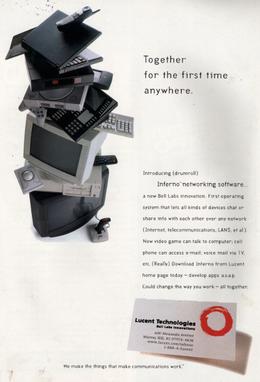

Key design principles
The system is guided by a small set of core ideas that shape how programs are written and how the environment is organized:
- Resources as files: Every identifiable object—devices, network connections, processes, and services—is presented as a file or a file-like interface within a hierarchical namespace.
- Per-process namespaces: Each program sees its own customized namespace. Namespaces can combine local and remote resources in a single logical tree without revealing physical location.
- Standard communication protocol: Access to local and remote resources is performed with a single, uniform protocol derived from the Plan 9 9P protocol (often referred to in the Inferno project as Styx), which simplifies distributed programming and resource sharing.
Architecture and components
Inferno separates a small kernel-like layer, a language runtime and a standard set of system libraries and servers. Applications are typically written in the Limbo programming language and compiled to a portable bytecode executed by the runtime virtual machine called Dis virtual machine. Limbo offers static typing, concurrent processes, and communication primitives tailored to the file-and-protocol model of the environment. Core components include:
- The Dis bytecode interpreter and runtime, which performs execution and resource management across platforms;
- System libraries that present device and network access through file-like interfaces;
- Toolkits and user-level servers that implement windowing, graphics and network services when Inferno is used as a hosted environment or standalone system.
History and development
Inferno grew from experimental work at Bell Labs exploring distributed systems and clean, uniform interfaces for computing resources. While it shares philosophical roots with Plan 9, Inferno was designed specifically for portability and for deployment across heterogeneous networks and devices. It has been available in forms that run directly on hardware as a complete operating environment and as an application running on top of other host systems, which made it attractive for embedded devices and cross-platform networked applications.
Uses, examples and significance
Inferno has been used as a platform for network services, embedded systems, and educational projects that demonstrate distributed-system principles in a small, self-contained environment. The portability of Limbo/Dis allows the same application code to run across different underlying processors and hosts without recompilation. Common use cases emphasize:
- Uniform access to remote and local resources via namespaces and the Styx/9P protocol;
- Rapid construction of distributed services that treat remote endpoints as file servers;
- Deployment on resource-constrained devices where a lightweight, consistent runtime is beneficial.
Notable distinctions and legacy
Inferno is notable for bringing the Plan 9 concepts of ‘‘resources as files’’ and per-process namespaces into a portable, language-centered runtime. Its combination of a purpose-built language, a simple bytecode virtual machine, and a single network protocol for resource access makes it distinct from more monolithic operating systems. Though it never became mainstream, Inferno influenced thinking about distributed resource naming and lightweight, platform-independent execution environments. Its ideas continue to be referenced in discussions of namespace design, micro-kernel architectures and highly portable runtime systems.
For further technical detail and historical material, read project documentation and retrospectives available from primary sources and archives: see the project pages and technical papers linked from official repositories and developer accounts.
Related articles
Author
AlegsaOnline.com Inferno (operating system) Leandro Alegsa
URL: https://en.alegsaonline.com/art/47275
Sources
- vitanuova.com : "Inferno Design Principles"
- nytimes.com : "Bell Labs Operating System To Be Offered for Networks"
- arstechnica.com : "“If it ain’t broke, break it”: Inferno environment ported to Android"
- vitanuova.com : "Inferno Application Programming"