
Indo-Australian Plate
A major tectonic plate that carries Australia and part of the Indian region, and whose northern edge drives major mountain building and earthquakes.
The Indo-Australian Plate is a major tectonic plate in Earth’s lithosphere. It is commonly described as carrying Australia, surrounding ocean, and, to the northwest, the Indian subcontinent and adjacent waters. In many older accounts it is treated as a single large plate, although modern geoscience often describes it as a complex region that includes separate Indian and Australian plate domains.
Like other tectonic plates, it moves slowly over the planet’s mantle and interacts with neighboring plates along its edges. Its northern margin is especially important because it meets the Eurasian Plate, a collision that helps shape the Himalayas, the Tibetan Plateau, and the seismic activity of South and Southeast Asia. Other boundaries connect with the Antarctic, Pacific, and surrounding oceanic plates.
Image gallery
1 Image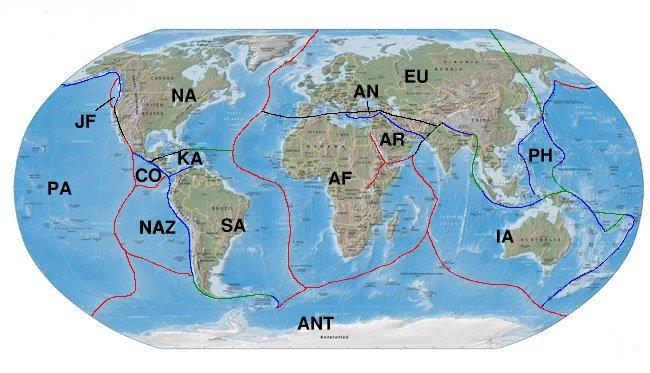
Formation and structure
The name reflects the idea that the Indian and Australian portions were once considered parts of a single plate. They are thought to have fused tens of millions of years ago, roughly in the middle of the Cenozoic era. Since then, continued movement has been uneven, and many researchers now note a broad zone of internal deformation rather than a perfectly rigid plate.
This distinction matters because plate tectonics is not always as simple as one solid slab moving independently. In the Indo-Australian region, stress can be spread across wide areas of ocean floor and continental crust, which influences earthquakes and the shape of plate boundaries. The term is still widely used, especially in general references and older literature.
Geologic importance
The plate is significant because it helps explain several major features of Asia and the Indian Ocean region. Its northward motion is one of the forces behind continental collision in the Himalayas, while subduction and compression around its margins contribute to volcanic arcs, trenches, and frequent earthquakes. In Australia, the plate provides the tectonic setting for a comparatively stable continent that is still slowly moving north.
- Australia: carried on the plate’s eastern or Australian part
- India: associated with the plate’s northern or Indian part
- Indian Ocean: much of the plate underlies oceanic crust
- Plate boundaries: regions where earthquakes, mountain building, and volcanism are concentrated
In short, the Indo-Australian Plate is both a useful broad label and a reminder that Earth’s surface is dynamic. Its movement has helped shape some of the world’s highest mountains, most active seismic zones, and major geological contrasts between oceanic and continental crust.
Questions and answers
Q: What is the Indo-Australian plate?
A: The Indo-Australian plate is a large tectonic plate that includes the continent of Australia and surrounding ocean, as well as the Indian subcontinent and adjacent waters.
Q: How old is the Indo-Australian plate?
A: The Indo-Australian plate was formed about 43 million years ago.
Q: What two plates fused to form the Indo-Australian plate?
A: The Indo-Australian plate was formed by the fusion of the Indian and Australian plates.
Q: What geographic areas are included in the Indo-Australian plate?
A: The Indo-Australian plate includes the continent of Australia and surrounding ocean, as well as the Indian subcontinent and adjacent waters.
Q: How large is the Indo-Australian plate?
A: The size of the Indo-Australian plate varies, as it is constantly shifting and changing in size due to tectonic activity.
Q: What is tectonic activity?
A: Tectonic activity refers to the movement and interactions of tectonic plates, which can cause earthquakes, volcanic eruptions, and the formation of mountains and new landmasses.
Q: What are some of the effects of tectonic activity on the Indo-Australian plate?
A: The Indo-Australian plate has experienced a significant amount of tectonic activity over the years, which has resulted in the formation of the Himalayan mountain range, earthquakes in the Indian Ocean, and the formation of new land masses through volcanic activity.
Related articles
Author
AlegsaOnline.com Indo-Australian Plate Leandro Alegsa
URL: https://en.alegsaonline.com/art/47186
Sources
- austhrutime.com : "The Indo-Australian Plate"