
Indigenous Australian music: traditions, instruments, and contemporary forms
Music of Aboriginal and Torres Strait Islander peoples, spanning ancient ceremonial songlines and modern fusion across rock, country, hip hop and classical traditions.
Indigenous Australian music encompasses the songs, instruments and performance practices of Aboriginal peoples and Torres Strait Islanders. These two groups are collectively known as Indigenous Australians, with musical expressions deeply tied to community identity, law and ceremony. Many songs transmit knowledge of country, family relationships and ancestral journeys often referred to in English as songlines or the Dreaming. The Torres Strait Islanders have cultural links across the Torres Strait and into New Guinea that give parts of their music a Melanesian character.
Image gallery
4 Images


Distinctive features and common elements
Traditional music shows wide regional variation but several features recur across the continent. Vocal styles range from solo narrative singing to layered group chants. Rhythmic accompaniment is commonly provided by clapsticks and percussive instruments. Some songs are restricted by gender, clan or place, and songs often belong to particular custodians who are responsible for their performance and transmission. Performance is frequently combined with dance, body painting and sculptural or costume elements.
Instruments and performance practices
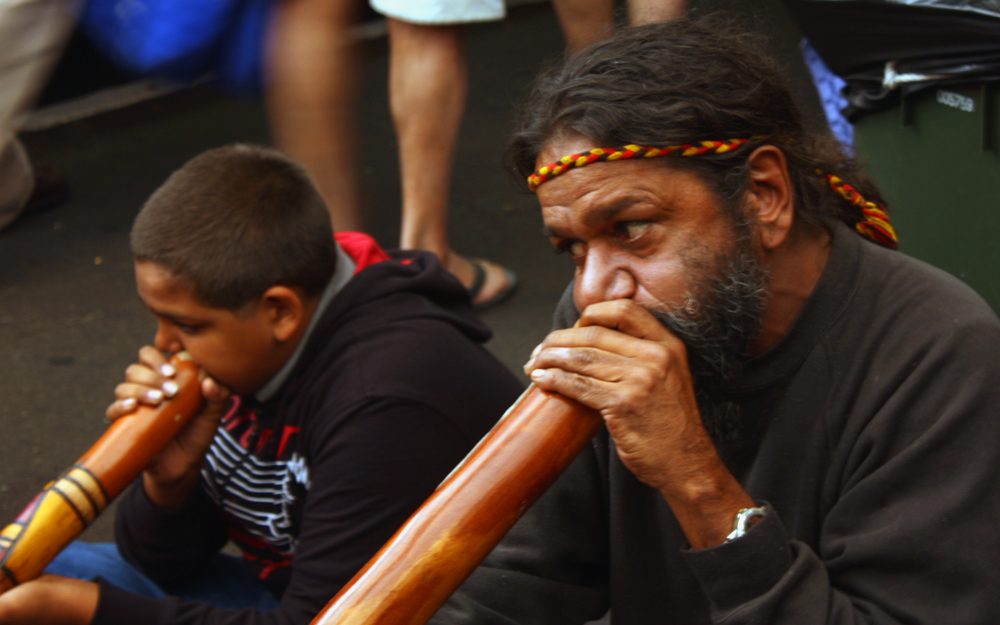
- Didgeridoo (a long blown aerophone traditionally made in northern Australia) produces a continuous drone and is often played with circular breathing.
- Clapsticks provide steady rhythm and are used across many language groups.
- Bullroarer and percussion appear in initiation and ceremonial contexts in some regions.
- Song cycles and storytelling: many compositions encode landscape, law and genealogies and are performed in sequence as part of ceremonies.
Instruments and repertoire are not uniform: what is central in one region may be absent in another. For example, the didgeridoo is most strongly associated with parts of northern Australia, while Torres Strait Islander music often uses different melodic and rhythmic patterns reflecting islander traditions.
History, contact and continuity
These musical traditions developed over many thousands of years and were integral to social life long before European colonisation. From the late 18th century contact with Europeans introduced new instruments and genres, and colonial policies often disrupted Indigenous cultural life. Despite pressure, many traditional practices survived and have been actively maintained, revived or adapted by communities. Since the mid-20th century there has been increasing recognition of Indigenous music in national culture and growing opportunities for Indigenous performers to present traditional and contemporary work to wider audiences.
Contemporary forms and cultural importance
Today Indigenous musicians work across a broad range of styles. Some artists combine traditional voice, language and instruments with rock, country, reggae, hip hop and classical forms, using music as a platform for cultural expression, education and political advocacy. Notable examples of cross-cultural projects and contemporary performers have helped raise awareness of Indigenous issues and languages. Non-Indigenous musicians have also borrowed elements of Indigenous music, which raises important questions about permission, attribution and cultural rights.
Social roles, rights and education
Music remains vital to ceremony, law and intergenerational learning. Many communities emphasise that songs are owned by particular families or groups and should be performed according to customary protocols. Music participates in language maintenance and school programs and is frequently used in cultural festivals, community events and national celebrations.
Further resources
- Overview of Indigenous Australian music
- Information about Indigenous Australian peoples
- Traditional music styles and regions
- Social functions of music
- Cultural and ceremonial context
- Instruments and craftsmanship
- Geographic distribution and regional differences
- Torres Strait Islander music and Melanesian links
- Contemporary rock and fusion
- Country and popular forms
- Hip hop, reggae and modern genres
Questions and answers
Q: What is included in Australian indigenous music?
A: Australian indigenous music includes the music of Australian Aborigines and Torres Strait Islanders.
Q: What are Indigenous Australians?
A: Indigenous Australians are the collective term for Australian Aborigines and Torres Strait Islanders.
Q: What is the role of music in the social, cultural, and ceremonial observances of Indigenous Australians?
A: Music has formed an important part of the social, cultural, and ceremonial observances of Indigenous Australians in the past and present.
Q: Are there unique performance and musical instrumentation specific to particular regions or Indigenous groups?
A: Yes, there are performance and musical instrumentation which are unique to particular regions or Indigenous Australian groups.
Q: Have non-indigenous artists and performers incorporated indigenous Australian styles and instruments into their works?
A: Yes, non-indigenous artists and performers have used and sampled indigenous Australian styles and instruments in their works.
Q: What are some contemporary musical styles that have featured notable Indigenous Australian performers?
A: Contemporary musical styles such as rock and roll, country, rap, and reggae have all featured a variety of notable Indigenous Australian performers.
Q: Is the culture of Torres Strait Islanders part of New Guinea?
A: Yes, the culture of the Torres Strait Islanders is part of New Guinea.
Related articles
Author
AlegsaOnline.com Indigenous Australian music: traditions, instruments, and contemporary forms Leandro Alegsa
URL: https://en.alegsaonline.com/art/47168