
Indiana Jones and the Kingdom of the Crystal Skull
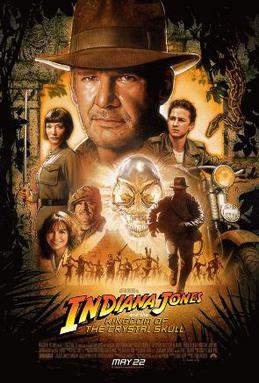
The fourth Indiana Jones film (2008), directed by Steven Spielberg and developed with George Lucas. Set in 1957, it reunites Harrison Ford with familiar allies as Indy opposes Soviet agents over a mysterious crystal skull.
Overview
Indiana Jones and the Kingdom of the Crystal Skull is a 2008 American adventure film directed by Steven Spielberg and produced by Lucasfilm. It is the fourth feature in the Indiana Jones series and relocates the familiar archaeological adventurer to the late 1950s, a period shaped by Cold War tensions and emerging science-fiction tropes. The film blends pulpy action, practical stunts and speculative elements around an enigmatic artifact called the crystal skull. The screenplay credit reflects a long development history, with a final script by David Koepp after numerous earlier drafts.
Image gallery
8 Images





Setting and plot summary
Set primarily in 1957, the story follows an older Indiana Jones as he becomes embroiled in a search for a crystal skull that various factions — including agents of the Soviet Union — wish to control. The plot sends him from American towns to academic settings, and on expeditions into jungle ruins and a Cold War-era military test site. Along the way Indy is reunited with Marion Ravenwood and finds new allies and adversaries. The narrative deliberately mixes adventure serial motifs with mid-century anxieties about nuclear power, espionage and rapid technological change. Because the film intentionally evokes pulp and science-fiction sources, some of its plot elements were divisive among audiences and critics who compared them to the original trilogy's tone.
Cast and characters
The production reunites Harrison Ford in the title role of Indiana Jones and Karen Allen as Marion Ravenwood, a character introduced in the first film. New supporting cast members include Shia LaBeouf as Mutt Williams, a young, energetic companion who brings a generational contrast to Indy. Cate Blanchett plays Dr. Irina Spalko, a Soviet agent with an intellectual and enigmatic presence. Veteran performers John Hurt, Jim Broadbent and Ian McDiarmid appear as colleagues and academics who help anchor the story in an academic and historical context. Ray Winstone portrays a loyal ally known as Mac. The ensemble is used to balance nostalgia, comic beats and the franchise's continuing themes of myth encountering modernity.
Production and development
The film emerged after a lengthy development period following Indiana Jones and the Last Crusade (1989). George Lucas, Steven Spielberg and Harrison Ford collaborated on the direction of the project, but the story's central device and tone were the subject of many revisions. Several writers contributed early drafts, including Jeb Stuart, Jeffrey Boam, M. Night Shyamalan, Frank Darabont and Jeff Nathanson, before David Koepp's screenplay was chosen. Principal photography began in mid-2007 and took place across multiple states and soundstages.
Filming and effects
Filming locations included New Mexico, Connecticut, Hawaii, and California, complemented by studio work in Los Angeles. Spielberg emphasized the use of practical stunts and physical effects to maintain the tactile qualities associated with the earlier films in the series, though the production also used computer-generated imagery where necessary to create sequences that would be difficult or unsafe to stage otherwise. The decision to foreground practical action was widely noted by both the production team and reviewers.
Music
John Williams returned to compose the film's score, reaffirming the series' distinctive musical identity. Williams' themes reinforce the franchise's adventurous tone while adapting to the film's Cold War setting and more speculative elements.
Release, reception and legacy
Upon release the film achieved significant commercial reach and brought the character of Indiana Jones back to mainstream attention. Critical reaction was mixed: many praised the cast performances, period production design and action choreography, while others criticized certain plot choices and the incorporation of overt science-fiction motifs. Over time the film has remained a topic of debate among fans and scholars, discussed in terms of how it updates a pulp hero for a later historical moment and how franchises negotiate nostalgia and innovation.
Themes and analysis
Notable themes include the tension between myth and modernity, the persistence of colonial and archaeological ethics in popular adventure stories, and an exploration of generational transition as represented by younger characters entering Indy’s world. The Cold War backdrop reframes the villainous forces from World War II-era antagonists in earlier films to espionage-driven rivals, reflecting shifts in global politics and mid-century fears.
Notable facts
- The film relocates the series from World War II-era antagonists to Cold War adversaries, changing the geopolitical backdrop.
- Practical stunts and on-location shooting were emphasized to preserve the tactile feel of the earlier films.
- John Williams returned as composer, reinforcing the franchise's musical continuity.
- The crystal skull serves as a MacGuffin that combines archaeological legend with 1950s science-fiction motifs, a choice that generated debate.
Principal cast
- Harrison Ford — Indiana Jones
- Karen Allen — Marion Ravenwood
- Shia LaBeouf — Mutt Williams
- Cate Blanchett — Dr. Irina Spalko
- Ray Winstone — Mac
- John Hurt, Jim Broadbent, Ian McDiarmid — supporting academics
Further reading and resources
- Film overview and synopsis
- Production notes and crew credits
- Interview with the director
- George Lucas on story origins
- Character profiles
- Harrison Ford: role and return
- Cold War context in the film
- Cate Blanchett on playing Spalko
- Karen Allen and Marion Ravenwood
- Shia LaBeouf on joining the franchise
- Ray Winstone: supporting performance
- John Hurt and the ensemble cast
- Jim Broadbent's role
- Ian McDiarmid in a supporting part
- Development since Last Crusade
- Early screenplay contributors
- Drafts and writers' contributions
- Filming locations: New Mexico
- Filming in Connecticut
- Hawaii production sequences
- California locations and shoots
- Los Angeles soundstage work
- Approach to stunts versus CGI
- John Williams and the musical score
Questions and answers
Q: Who directed Indiana Jones and the Kingdom of the Crystal Skull?
A: Steven Spielberg directed Indiana Jones and the Kingdom of the Crystal Skull.
Q: What is the setting for this movie?
A: The movie is set in 1957.
Q: Who wrote the story for this fourth installment in the series?
A: The story was written by Spielberg and executive producer George Lucas.
Q: What is Indiana Jones fighting against in this movie?
A: In this movie, Indiana Jones is fighting against agents of the Soviet Union led by Spalko (Cate Blanchett).
Q: Who are some of Indy's allies in his mission to find a crystal skull?
A: Indy's allies include his former lover Marion Ravenwood (Karen Allen), Mutt (Shia LaBeouf) and friend Mac (Ray Winstone). John Hurt, Jim Broadbent, and Ian McDiarmid also play fellow academics.
Q: How long did it take to develop this film before shooting began?
A: It took 18 years to develop this film before shooting started on June 18, 2007.
Q: What techniques were used to make sure that this movie looks like other films in the series?
A: This movie uses more stunts than CGI so that it looks like other films in the series.
Related articles
Author
AlegsaOnline.com Indiana Jones and the Kingdom of the Crystal Skull Leandro Alegsa
URL: https://en.alegsaonline.com/art/47143
Sources
- theraider.net : "Official Indy 4 Running Time is 2 Hours!"