
Indian Standard Time (IST)
Indian Standard Time (IST) is the single official time for India and Sri Lanka, set at UTC+5:30 based on the 82.5°E meridian; it does not observe daylight saving time.
Overview
Indian Standard Time, commonly abbreviated IST, is the official civil time zone used across the Republic of India and the Democratic Socialist Republic of Sri Lanka. Its offset from Coordinated Universal Time is five hours and thirty minutes ahead (UTC+5:30). IST is a single national time for countries that span many degrees of longitude and it does not change seasonally for daylight saving.
Image gallery
1 Image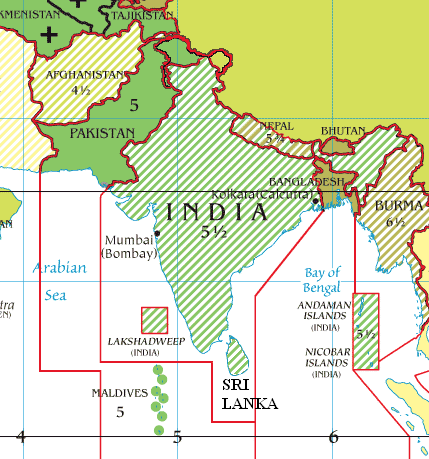
Basis and characteristics
The standard meridian for IST is 82.5° east of the Prime Meridian (sometimes written as 82°30′E). That longitude corresponds to 5.5 hours ahead of UTC because the Earth rotates 15° per hour (82.5 ÷ 15 = 5.5). The abbreviation IST is widely used in timetables, legal documents and public communication.
- Offset: UTC+5:30.
- Seasonal change: no daylight saving time is observed.
- Timekeeping authority: national laboratories and standards bodies maintain official time signals.
History and development
Before a single standard was adopted, different regions used local mean time based on their longitude, resulting in multiple times for cities such as Bombay and Calcutta. During the period of modern standardization, a meridian was chosen near central India to provide a practical compromise across the country. Over the 19th and 20th centuries, this choice was formalized so that railways, telegraphs, government administration and commerce could operate on a common schedule.
Uses, examples and regional context
IST is the legal time used for government operations, transport timetables, broadcasting, banking and business hours. Because India and Sri Lanka cover a wide east–west span but use a single standard, local sunrise and sunset times vary significantly from one end of the territory to the other. Neighbouring countries use different offsets—for example, Pakistan at UTC+5, Bangladesh at UTC+6 and Nepal at UTC+5:45—making IST one of several South Asian time standards.
Notable facts and debates
Two features often discussed are the half‑hour offset and the choice to avoid daylight saving. The half‑hour increment is shared by a handful of jurisdictions worldwide and simplifies coordination with both western and eastern neighbours. Periodic public and policy debates have considered proposals such as multiple time zones within India or adjustments to working hours to better match daylight patterns, but IST remains the single official time in current use.
Questions and answers
Q: What is Indian Standard Time (IST)?
A: Indian Standard Time (IST) is the time zone used in India and Sri Lanka.
Q: How many hours is IST ahead of Coordinated Universal Time (UTC)?
A: IST is 5 hours and 30 minutes forward to Coordinated Universal Time (UTC+5:30).
Q: Does IST use Daylight Saving Time (DST)?
A: No, IST does not use Daylight Saving Time (DST).
Q: What is the purpose of having a standardized time zone in India?
A: Standardized time zone helps regulate scheduling and communication across different regions.
Q: How do I convert my local time to IST?
A: To convert local time to IST, add 5 hours and 30 minutes to your local time.
Q: What are the benefits of using a standardized time zone?
A: Standardized time zones make communication and coordination across regions easier and more efficient.
Q: Does Sri Lanka use the same time zone as India?
A: Yes, Sri Lanka uses the same time zone as India, which is Indian Standard Time (IST).
Related articles
Author
AlegsaOnline.com Indian Standard Time (IST) Leandro Alegsa
URL: https://en.alegsaonline.com/art/47136
Sources
- wwp.greenwichmeantime.com : Indian Standard Time