
Impossible object
A two-dimensional depiction that the visual system interprets as a coherent three-dimensional form despite internal inconsistencies; important in art, perception psychology, and mathematical illustration.
An impossible object is a depiction on a flat surface that invites the visual system to infer a plausible three-dimensional structure while embedding contradictions that make any real 3D realization impossible. Also called an undecidable figure, these figures exploit perceptual rules and depth cues so that local parts appear consistent even when the whole is not. They are commonly presented as an optical illusion on a two-dimensional picture: the viewer’s brain completes surfaces and resolves junctions into a solid form, producing a compelling impression of depth that cannot exist in physical space.
Image gallery
2 Images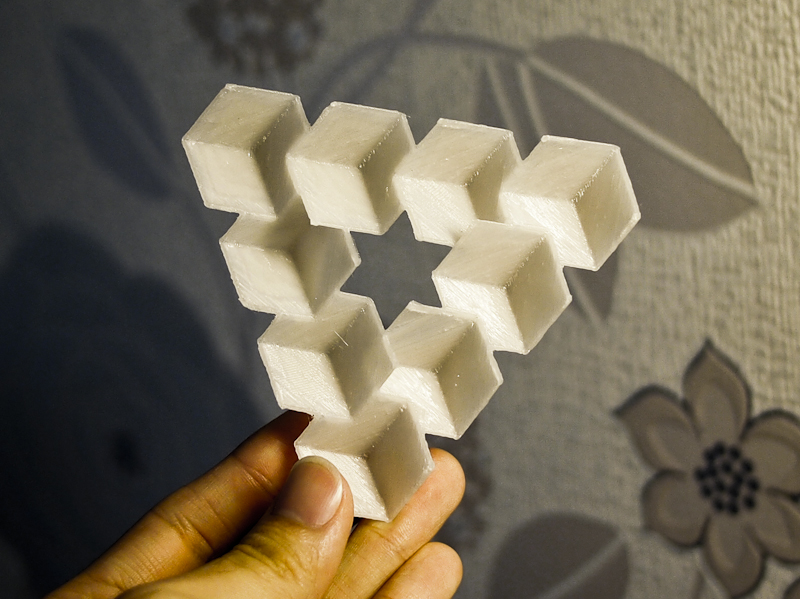

Visual characteristics
Impossible objects share visual features that generate paradox. Small regions and connections—corners, edges and T-junctions—are drawn to be locally consistent, yet their global arrangement violates ordinary spatial relations. Typical cues that create the effect include conflicting depth signals, ambiguous occlusion relationships, and closed loops that require inconsistent ordering of nearer and farther surfaces. In many examples the contradiction is obvious on first glance; in others the inconsistency is subtle and must be discovered by careful inspection of the drawing.
History and cultural context
The modern study of impossible objects emerged in the 20th century, with widely known instances such as the Penrose triangle and the Penrose stairs, described by mathematician Roger Penrose and popularized by the artist M. C. Escher in his prints. Escher and other artists used these constructions to explore perspective, infinity and visual paradox. Popular variants include the so-called "impossible trident" or blivet. The subject attracted attention from artists, scientists and the general public, contributing to both recreational puzzles and serious research into perception.
Perception and psychology
Researchers in perception study impossible figures to learn how the brain reconstructs three-dimensional structure from two-dimensional images. The visual system applies heuristics—assumptions such as smooth surfaces, consistent lighting, and simple depth ordering—to resolve ambiguity. Impossible objects reveal limitations and strengths of those heuristics: the system will often prefer a coherent interpretation that is locally optimal even if it is globally inconsistent. Psychologists probe such phenomena to understand attention, object recognition, and how prior experience shapes perceptual inference. See studies by psychologists for related research approaches.
Mathematics, formalization and creation
Mathematicians and theoreticians analyze impossible figures by describing the combinatorial and topological relations implied by line drawings. Formal approaches examine how planar drawings encode contradictory depth orders and how graphs of edges and vertices can be interpreted as inconsistent surface arrangements. Practical methods for creating impossible objects often manipulate junction types and continuity of edges so that every local neighborhood satisfies ordinary rules while the whole does not. Related work by mathematicians formalizes aspects of these representations.
Art, sculpture and applied uses
Artists have long used impossible objects as motifs in prints, murals and installations. Some sculptors produce three-dimensional works that appear impossible from a single vantage point by using forced perspective and carefully aligned components; these pieces are realizable in space but only create the contradiction for viewers standing at a specific location. Designers and advertisers sometimes use impossible imagery to attract attention or suggest paradox. The phenomenon connects to broader artistic concerns about representation, perspective and the limits of visual truth, and continues to inspire creative practice among artists.
Classification and related phenomena
Impossible objects can be contrasted with ambiguous or bistable images: ambiguous figures present multiple plausible interpretations (for example, the Necker cube), while impossible figures present a single coherent but inconsistent interpretation that cannot correspond to any real object. Both classes illuminate how visual inference works. Practical taxonomies classify impossible figures by the types of junctions and loops they use, and by whether the impossibility arises from local contradictions or from a global inconsistency that only appears when larger parts are compared. For geometric examples and illustrations, see resources on geometry.
Uses in education and research
Impossible objects serve as accessible tools in teaching perception, art and geometry. They are used as stimuli in laboratory studies, as exercises in drawing and spatial reasoning, and as demonstrations of how simple rules can produce surprising outcomes. Because they lie at the intersection of visual art and cognitive science, impossible figures remain a recommended topic for interdisciplinary study and public engagement.
- Geometric illustrations highlighting inconsistent spatial relations: geometry.
- Experimental stimuli for visual and cognitive studies: psychological research.
- Theoretical work on representation and topology: mathematical approaches.
- Artistic use in prints, murals, installations and perspective sculptures: art.
Questions and answers
Q: What is an impossible object?
A: An impossible object is a type of optical illusion where a person looks at a two-dimensional picture and interprets it as a three-dimensional object, even though it is impossible in reality.
Q: What are other names for impossible objects?
A: Impossible objects are also known as undecidable figures.
Q: How does the brain interpret impossible objects?
A: The vision center of the brain does much of its work subconsciously and automatically, interpreting the figure as a three-dimensional object.
Q: What happens when a viewer looks at an impossible object?
A: The viewer usually knows such an object is impossible soon after looking at the figure. However, the impression of a 3D figure may still remain even when the viewer knows it is impossible in reality.
Q: Are all impossible objects immediately obvious?
A: No, some impossible objects are more subtle and it is not obvious that they are impossible right away. The viewer needs to carefully look at the geometry of the object to find out that it is indeed impossible.
Q: Who are interested in impossible objects?
A: Impossible objects are of interest to psychologists, mathematicians, and artists.
Q: What is the importance of impossible objects?
A: The study of impossible objects can help us understand how our brain processes visual information, and it can inspire artistic creations and mathematical discoveries.
Related articles
Author
AlegsaOnline.com Impossible object Leandro Alegsa
URL: https://en.alegsaonline.com/art/46906