
Imperial State Crown
The Imperial State Crown is a principal British crown jewel worn by the sovereign at state occasions. Richly jewelled and historically layered, it bears several famous gems and is displayed at the Tower of London.
The Imperial State Crown is one of the best‑known pieces among the British Crown Jewels. It serves as a visible emblem of the monarch's authority and public duties and has been remade in several forms since the late medieval period. Unlike the heavier St Edward's Crown, the Imperial State Crown is designed for use at ceremonies such as the State Opening of Parliament and for public appearances immediately after coronations.
Image gallery
10 Images

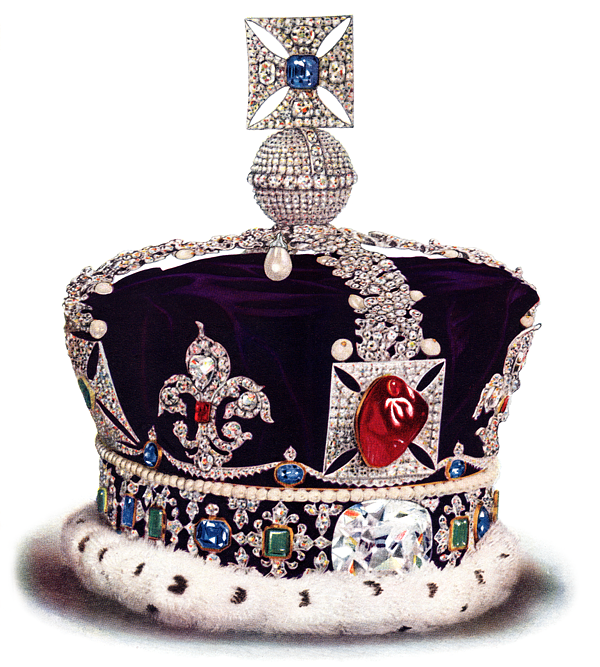


Design and main features
The crown combines traditional heraldic motifs with a profusion of gemstones. Its structure typically includes a circlet decorated with four crosses pattée alternating with four fleurs‑de‑lis. Rising from the circlet are four half‑arches that meet beneath a monde and a cross at the top. The interior contains a purple velvet cap edged with an ermine band. Compared with some other crowns, it is relatively low in profile so it can be worn more comfortably during public duties.
- Setting and ornamentation: base circlet of crosses and fleurs‑de‑lis, four half‑arches, monde and cross.
- Materials: gold frame set with a large number of diamonds, pearls and coloured gemstones; velvet cap and ermine trimming.
- Function: ceremonial wear at state events and worn by the sovereign on leaving the coronation ceremony.
Gems and notable stones
The Imperial State Crown is notable for hosting a number of historically important gems. It contains thousands of diamonds and hundreds of pearls, together with a selection of coloured stones. In descriptive inventories the crown is recorded as containing large numbers of stones, for example many diamonds and pearls highlighted in public descriptions (diamonds) and (pearls), as well as sapphires (sapphires), emeralds (emeralds) and rubies (rubies).
- Cullinan II (Lesser Star of Africa): a large brilliant cut diamond set in the front of the circlet.
- Black Prince's Ruby: a historic spinel mounted in the front cross, associated with medieval provenance and battles.
- St Edward's Sapphire: mounted in the cross at the crown's summit and traditionally linked to Edward the Confessor (historical association).
- Stuart Sapphire: a substantial blue stone set in the rear band of the circlet.
- Queen Elizabeth's Pearls: pearls long associated with modern sovereigns and ceremonial dress.
History and usage
The name and form of the Imperial State Crown evolved over centuries. Crowns with similar names and designs appear in records from the 15th century onwards; successive monarchs ordered new versions or restorations as styles and needs changed. The present form is a 20th‑century recreation of older models, incorporating ancient stones with modern mounting techniques. In routine ceremonial life the crown is most often seen at the State Opening of Parliament, when the sovereign wears it while delivering the speech from the throne, and it traditionally replaces the heavier coronation crown when the newly crowned monarch departs the coronation service.
Care, display and public access
When not required for official duties, the Imperial State Crown is part of the public display of regalia and is normally housed with other crown jewels in the Jewel House at the Tower of London (display location). It is subject to careful conservation, security measures and occasional removal for inspection, resizing or repair. Museums and conservation teams work to preserve both the precious stones and the historic framework so the crown can remain a functioning symbol rather than only a museum object.
Because of its layered history — combining medieval gemstones with later goldwork and 20th‑century remounting — the Imperial State Crown is not only a ceremonial headpiece but also a composite record of royal taste, craftsmanship and political symbolism. Researchers, curators and the public continue to study its materials and provenance to understand better how regalia communicates authority and tradition across generations.
Further information on the crown's ceremonial role, conservation and individual jewels can be consulted through institutional catalogues and curated guides available from official collections and scholarly publications (sovereignty and symbolism).
For items connected to its physical description and exhibition history, specialist references and collection entries provide detailed inventories and historical notes (Crown Jewels), while conservation reports often cite provenance for individual gems and technical approaches to preserving the crown's materials (diamond records) and (coloured gem documentation).
Readers interested in visiting or viewing photographic records should consult the Tower of London's public information and catalogues, and institutional archives that document restorations and scholarly assessments (pearls and adornment), (emeralds) and (rubies). Specialized studies of royal gems and regalia also reference medieval connections such as the association with Edward the Confessor (Edwardian relics) and dynastic stones like the Stuart Sapphire (Stuart connections).
Questions and answers
Q: What is the Imperial State Crown?
A: The Imperial State Crown is one of the Crown Jewels of the United Kingdom and symbolises the sovereignty of the monarch.
Q: How long has the Imperial State Crown existed?
A: The crown has existed in several versions since the 15th century.
Q: How is the modern version of the Imperial State Crown designed?
A: The modern version of the Imperial State Crown is of a design somewhat similar to that of St Edward's Crown, but shorter and encrusted with jewels: it includes a base of four crosses alternating with four fleurs-de-lis, above which are four half-arches surmounted by a cross.
Q: What precious gems are included in the Imperial State Crown?
A: The Imperial State Crown includes many precious gems, including 2,868 diamonds, 273 pearls, 17 sapphires, 11 emeralds, and 5 rubies.
Q: What famous jewels are included in the Imperial State Crown?
A: The crown includes several famous jewels, such as the St. Edward's Sapphire, the Black Prince's Ruby, the Cullinan II (or Lesser Star of Africa), and the Stuart Sapphire. It also contains Queen Elizabeth’s Pearls.
Q: Where is the Imperial State Crown kept when not in use?
A: When not in use, the Imperial State Crown is kept with the other Crown Jewels on display at the Jewel House in the Tower of London.
Q: What is the significance of the Imperial State Crown?
A: As one of the Crown Jewels of the United Kingdom, the Imperial State Crown symbolises the sovereignty of the monarch.
Related articles
Author
AlegsaOnline.com Imperial State Crown Leandro Alegsa
URL: https://en.alegsaonline.com/art/46892
Sources
- royal.gov.uk : "The Crown Jewels: Gallery"