
Illinois River
Major tributary of the Mississippi River in Illinois. It links the Great Lakes and Mississippi watersheds, supports navigation and recreation, and is important for regional ecology and commerce.
The Illinois River is a principal waterway in the U.S. state of Illinois and an important tributary of the Mississippi River. Running roughly southwest across the state for about 439 km (approximately 273 miles), it drains a large portion of northeastern and central Illinois and has long been a corridor for transportation, commerce, and wildlife.
Image gallery
7 Images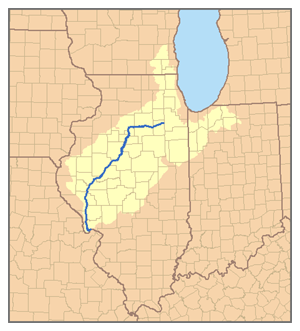


Course and main features
The river begins where the Des Plaines and Kankakee rivers converge and flows generally southwest to join the Mississippi near the lower Illinois River valley. Major tributaries include the Des Plaines, Kankakee, Vermilion, and Sangamon rivers. The corridor contains broad floodplains, extensive backwater lakes and sloughs, and engineered navigation channels maintained for barge traffic. For maps and detailed route information see river course.
Human modification and history
People have used the Illinois River valley for thousands of years. In the 19th century the construction of canals and locks, including the Illinois and Michigan Canal and later the Chicago Sanitary and Ship Canal, established a navigable link between the Great Lakes and the Mississippi watershed and helped spur urban and industrial growth in Chicago and river towns. The river’s channel and adjacent wetlands have been altered repeatedly for flood control, navigation, and sanitation, reshaping hydrology and connectivity; further historical context appears at regional history.
Ecology and environmental issues
The Illinois River supports a mosaic of habitats—marshes, backwater lakes, shallow floodplain lakes and riparian forests—that host fish, waterfowl and other wildlife. It has faced water quality pressures from agricultural runoff, urban and industrial discharges, and sedimentation. Invasive species, notably carp, have altered food webs and habitat structure. Numerous restoration and management initiatives seek to improve habitat, reduce nutrient loads and control invasive populations; examples are summarized at conservation efforts.
Uses and significance
- Commercial navigation: a major barge route linking lake and river systems via canal connections, supporting freight and industry.
- Recreation: fishing, boating, hunting and bird-watching in public access areas and wildlife refuges.
- Water supply and agriculture: supporting communities, industry and farmland across the basin.
Management of the river seeks to balance economic use with habitat protection and flood risk reduction. Planning, permits and river operations are coordinated among state agencies, federal corps and local stakeholders; see management resources for policy details.
Notable places and continuing issues
Communities such as LaSalle-Peru, Ottawa, Peoria and towns near the river mouth are closely linked to river commerce and recreation. The Illinois River’s large backwater complexes are internationally important for migratory birds and fisheries. Ongoing debates about lock operations, invasive species control and wetland restoration keep the river central to environmental science and regional planning; further materials and data are available at additional materials.
Questions and answers
Q: Where is the Illinois River located?
A: The Illinois River is located in the state of Illinois in the United States.
Q: What is the Illinois River?
A: The Illinois River is a river.
Q: How long is the Illinois River?
A: The length of the Illinois River is about 439 km.
Q: What is the importance of the Illinois River?
A: The Illinois River is an important tributary of the Mississippi River.
Q: Which state is home to the Illinois River?
A: The state of Illinois is home to the Illinois River.
Q: What kind of river is the Illinois River?
A: The Illinois River is a freshwater river.
Q: What is the total length of the Illinois River?
A: The Illinois River is about 439 km long.
Related articles
Author
AlegsaOnline.com Illinois River Leandro Alegsa
URL: https://en.alegsaonline.com/art/46730