
Ichthyosaurus — Early Jurassic marine reptile genus
Ichthyosaurus, an Early Jurassic ichthyosaur first recognized from Mary Anning’s finds, is a dolphin‑like marine reptile known from many European fossils and important to understanding marine reptile evolution.
Overview: Ichthyosaurus is an extinct genus of marine reptile that lived during the Early Jurassic, roughly 199–189 million years ago. It was among the first members of the order Ichthyosauria to be recognized and named, and its fossils helped establish early ideas about fossil reptiles. The initial complete skeletons were unearthed in the early 19th century by collectors such as Mary Anning, and these discoveries played a key role in the development of paleontology as a science.
Image gallery
10 Images


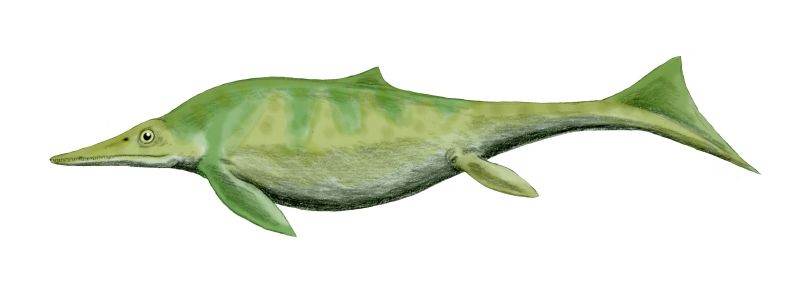


Physical characteristics
Ichthyosaurus had a streamlined, fishlike body showing strong convergence with modern dolphins and tunas: a long snout, a relatively stiff trunk, paddle-like flippers, and a crescent-shaped tail fluke adapted for powerful swimming. The skull bore numerous conical teeth suited to seizing slippery prey. Eyes were large and supported by robust sclerotic elements, indicating good vision in dim or deepwater conditions. Adult individuals of well-known species are commonly a few metres long; size and proportions vary among specimens and named species.
Anatomy and preservation
Skeletons of Ichthyosaurus commonly preserve well-articulated bones, and some specimens show impressions of skin and body outline in fine-grained marine deposits. Limb bones are shortened and broadened into paddles, and the vertebral column is adapted for a powerful side-to-side tail beat. The combination of skull shape, tooth form, and limb anatomy places Ichthyosaurus clearly within broader groups of ichthyosaurs, though the number and limits of species assigned to the genus have been revised repeatedly by researchers working with new material and modern methods.
Fossil record and discovery
The first essentially complete Ichthyosaurus skeletons were discovered along the southern English coast, particularly in Dorset on the Jurassic Coast, and many important specimens came from Early Jurassic marine deposits elsewhere in Europe. Notable continental finds originate from classic localities such as the Holzmaden region in southern Germany, where fine limestones and black shales preserve articulated skeletons in great detail. Quarry and shale horizons, often described as quarry deposits in the literature, have produced museum-quality fossils that inform anatomy, ontogeny and taphonomy.
Ecology and behavior
Ichthyosaurus was an active marine predator that fed on fish and cephalopods, as indicated by tooth morphology and fossil specimens that preserve stomach contents or associated prey remains. Its body plan suggests rapid, sustained swimming suited to pursuit predation; tail-driven propulsion and a stiffened trunk would have helped in maintaining speed and maneuverability. Reproductive biology in ichthyosaurs as a group shows evidence of live birth (viviparity), an important adaptation to a fully marine existence, and although specific embryonic finds are better known in related genera, such reproductive strategies are widely accepted for Ichthyosaurus and its relatives.
Taxonomy and scientific importance
Ichthyosaurus was one of the earliest fossil reptiles to be described and studied in detail, and it remains significant for understanding the early radiation of marine reptiles after the end-Triassic. Taxonomically the genus has been the subject of extensive revision: many species names have been proposed historically and later re-evaluated with improved comparative anatomy and stratigraphic context. The study of Ichthyosaurus has contributed to broader themes in paleontology such as evolutionary convergence between reptiles and marine mammals and the interpretation of fossil soft tissues and life habits.
- First discoveries: Early 1800s; notable collector Mary Anning.
- Geographic range of finds: Coastal England and continental Europe, including Holzmaden in southern Germany.
- Stratigraphic context: Known mainly from the Lower Jurassic (Early Jurassic) marine deposits.
- Group affiliation: Member of order Ichthyosauria and part of the broader assemblage of ichthyosaurs.
- Research resources: Extensive museum collections, field sites on the Jurassic Coast, and a long history of fossil study and anatomical analysis in the literature (marine reptile research, quarry reports).
Ichthyosaurus remains a central genus for understanding early marine reptile evolution, paleoecology and the history of paleontological discovery in Europe. Ongoing study of existing specimens and newly discovered material continues to refine knowledge of its anatomy, diversity and life history.
Questions and answers
Q: What is Ichthyosaurus?
A: Ichthyosaurus is an extinct marine reptile from the Lower Jurassic period.
Q: Who discovered the first complete skeleton of Ichthyosaurus?
A: The first complete skeleton of Ichthyosaurus was discovered by Mary Anning in the Dorset Jurassic Coast.
Q: Where were many more specimens of Ichthyosaurus found?
A: Many more specimens of Ichthyosaurus were found in Europe, especially from the limestone quarries in Holzmaden, southern Germany.
Q: When did Ichthyosaurus live?
A: Ichthyosaurus lived from about 199 to 189 million years ago (mya).
Q: What was the speed at which Ichthyosaurus could swim?
A: Ichthyosaurus could perhaps swim at speeds up to 25 mph (40 kph).
Q: Was Ichthyosaurus a land animal or a marine animal?
A: Ichthyosaurus was a marine reptile.
Q: What is the order to which Ichthyosaurus belongs?
A: Ichthyosaurus is the first member of the order Ichthyosauria to be discovered.
Related articles
Author
AlegsaOnline.com Ichthyosaurus — Early Jurassic marine reptile genus Leandro Alegsa
URL: https://en.alegsaonline.com/art/46477
Sources
- doi.org : 10.1002/spp2.1065
- wikidata.org : Q131565
- species.wikimedia.org : Ichthyosauridae
- fossilworks.org : 36558
- gbif.org : 4818047
- irmng.org : 1197374