
Ichthyosaur (extinct Mesozoic marine reptile)
Ichthyosaurs were dolphin-like marine reptiles of the Mesozoic, with streamlined bodies, large eyes and live birth. Their global fossils illustrate marine adaptation and convergent evolution with fishes and dolphins.
Overview
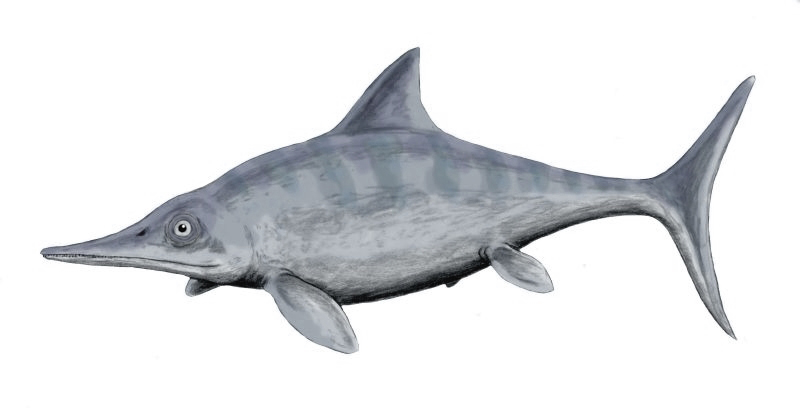
Ichthyosaurs were a diverse order of marine reptiles that inhabited the world’s oceans during much of the Mesozoic Era. First known from Early Triassic marine deposits, they persisted through the Jurassic and into the Cretaceous before disappearing from the fossil record. Over tens of millions of years many ichthyosaurs evolved a highly streamlined, fish- or dolphin-like body plan adapted for sustained swimming in open water. This external similarity to modern cetaceans and to pelagic fishes is a clear example of convergent evolution, where unrelated groups evolve similar solutions to comparable ecological challenges.
Image gallery
10 Images


Characteristics and anatomy
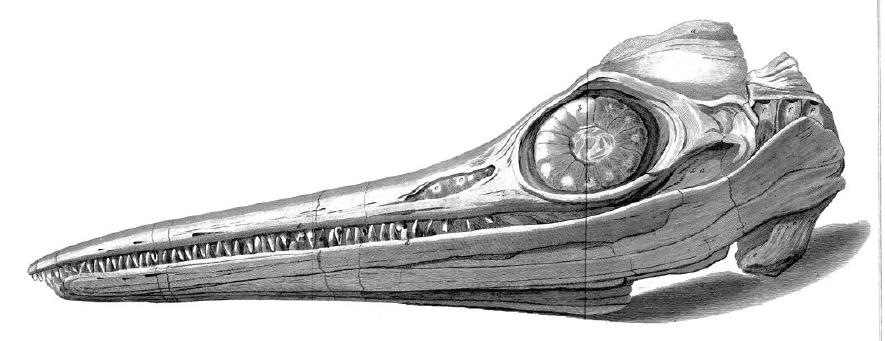
Typical ichthyosaur anatomy includes a long, narrow skull with numerous conical teeth suited to catching slippery prey, very large eye sockets often supported by sclerotic rings, and a vertebral column that bends downwards near the tail to support a powerful caudal fin. Forelimbs and hindlimbs were modified into flippers composed of many short, flattened bones. Some exceptionally preserved fossils show soft-tissue outlines, indicating a dorsal fin in many species and a crescent-shaped tail fluke. Body proportions varied considerably: early forms could be elongate and eel-like, while later species became more compact and tuna- or dolphin-like.
Size, locomotion and feeding
Body size among ichthyosaurs ranged from small species a metre or so long to very large forms. Locomotion relied primarily on lateral body and tail movements, with the deep tail fluke providing most of the thrust; flippers appear to have been used mainly for steering, stabilization and maneuvering. Teeth and preserved stomach contents indicate a diet of fish, cephalopods and other marine animals. The large eyes of many species suggest they hunted at depth or in low-light conditions. Bone structure and muscle attachments show adaptations for sustained, efficient swimming.
Reproduction and life history
Ichthyosaurs are among the earliest reptiles known to give live birth. Fossils preserving embryos inside adult bodies demonstrate viviparity, an important adaptation for fully pelagic life because returning to land to lay eggs would have been impractical. Growth patterns inferred from bone histology show a range of life histories, and some well-preserved specimens preserve soft tissues and stomach contents that illuminate behavior and ecology.
Evolution and fossil record
Ichthyosaurs are usually placed within the broader group Ichthyopterygia. Early and transitional Triassic genera such as Mixosaurus and Cymbospondylus document the change from more elongated, partially amphibious ancestors to the compact, fast-swimming forms of later periods. The fossil record is global, with important finds from Europe, North America, China and elsewhere. Classic early discoveries in Britain by fossil collectors such as Mary Anning played a key role in recognizing ichthyosaurs and advancing early paleontology.
Extinction and scientific significance
Ichthyosaurs declined in diversity during the Cretaceous and eventually became extinct before the end of that period. Causes remain a subject of research and likely include changing marine ecosystems, climatic shifts, and competition with other marine predators. Ichthyosaurs remain important in studies of marine adaptation because they illustrate how very different groups can converge on similar body plans, and because their fossils preserve rare details such as soft tissues and embryos that shed light on the evolution of reproductive strategies in reptiles.
Notable genera and examples
- Mixosaurus and other Triassic forms that retain transitional features.
- Cymbospondylus, a Triassic genus showing intermediate body shapes.
- Later streamlined genera with crescentic tails and reduced hindlimbs.
- Large-eyed ophthalmosaurids adapted for low-light hunting.
Discovery and museums
Important early finds were made by 19th-century collectors such as Mary Anning, and many classic specimens are held in national and regional museums where they continue to inform research and public education. For museum collections, specimen records and educational overviews consult the resources and institutional pages listed below.
Further reading and resources
- Resource 1
- Resource 2
- Resource 3
- Resource 4
- Resource 5
- Resource 6
- Resource 7
- Resource 8
- Resource 9
- Resource 10
- Resource 11
- Resource 12
- Resource 13
- Resource 14
- Resource 15
- Resource 16
- Resource 17
- Resource 18
- Resource 19
- Resource 20
Ichthyosaurs continue to be a focus of paleontological research because their well-preserved fossils illuminate how vertebrates adapt physically and reproductively to life in the open ocean, and because they provide a window onto the structure and dynamics of Mesozoic marine ecosystems.
Questions and answers
Q: What is an ichthyosaur?
A: An ichthyosaur is an extinct order of marine reptiles from the Mesozoic era.
Q: How are ichthyosaurs similar in shape to other animals?
A: Ichthyosaurs are similar in shape to dolphins and fast predatory fish like tuna, a phenomenon known as convergent evolution.
Q: When did ichthyosaurs first appear?
A: Ichthyosaurs first appeared during the earliest Triassic period.
Q: What was one of the first species of ichthyosaur to have a typical dolphin-like body shape?
A: Californosaurus was one of the first species of ichthyosaur to have a typical dolphin-like body shape.
Q: Who discovered the fossil which showed the typical form of an ichthyosaur?
A: Mary Anning and her brother Joseph discovered the fossil which showed the typical form of an ichthyosaur.
Q: Who was Mary Anning? A: Mary Anning was an early British fossil collector, dealer and paleontologist who made many important finds that can still be seen today at London's Natural History Museum.
Related articles
Author
AlegsaOnline.com Ichthyosaur (extinct Mesozoic marine reptile) Leandro Alegsa
URL: https://en.alegsaonline.com/art/46476
Sources
- www-alt.naturkundemuseum-bw.de : www-alt.naturkundemuseum-bw.de
- jstor.org : JSTOR
- plesiosaur.com : "Notice of the discovery of a new fossil animal, forming a link between the Ichthyosaurus and Crocodile, together – with general remarks on the osteology of the Ichthyosaurus"
- annualreviews.org : annualreviews.org/doi/abs/10.1146/annurev.earth.33.092203.122707
- genetologisch-onderzoek.nl : genetologisch-onderzoek.nl/index.php/42/beeldende-kunst/
- ucmp.berkeley.edu : ucmp.berkeley.edu/people/motani/ichthyo/eyes.html
- doi.org : 10.1007/s12052-009-0139-y
- worldcat.org : 1936-6426
- afp.google.com : World's biggest squid reveals 'beach ball' eyes
- plosone.org : plosone.org/article/info:doi/10.1371/journal.pone.0088640
- plosone.org : plosone.org/article/info:doi/10.1371/journal.pone.0084709