
Iapetus Ocean
An ancient ocean that existed between roughly 600 and 400 million years ago, separating the paleocontinents that later collided to form Euramerica/Laurussia and leaving a suture preserved in parts of Europe and North America.
Overview
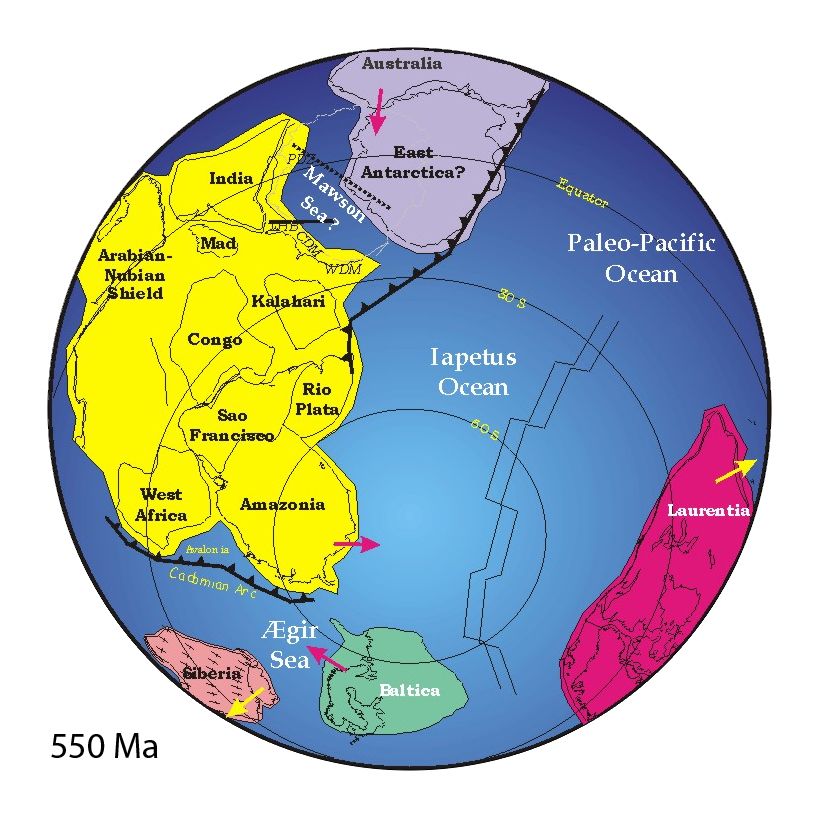
The Iapetus Ocean was an ocean basin that occupied a key position in late Precambrian and early Paleozoic Earth history, forming between continental blocks that later became parts of modern North America and northwestern Europe. It existed during the Neoproterozoic and into the early Palaeozoic eras, a span commonly framed as roughly 600–400 million years ago. The name evokes the mythic predecessor of the modern Atlantic Ocean, because the margins separated by Iapetus later became roughly opposite shores of the present-day Atlantic Ocean.
Image gallery
3 Images

Geography and main characteristics
At its greatest extent the Iapetus lay between three primary paleocontinents or microcontinents: Laurentia to the west, Baltica to the east, and several smaller terranes often grouped as Avalonia. These bodies lay in what was then the southern hemisphere and were separated by appreciable oceanic crust and island-arc systems. The basin hosted distinctive marine faunas and sedimentary environments and developed a complex margin architecture of continental shelves, deep basins, and volcanic arcs as subduction and rifting evolved through time.
Discovery and historical research
Geological awareness of this ancient ocean grew from nineteenth- and twentieth-century paleontological and stratigraphic work. Notably, Charles Doolittle Walcott and other early paleontologists observed consistent differences in early Paleozoic benthic fossils: for example, distinct groups of trilobites and other benthic taxa on opposite margins. These differences were later mapped as faunal provinces — sometimes called the "Pacific fauna" of Scotland and western Newfoundland versus the "Atlantic fauna" of the southern British Isles and eastern Newfoundland — implying long-lived separation by an oceanic barrier.
Tectonic evolution and closure
During the early Paleozoic the Iapetus underwent progressive closing as plate motions brought Laurentia, Baltica and Avalonia together. The terminal suturing produced a broad collisional belt and a composite continental mass variously called Laurussia, the Old Red Sandstone continent, or more commonly Euramerica. This cycle of ocean opening and closure, now interpreted in the context of plate tectonics, illustrates how earlier oceans are consumed by subduction and replaced by mountain belts. The closure of Iapetus occurred well before the assembly of Pangaea, but it set the configuration of continents that would later participate in global-scale collisions.
Geological evidence and modern significance
Evidence for the Iapetus Ocean and its closure is preserved in rock fabrics, fossil assemblages and suture zones that can be traced across continents. Field and geophysical data identify belts of intensely deformed rocks and ophiolitic fragments marking where oceanic lithosphere was subducted and soldered to continental margins. Typical lines of evidence include:
- Contrasting fossil assemblages and biogeographic provinces across former margins.
- High-pressure metamorphism and orogenic (mountain-building) structures along suture zones.
- Remnants of oceanic crust, such as ophiolites and serpentinized ultramafic rocks, preserved in collision belts.
These signatures are widely studied because they illuminate broader principles of continental growth, terrane accretion and the paleogeographic evolution preceding later supercontinents.
Notable distinctions and examples
The Iapetus story is particularly useful as a case study in how paleontology and tectonics combine to reconstruct ancient oceans. The faunal contrasts first noted in the field led to mapping the so-called Iapetus realm and, ultimately, to recognition of a specific suture — the line along which the ocean once closed — preserved in places across the British Isles and eastern North America. Modern researchers continue to refine its timing, the sequence of terrane collisions and the details of sedimentary and volcanic records. The Iapetus exemplifies how an ocean can vanish from the globe's surface yet leave a clear and testable imprint in the rock record.
For further reading on time intervals, faunal provinces, and tectonic interpretations see specialized summaries on the Neoproterozoic, the Palaeozoic, and resources describing the role of plate tectonics in reconstructing vanished oceans.
Key historical and regional references discuss the early observations by Walcott, examples from Scotland and western Newfoundland, and compilations of the continental assembly sometimes called Laurussia or the Old Red Sandstone continent. The Iapetus remains a central example in studies of how pre-Pangaea oceans formed and disappeared.
Additional topics and regional guides can be found through geological surveys and academic syntheses about the Iapetus realm and its preserved sutures and faunal divisions.
Questions and answers
Q: What eras did the Iapetus Ocean exist in?
A: The Iapetus Ocean existed in the Neoproterozoic and Palaeozoic eras (between 600 and 400 million years ago).
Q: What is the name of the large continent that formed when three continents joined together?
A: The large continent has been given various names, such as Laurussia or the Old Red Sandstone continent. Probably the best name is Euramerica, because basically it was American and Europe stuck together.
Q: What are two different names for the fauna found on either side of the Iapetus Suture?
A: The so called "Pacific fauna" of Laurentia, as found in Scotland and western Newfoundland, was quite different from those of Baltica, often called the "Atlantic fauna".
Q: How did geologists come to understand that an ocean had preceded Pangaea?
A: With the development of plate tectonics in the 1960s geologists concluded that an Atlantic Ocean must have had a precursor before Pangaea's time. That ocean had closed as three continents joined, producing what is now known as Iapetus Suture.
Q: Who first noticed differences between early Paleozoic benthic trilobites on either side of what would later be called Iapetus Suture?
A: At the start of 19th century, American paleontologist Charles Doolittle Walcott noticed differences between early Paleozoic benthic trilobites on either side of what would later be called Iapetus Suture.
Q: Where are some places where Pacific Fauna can be found?
A: Pacific Fauna can be found in Scotland and western Newfoundland.
Q: Where are some places where Atlantic Fauna can be found?
A: Atlantic Fauna can be found in southern parts of British Isles and eastern Newfoundland.
Related articles
Author
AlegsaOnline.com Iapetus Ocean Leandro Alegsa
URL: https://en.alegsaonline.com/art/46350