
Hypsilophodon: a small, fast-running Early Cretaceous ornithopod
Hypsilophodon was a small bipedal herbivorous dinosaur from the Early Cretaceous of Europe, notable for its speed, numerous fossils, and historical role in understanding small ornithopods.
Overview
Hypsilophodon was a small, agile dinosaur that lived in the Early Cretaceous, roughly 125 million years ago. About 2.3 metres long from nose to tail and with a mass roughly comparable to an adult human, it is one of the better-known small ornithopods. Many fairly complete skeletons have been recovered, especially from deposits on the Isle of Wight in what is now southern England.
Image gallery
10 Images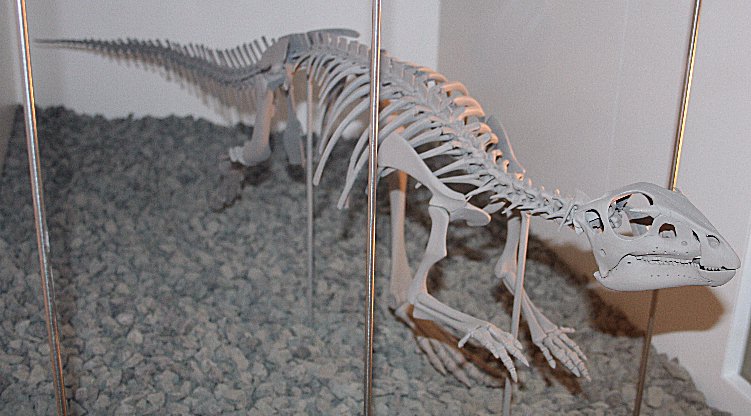


Physical characteristics
Hypsilophodon was bipedal with long hind limbs and a long, stiffened tail used for balance. The skull was relatively small with a beak and rows of cheek teeth adapted for cropping and processing plant material, indicating a primarily plant-based or herbivorous diet. Its body plan reflects an animal built for speed and quick maneuvering rather than strength or heavy protection.
Discovery and classification
First described in the 19th century from multiple fossils, Hypsilophodon was originally compared to larger ornithopods and at one time was thought to represent juvenile forms of other genera such as Iguanodon. Subsequent study established it as a distinct genus. Historically placed in a group called Hypsilophodontidae, modern analyses treat it as a basal ornithopod whose exact relationships are debated; it remains an important reference point for small herbivorous dinosaurs (species level taxonomy has been revised over time).
Behavior and ecology
Its anatomy suggests Hypsilophodon was a fast runner that fed on low-growing vegetation. The tail and limb proportions indicate active pursuit of food and escape from predators rather than climbing. Multiple individuals found together have led some researchers to infer possible social or group behavior, though direct evidence for herding is limited.
Significance and notable facts
- Numerous, well-preserved skeletons make Hypsilophodon one of the most familiar small ornithopods from Europe.
- It played a historical role in early paleontology by helping define small bipedal herbivores as a distinct ecological type.
- The genus illustrates how interpretations of dinosaur lifestyle and relationships can change as new fossils and methods appear.
For more detailed information on anatomy, fossil sites, and current classification debates see specialized sources and collections (plant diet, herbivore studies, dinosaur research, geological dating, time scales, comparative genera, taxonomic revisions).
Questions and answers
Q: What kind of dinosaur was Hypsilophodon?
A: Hypsilophodon was a small, fast-running, plant-eating dinosaur.
Q: When did Hypsilophodon live?
A: Hypsilophodon lived 125 million years ago.
Q: How long was Hypsilophodon?
A: Hypsilophodon was 2.3 metres long (7/8 feet), including tail.
Q: How much did Hypsilophodon weigh?
A: Hypsilophodon weighed about the same as a man.
Q: What was the initial hypothesis about Hypsilophodon?
A: Initially, Hypsilophodon was thought to be a young Iguanodon which could climb trees.
Q: What was later realized about Hypsilophodon?
A: Later, it was realized that Hypsilophodon was a different species, and was a running dinosaur, not adapted for climbing.
Q: What did Hypsilophodon eat?
A: Hypsilophodon was a plant-eating dinosaur.
Related articles
Author
AlegsaOnline.com Hypsilophodon: a small, fast-running Early Cretaceous ornithopod Leandro Alegsa
URL: https://en.alegsaonline.com/art/46219
Sources
- ingentaconnect.com : "A new basal ornithopod dinosaur from the Upper Cretaceous of South Korea"
- doi.org : 10.1127/0077-7749/2010/0102