
Hypersonic speed
Speeds greater than about five times the speed of sound. Hypersonic flight produces extreme aerodynamic heating and chemical changes in air, creating special engineering and scientific challenges.
Overview
In aerodynamics the term hypersonic designates flight at velocities greatly exceeding the local speed of sound. Conventionally, the threshold is taken as Mach 5 or higher; the Mach number itself is a nondimensional ratio often written as Mach. Actual numeric speed varies with atmospheric conditions, so a Mach value is the meaningful measure rather than a single fixed metres‑per‑second figure. Hypersonic regimes differ qualitatively from the supersonic band encountered by many aircraft, producing new physical effects that dominate vehicle behavior.
Image gallery
2 Images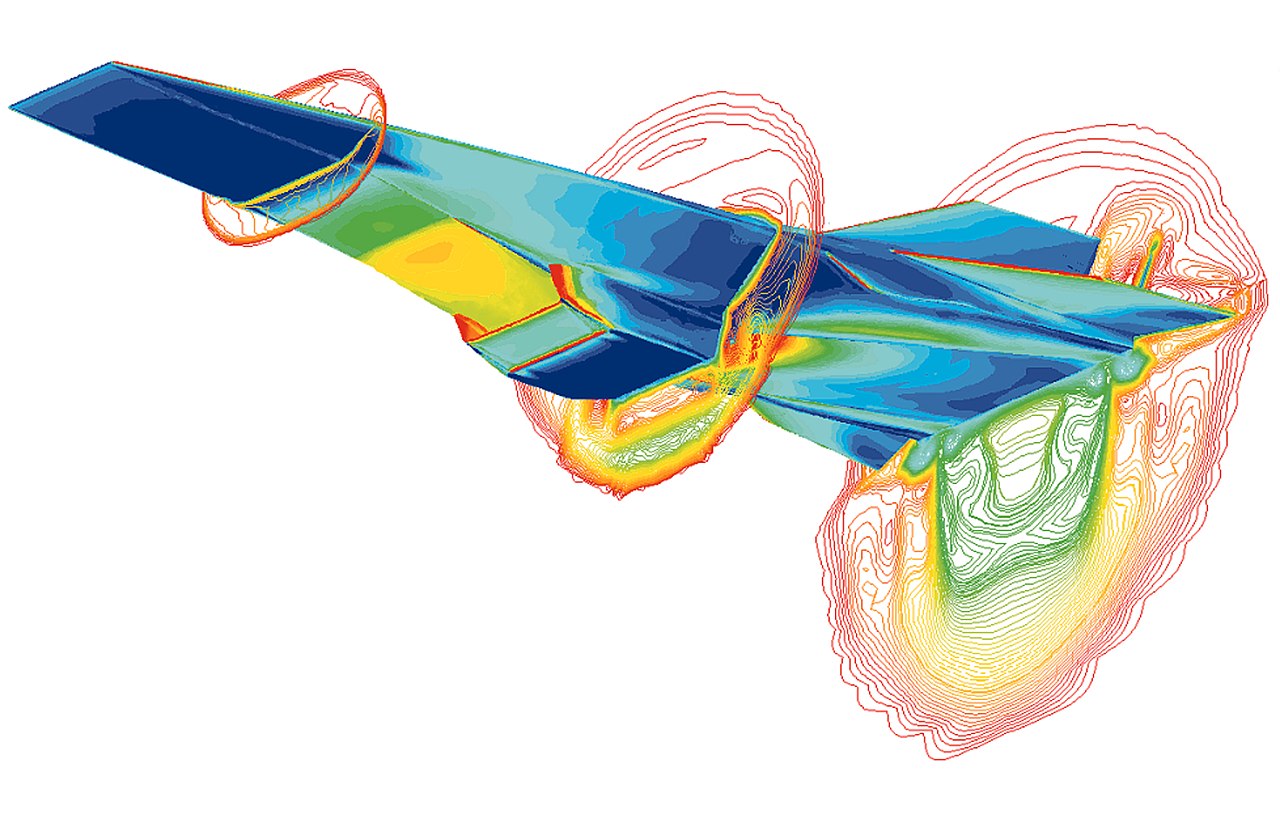
Physical characteristics
At hypersonic velocity, the airflow immediately ahead of a vehicle is compressed into a very strong shock and a thin, high‑temperature layer. Temperatures in that shock layer can be sufficient to dissociate molecular oxygen and nitrogen and to partially ionize the gas, changing chemical composition and heat transfer rates. Boundary layers near surfaces tend to transition to turbulence and grow rapidly, increasing convective heating. Aerodynamic forces scale differently than at lower speeds, so lift, drag and stability must be treated with high‑temperature gas dynamics and coupled thermal‑structural analysis.
Engineering challenges and technologies
Designing hypersonic vehicles requires specialized materials, thermal protection systems and propulsion concepts. Key concerns include:
- Managing extreme surface heating with heat‑resistant alloys, ceramics or ablative coatings;
- Controlling airflow for air‑breathing engines such as ramjets and scramjets, which operate only within particular speed windows;
- Maintaining stability and control as conventional control surfaces lose effectiveness at high dynamic pressures;
- Integrating lightweight structures that tolerate temperature gradients and vibrational loads.
History and development
Scientific interest in hypersonics grew in the mid‑20th century as rocketry and high‑altitude research advanced. Early theoretical work by aerodynamicists established scaling laws for high Mach numbers, and experimental programs explored reentry vehicles and flight testbeds. Notable milestones include rocket‑powered and scramjet demonstrators and the routine hypersonic return of spacecraft through planetary atmospheres. Research continues in national laboratories, universities and industry to improve engine concepts, materials and predictive simulation tools.
Applications and significance
Hypersonic speeds are important for several domains: atmospheric reentry of spacecraft and probes, rapid global strike and missile systems, experimental high‑speed transport concepts, and scientific vehicles used to study high‑enthalpy aerothermodynamics. Compared with supersonic flight, hypersonic regimes demand different design philosophies and testing methods; they sit alongside transonic and supersonic regimes as separate operational ranges with their own constraints. Ongoing advances aim to make hypersonic travel safer, more reliable and feasible for a broader set of missions.
Notable distinctions
Practitioners sometimes subdivide the high‑speed continuum: transonic (around Mach 0.8–1.2), supersonic (above that to about Mach 5), hypersonic (Mach 5 and above), and sometimes 'high' or 'deep' hypersonic for much higher Mach numbers. Also important is altitude: at very high altitude the air becomes rarefied and continuum assumptions break down, requiring different analysis methods. These distinctions guide testing, materials selection and mission planning across the broad field of high‑speed flight.
Questions and answers
Q: What is considered hypersonic speed in aerodynamics?
A: In aerodynamics, any speed faster than Mach 5 (1,715 m/s at sea level) is considered hypersonic speed.
Q: How is hypersonic speed different from supersonic speed?
A: Hypersonic speed is different from supersonic speed in that air and aircraft act even stranger at hypersonic speeds than at supersonic speeds.
Q: Why is it important to distinguish between hypersonic and supersonic speeds?
A: It is important to distinguish between hypersonic and supersonic speeds because the behavior of air and aircraft is significantly different at these speeds.
Q: What is the speed of sound at sea level?
A: The speed of sound at sea level is 1,715 m/s.
Q: Can you give an example of a hypersonic speed?
A: Any speed faster than Mach 5, such as Mach 6 or Mach 7, is an example of hypersonic speed.
Q: Does the text mention any other important factors at hypersonic speeds?
A: The text only mentions that air and aircraft act very strangely at hypersonic speeds.
Q: What is aerodynamics?
A: Aerodynamics is the study of the motion of air and other gases and how they interact with objects in motion, such as aircraft.
Related articles
Author
AlegsaOnline.com Hypersonic speed Leandro Alegsa
URL: https://en.alegsaonline.com/art/46177