
Hyderabad, India: History, Culture, and Modern Role
Overview of Hyderabad — capital of Telangana — covering its founding, historic rulers, culture, economy, landmarks and contemporary significance.

Image gallery
10 Images




Historical origins and rulers
The modern city of Hyderabad was founded in 1591 by Muhammad Quli Qutb Shah on the banks of the Musi River. It later came under the influence of Mughal authority, and local governance passed to officials whose titles and alliances reflected broader imperial politics — see references to the Mughal period and the role of provincial governors such as the governor who established regional autonomy. From the early 18th century the Asaf Jahi family established the line commonly known as the Asaf Jahi dynasty, or the Nizams, who shaped Hyderabad’s institutions and culture for more than two centuries. The last Nizam, Osman Ali Khan, retained an influential role until the mid-20th century.
Culture, identity and economy
Hyderabad is widely associated with its historic jewelry trade, earning the sobriquet "City of Pearls", and it maintains a reputation for artisanship in pearls and traditional textiles. The city’s cuisine — particularly Hyderabadi biryani — and its Urdu-Telugu cultural fusion are notable features of daily life. In the contemporary era, Hyderabad has developed large technology and pharmaceutical sectors that coexist with older crafts and wholesale markets. The local film industry, historically centered on Urdu- and Telugu-language production, includes large studios such as Ramoji Film City, a complex spread over more than 2,000 acres.
Landmarks and urban character
Hyderabad’s skyline and public spaces reflect multiple eras. Prominent historic sites and visitor attractions include:
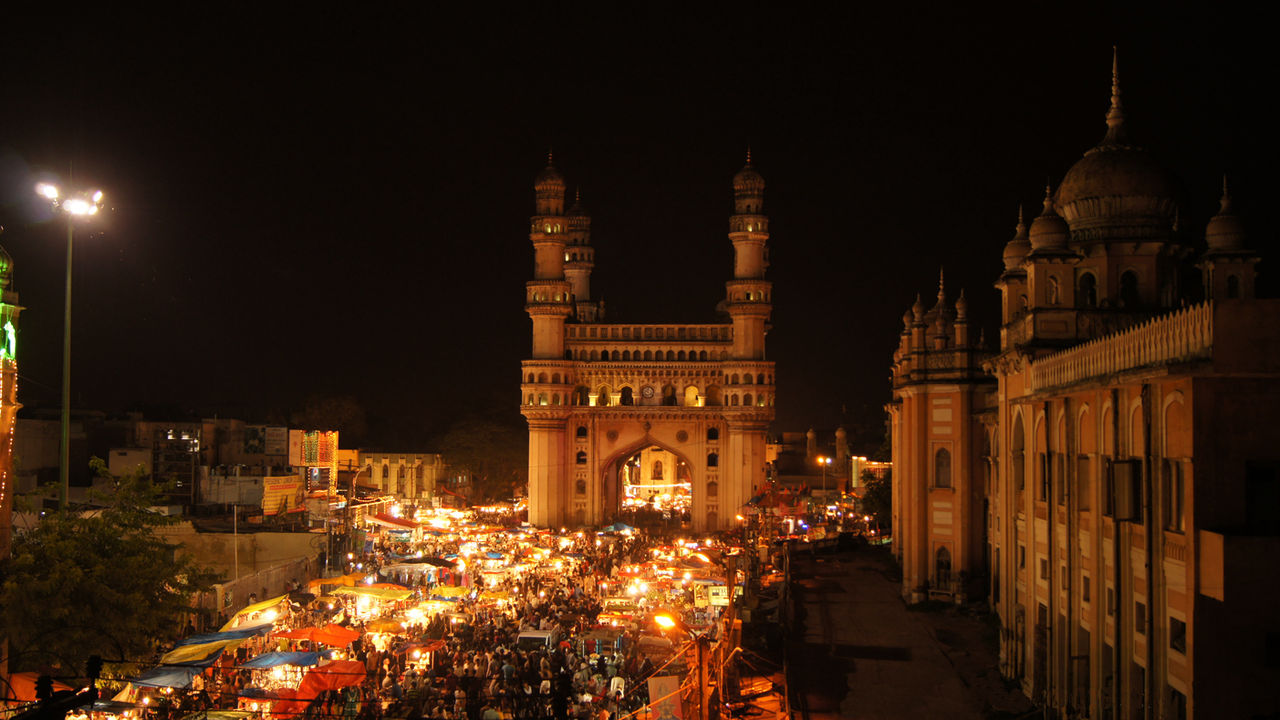
- Charminar — the iconic 16th-century monument and market area.
- Golconda Fort and other defensive structures from pre-modern rulers.
- Palaces, mosques and public lakes that recall Nizam patronage and urban planning.
Alongside these, planned business districts and technology parks have changed the city’s economic footprint, drawing national and international investment while prompting debates about infrastructure, housing and heritage conservation.
Notable facts and distinctions
Hyderabad’s dual identity — a historical capital with an evolving role as an information-technology and service hub — is one of its most frequently remarked features. It hosts large media and production facilities, continues to be associated with historic trading crafts, and functions as a regional center for education and research. The people of Hyderabad are commonly referred to as Hyderabadis, and the city remains a focal point for festivals, culinary traditions and linguistic diversity in southern India.
For further reading on the city’s civic structures and demographic profile consult official or scholarly sources that compile census and urban-planning material, and see specialized pages for cultural and tourist information such as local governance guides and historical summaries.
Questions and answers
Q: What is the population of Hyderabad?
A: The population of Hyderabad is over 12.2 million.
Q: What is Hyderabad known as?
A: Hyderabad is known as the city of pearls or city of Nizams.
Q: Who founded Hyderabad?
A: Hyderabad was founded in 1591 AD by Sultan Muhammad Quli Qutb Shah.
Q: Who ruled after the founder of Hyderabad?
A: After the founder, it was ruled by the Mughal governor Nizam Asaf Jah I who then founded the Asaf Jahi Dynasty (also known as The Nizams).
Q: How many Nizams were there in total?
A: There were a total of 10 Nizams with the last one being Osman Ali Khan, Asaf Jah VII.
Q: What is Ramoji Film City?
A: Ramoji Film City is a movie studio complex that spans an area of over 2,000 acres (8.1 km2; 3.1 sq mi).
Q: What is Deccanwood?
A: Deccanwood (also known as The Hyderabad Deccan Urdu film industry) refers to the movie industry based in and around Hyderabad.
Related articles
Author
AlegsaOnline.com Hyderabad, India: History, Culture, and Modern Role Leandro Alegsa
URL: https://en.alegsaonline.com/art/46065
Sources
- indiaonlinepages.com : "Hyderabad Population 2019- Current Population of Hyderabad City"
- censusindia.gov.in : censusindia.gov.in/2011-prov-results/paper2/data_files/India2/Table_2_PR_Cities_1Lakh_and…
- news.com.au : High times in Hyderabad
- indianexpress.com : "Satyam: true lies"
- hyderabadplanet.com : "Asaf Jahi Dynasty - Family of the Nizams of Hyderabad (1724 - 1948)"
- ramojifilmcity.com : "Ramoji Film City - India's Only Thematic Holiday Destination"
- aljazeera.com : "Deccanwood: An Indian film industry taking on Bollywood"
- timesofindia.indiatimes.com : "Rare discovery pushes back Iron Age in India | Hyderabad News - Times of India"
- economictimes.indiatimes.com : "Hyderabad's history could date back to 500 BC"
- timesofindia.indiatimes.com : "Charminar's location still has historians stumped"
- hinduonnet.com : "On the banks of the Godavari"
- doi.org : 10.1017/S0026749X00004996
- hindu.com : "The exit of an infamous ruler"
- hinduonnet.com : "A tale of two states"
- hyderabadonline.in : History