
Hyaenodontidae
Extinct family of creodont mammals notable for blade-like shearing teeth; diverse Paleogene–Neogene predators distributed across Africa, Eurasia and North America.
The Hyaenodontidae were a widespread family of extinct carnivorous mammals traditionally placed in the order Creodonta. Often described as "hyena-toothed" in reference to their distinctive dentition, the group includes several dozen genera that occupied top predatory roles in many ecosystems from the late Paleocene through the Miocene. Although they superficially resembled some modern meat-eaters, hyaenodonts are not direct ancestors of living carnivorans and represent an independent early experiment in mammalian carnivory.
Image gallery
4 Images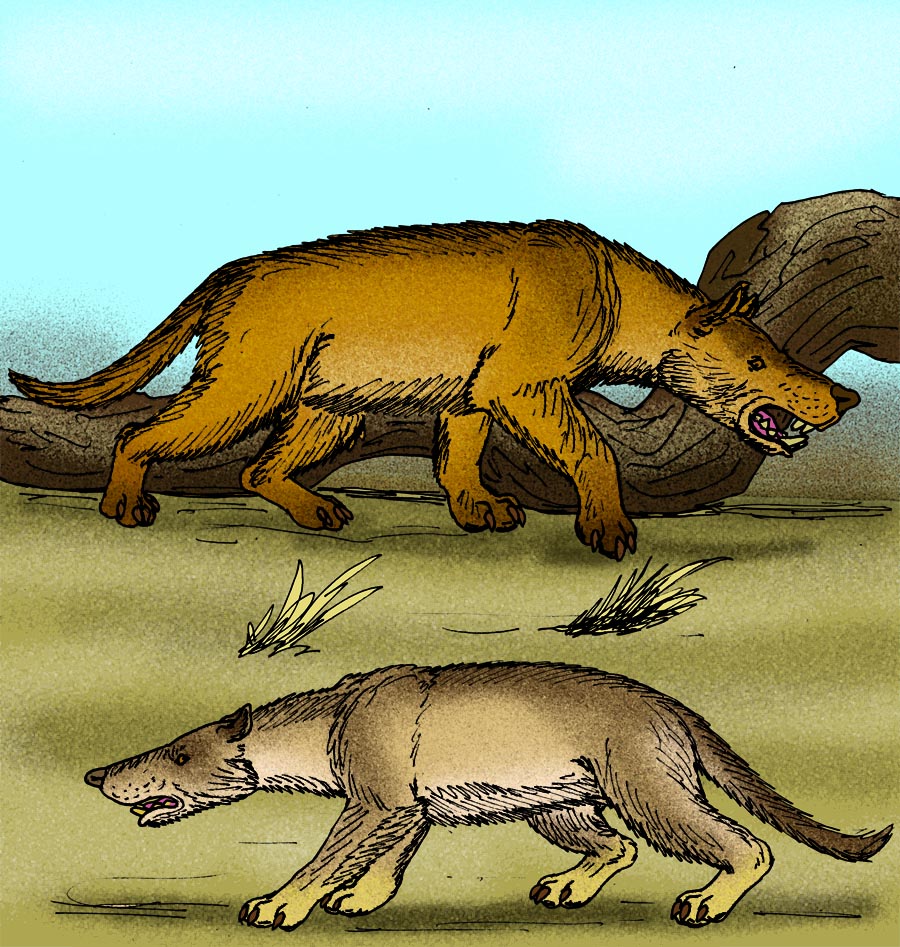


Key characteristics
Hyaenodontids are best known for their specialized slicing teeth. Unlike modern carnivores, whose principal shearing teeth are a fixed upper premolar and lower molar pair, hyaenodonts evolved a series of blade-like molars and premolars adapted for cutting flesh. Skull shapes tend to be elongated with strong jaws, and body size varied greatly across the family — from small, fox-sized forms to much larger species that served as apex predators.
- Dental adaptations: multiple sharp carnassial-like teeth suited for shearing rather than crushing.
- Skull and jaw: long rostra and powerful bite muscles in many taxa.
- Postcranial diversity: limb proportions range from cursorial (running) to more generalized, suggesting varied hunting strategies.
History, distribution and ecology
Hyaenodonts first appear in the fossil record during the Paleocene and diversified through the Eocene, occupying a variety of terrestrial niches. Fossils have been recovered from North America, Europe, Asia and Africa, indicating a broad geographic range. They were important mammalian predators in Paleogene communities, preying on contemporaneous herbivores and smaller vertebrates. Over time their dominance declined as modern carnivorans expanded and climates and habitats changed.
Notable genera and paleobiological significance
The genus Hyaenodon is among the best-known members and illustrates the group's typical anatomy and ecological role. Other genera show variations that illuminate how early mammals explored carnivorous lifestyles. Paleontologists study hyaenodonts to understand convergent evolution of meat-eating adaptations and the dynamics of predator communities after the extinction of the non-avian dinosaurs.
Extinction and legacy
By the end of the Miocene, most hyaenodont lineages had disappeared. Causes likely include competition with emerging carnivorans, changing prey communities and environmental shifts. Their well-preserved fossil record continues to provide important insights into early Cenozoic ecosystems and the multiple evolutionary pathways that lead to specialized meat-eating dentitions. For more on terminology and name origin see the etymology and naming discussions related to Hyaenodontidae, and for broader context on creodonts consult overview sources on Creodonta.
Researchers seeking taxonomic details or regional fossil lists may consult specialist literature and databases that catalog the many genera and species attributed to this family, including comparative studies that contrast hyaenodonts with their creodont relatives and with early carnivorans. For introductory resources and distribution summaries see general references on Paleogene predators and timeline treatments covering the Miocene.
Questions and answers
Q: What is the Hyaenodontidae?
A: The Hyaenodontidae is a family of the extinct order Creodonta.
Q: What does the name "Hyaena teeth" represent?
A: The name "Hyaena teeth" represents the teeth of the Hyaenodontids.
Q: What kind of animals were the Hyaenodonts?
A: The Hyaenodonts were important mammalian predators.
Q: When did the Hyaenodonts arise?
A: The Hyaenodonts arose during the late Paleocene.
Q: Till when did the Hyaenodonts persist?
A: The Hyaenodonts persisted well into the Miocene.
Q: Which family was less widespread and successful than the Hyaenodontidae?
A: The oxyaenids were less widespread and successful than the Hyaenodontidae.
Q: How many genera does the Hyaenodontidae contain?
A: The Hyaenodontidae contains several dozen genera.
Related articles
Author
AlegsaOnline.com Hyaenodontidae Leandro Alegsa
URL: https://en.alegsaonline.com/art/46040
Sources
- onlinelibrary.wiley.com : onlinelibrary.wiley.com/doi/10.1111/1475-4983.00189/abstract;jsessionid=769F24911E3FEFA6E…