
Hurricane Nora (1997) — Pacific hurricane that impacted Baja California and the U.S. Southwest
Comprehensive overview of Hurricane Nora (1997): its development, track, landfalls on the Baja California Peninsula, impacts across Mexico and the U.S. Southwest, rainfall and aftermath.
Overview
Hurricane Nora was a late‑season eastern Pacific tropical cyclone in September 1997 that produced heavy rains, coastal storm surge and damaging winds across the Baja California Peninsula and into the southwestern United States. Originating from a tropical wave that had earlier contributed to Atlantic development, Nora intensified to hurricane strength and made multiple landfalls on Baja California Sur and Baja California before moving inland over the border region. Although the cyclone weakened as it crossed the peninsula and the desert, its remnants produced widespread flooding, wind damage and agricultural losses well into the interior of the American West and the intermountain states. The storm is notable for bringing a rare tropical cyclone impact to the Continental United States and for producing some rainfall totals that equaled or exceeded local annual averages in desert and mountain locations.
Image gallery
8 Images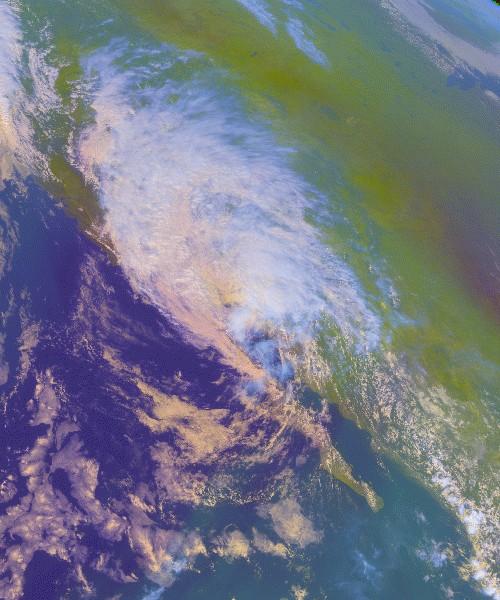



Meteorological history and characteristics
Nora formed from a tropical wave that tracked westward from the Atlantic into the eastern Pacific and organized into Tropical Depression Sixteen‑E on September 16, 1997. The system quickly strengthened into Tropical Storm Nora later that day, and favorable environmental conditions—warm sea surface temperatures and low vertical wind shear—allowed further intensification. By September 18 Nora had reached hurricane strength while moving generally northwest. The cyclone's intensity fluctuated in response to ocean temperatures and interactions with other nearby systems: at times it weakened while passing over cooler upwelled waters, and at other times it reintensified when moving over warmer patches. At its peak Nora attained major hurricane characteristics with central pressures and winds consistent with a powerful tropical cyclone, but interaction with the wake of Hurricane Linda and with cooler coastal waters limited sustained peak intensity. A mid‑latitude trough later turned Nora toward the northeast, accelerating its forward motion and steering it toward the Baja California Peninsula and the U.S. Southwest.
Track and landfalls
Nora followed a somewhat unusual track for eastern Pacific storms by moving close to the western coast of the Baja California Peninsula and making more than one landfall. After initial organization offshore, Nora first approached the southern peninsula and made landfall near Bahía Tortugas in Baja California Sur as a hurricane. While part of the circulation moved inland, convection over the narrow Gulf of California allowed the sector of the storm adjacent to the gulf to maintain or regain strength. The hurricane then made a second landfall further north along the peninsula, near the area south of San Fernando in Baja California, still at hurricane intensity. A strengthening trough to the north increased Nora's forward speed to roughly 30 mph (50 km/h), carrying the system and its moisture toward the continental border region and into the southwestern United States as a tropical storm. Nora was one of the few tropical cyclones on record to enter the continental U.S. while retaining at least tropical storm characteristics before decaying to a depression over inland deserts.
Impacts in Mexico
In northwestern Mexico, especially on the Baja California Peninsula and along the northern Gulf of California coast, Nora produced destructive storm surge, large waves, strong winds and torrential rainfall. Coastal towns reported wave damage that destroyed or severely damaged dozens of homes, and wind gusts uprooted trees and stripped roofs from structures in localities such as Puerto Peñasco. Hundreds of residents were rendered homeless in some communities; for example, San Felipe and nearby areas experienced significant housing losses. Electricity and communications were disrupted by downed lines and poles. The storm was credited with at least two direct fatalities in Mexico—one person fatally injured by a fallen power line in the Mexicali area and another who drowned while scuba diving in turbulent currents. Agricultural sectors along the coast and in low‑lying valleys also suffered losses from saltwater intrusion, inundation and wind damage to orchards and groves.
Impacts in the United States: flooding, wind and agriculture
After crossing the border region as a tropical storm and then degenerating to a depression, Nora’s remnant moisture spread northeastward and produced some of the heaviest rains ever recorded in localized desert and mountain sites in the U.S. Southwest. Western Arizona recorded dramatic totals, with some mountain sites receiving over 11 inches (about 300 mm) of rain, causing flash floods that inundated streets and breached small earthen dams. In the Yuma area tens of thousands of residents lost power as winds downed transmission lines and utility poles; dozens of telephone and distribution poles were reported down in places like Seeley. Flooding and standing water occurred in low‑lying urban centers such as San Diego, Indio, El Centro and Palm Springs, leading to road closures and traffic disruptions. The California Highway Patrol later associated several traffic fatalities with hazardous conditions caused by the storm. Cropping and citrus orchards experienced heavy losses—estimates cited preliminary agricultural damage in the region on the order of hundreds of millions of dollars, with tens of millions specifically attributed to lemon tree damage. Farther inland, tornadoes were not a prominent feature, but an elevated remnant circulation produced near‑hurricane‑force gusts on occasion in elevated forested areas, toppling trees and damaging a few structures in the interior West.
Rainfall, hydrology and secondary effects
Nora’s chief hazard for much of the affected territory was rainfall in landscapes that are poorly suited to rapid runoff. The desert soils, hardpacked ground and steep mountain slopes funneled precipitation into flash floods that moved through washes and river channels, catching some communities off guard despite advance warnings. In Arizona, the Narrows Dam near Phoenix reportedly failed after intense runoff, and the Harquahala Mountains registered one of the highest storm totals. In Mexico the northern Gulf coast experienced pockets of rainfall exceeding 10 inches, compounding coastal erosion and inundation. Floodwaters contaminated drinking supplies in some communities and increased the risk of waterborne disease and sanitation problems. The downed power lines and uprooted trees complicated recovery efforts, delaying restoration of utilities and access to isolated neighborhoods.
Emergency response, economic toll and legacy
State and federal agencies in the United States mobilized emergency responses as Nora approached, with governors declaring emergency centers and deploying National Guard units and supplies such as drinking water and generators to hard‑hit border communities. Local authorities filled sandbags and issued flash flood watches and warnings. Economic assessments after the event placed insured and uninsured losses across agriculture, residential damage and public infrastructure in the range of many tens to several hundreds of millions of dollars (1997 USD), with significant losses in citrus and other specialty crops. Despite the severity of impacts in parts of Mexico and the United States, the World Meteorological Organization did not retire the name Nora at the following meeting in spring 1998, and the name remained in rotation for later eastern Pacific seasons. The storm is frequently cited in regional hazard studies as an example of how tropical cyclones can produce severe inland flooding far from their points of landfall when they interact with mid‑latitude troughs and local topography.
Notable timeline and aftermath
- Formation from an Atlantic‑seeded tropical wave and classification as Tropical Depression Sixteen‑E on September 16, 1997.
- Intensification to hurricane strength offshore on September 18, with fluctuations due to sea surface temperatures and interaction with Hurricane Linda’s wake.
- Landfalls on the Baja California Peninsula near Bahía Tortugas and later south of San Fernando while still at hurricane intensity.
- Entry into the United States as a tropical storm near the California–Arizona border on September 25, then rapid weakening to a depression and dissipation by September 26.
- Broad impacts ranging from coastal storm surge and wind damage in Mexico to flash flooding, power outages and agricultural losses across parts of California, Arizona, Nevada and Utah.
Further reading and resources
- Continental United States report and summaries
- Tropical depression and genesis analysis
- Baja California regional impacts
- Yuma local emergency operations
- Gale‑force winds and marine observations
- Dissipation and final advisory
- Mexicali incident reports
- Southern California urban flooding accounts
- Utah forest and wind damage reports
- Agricultural damage estimates (lemon trees)
- Bahía Tortugas landfall area details
- Gulf of California marine effects
- San Fernando landfall vicinity
- Synoptic trough and steering influences
- California state situational summaries
- Arizona state impact summaries
- National Weather Service assessments and radar analyses
- Colorado flood watches and inland effects
- Idaho remnant precipitation observations
- Wyoming remnants and hydrologic notes
- Arizona gubernatorial emergency actions
- National Guard deployments and support
- Logistics: water and generator shipments
- Flash flood watch and warning archives
- Nevada regional advisories
- California Highway Patrol traffic fatality analysis
- Economic and insured loss studies (1997 USD)
- Phoenix metropolitan area flood effects
- Los Angeles area power outages and impacts
- World Meteorological Organization naming decisions
- Subsequent uses of the name Nora in the Pacific list
Questions and answers
Q: What was the first hurricane to cause a significant danger to the Continental United States since 1976?
A: Hurricane Nora was the first hurricane to cause a significant danger to the Continental United States since Kathleen in 1976.
Q: When did Tropical Depression 16-E form?
A: Tropical Depression 16-E formed on September 16.
Q: How many people were killed by Hurricane Nora?
A: Two people were killed by Hurricane Nora, one in Mexicali and one while scuba diving.
Q: How much damage did Hurricane Nora cause in the United States?
A: Total damages from Hurricane Nora in the United States were estimated at "several hundred million dollars", as well as 40 million dollars to lemon trees. Thousands of people lost power and there was flooding reported in several cities.
Q: Where did Hurricane Nora make its second landfall?
A: Hurricane Nora made its second landfall about 60 miles south-southeast of San Fernando, Baja California.
Q: What caused flooding in western Arizona?
A: Rainfall from the storm caused flash floods in western Arizona, with 11.97 inches (304 mm) recorded at Harquahala Mountains being the largest total rainfall amount recorded from this storm.
Q: Was the name 'Nora' retired after this storm?
A:No, despite causing extensive damage, The World Meteorological Organization did not retire the name 'Nora' during its meeting in 1998 so it was used again for 2003 Pacific hurricane season and is on list of names for 2009 season too.
Related articles
Author
AlegsaOnline.com Hurricane Nora (1997) — Pacific hurricane that impacted Baja California and the U.S. Southwest Leandro Alegsa
URL: https://en.alegsaonline.com/art/45961
Sources
- smn.cna.gob.mx : "Huracán Nora"
- ams.allenpress.com : "An Analysis of the Landfall of Hurricane Nora"
- doi.org : 10.1175/1520-0493(2001)129<2073:AAOTLO>2.0.CO;2
- nhc.noaa.gov : "Preliminary Report: Hurricane Nora: 16 – September 26, 1997"
- ams.allenpress.com : "Eastern North Pacific Hurricane Season of 1997"
- 156.42.96.39 : "TS Nora Storm Report"
- cnn.com : "Hurricane Nora to hit Baja Thursday morning"
- cnn.com : "Hurricane Nora nears Mexico"
- cnn.com : "Nora weakens, but heavy rains threaten U.S."
- hpc.ncep.noaa.gov : "Storm Summary for Tropical Depression Nora, 4 a.m. EDT September 26, 1997"
- cnn.com : "Nora gives Arizona a soaking"
- drought.unl.edu : "Reported Effects of the 1997 – 98 El Niño"
- www4.ncdc.noaa.gov : "NCDC Event Details"
- comet.ucar.edu : "Nora: After Landfall (VIS)"
- ispe.arizona.edu : "Tropical Storm Impacts on Arizona and New Mexico"