
Hurricane Belle (August 1976)
Hurricane Belle was a Category 3 Atlantic hurricane in August 1976 that made landfall on Long Island and southern Connecticut, causing about a dozen deaths and roughly $100 million in damage.
Overview
Hurricane Belle was an Atlantic tropical cyclone that formed in early August 1976 and attained Category 3 intensity on the Saffir–Simpson scale. At peak strength the storm produced sustained winds near 120 miles per hour (about 190 km/h). Belle tracked generally northward along the U.S. East Coast and made landfall on Long Island before crossing into southern New England. The storm prompted extensive coastal warnings and emergency preparations from the southeastern United States into New England.
Image gallery
8 Images





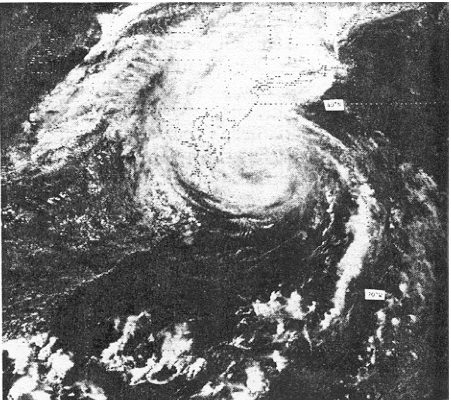
Meteorological history
The disturbance that became Belle was first detected on August 6 and was designated Tropical Storm Belle on August 7. It intensified to hurricane status later on August 7 and continued strengthening to reach its estimated peak on August 9. Maximum sustained winds were near 120 mph (190 km/h), making Belle a Category 3 hurricane at its strongest.
Unlike many storms that approach higher latitudes and accelerate to the northeast, Belle retained a relatively steady northward motion prior to landfall. This slower forward speed affected forecast timing and the progression of watches and warnings along the coast. On the morning of August 10 the cyclone came ashore near Jones Beach on Long Island and, after traversing the Long Island Sound, produced a second landfall on the Connecticut coast near Bridgeport and New Haven.
Key timeline
- August 6: Initial disturbance forms over the Atlantic.
- August 7: System is designated Tropical Storm Belle, later intensifies into a hurricane.
- August 9: Peak intensity reached, approximately 120 mph (190 km/h).
- August 10: Landfall near Jones Beach, Long Island; subsequent landfall in southern Connecticut.
Preparations and warnings
Because of Belle's proximity to the shoreline, hurricane watches and warnings were issued along a long stretch of the Atlantic coast. Advisories extended from states in the Southeast northward into New England as the storm approached. Local officials in many coastal communities ordered evacuations of low‑lying beach areas, suspended ferry services, and prepared emergency shelters. Public messaging emphasized the hazards of storm surge, beach erosion, high surf, and the potential for damaging winds and power outages.
Impact
Belle brushed portions of the North Carolina coast with gale‑force winds before moving north. When the storm struck Long Island and southern Connecticut it produced strong winds, storm surge along exposed barrier beaches, and heavy rainfall inland. Residential and commercial structures near the shore experienced damage from waves and surge, while falling trees and utility failures caused power outages across a broader area.
- Fatalities: The storm was associated with about a dozen deaths along the Atlantic seaboard, from accidents, flooding, and wind-related incidents.
- Damage: Aggregate damage from Belle was commonly estimated at roughly $100 million (1976 dollars), affecting homes, businesses, and coastal infrastructure.
Aftermath and response
Following landfall, state and local agencies coordinated cleanup and recovery activities, including restoring electrical service, clearing roads, and repairing damaged coastal defenses. Emergency management emphasized rebuilding with attention to shoreline hazards and improving preparedness for future storms. The event reinforced the importance of timely warnings and evacuation plans, especially for densely populated coastal regions.
Historical context and legacy
Hurricane Belle is remembered as a summertime hurricane that affected the densely populated northeastern United States, a region that experiences fewer hurricane landfalls than the Southeast. Its relatively slow approach and landfalls on Long Island and southern New England provided a notable example of how even storms that weaken before final landfall can produce significant coastal impacts and inland hazards. Studies of Belle have contributed to understanding of storm surge, forecasting challenges, and emergency planning in the Northeast.
For regional background and related topics, see resources on the Atlantic basin and on tropical cyclones in general (tropical cyclone). The storm tracked along the East Coast of the United States, prompting watches and warnings that extended from Georgia to Maine. Belle brushed the coast of North Carolina with gale‑force winds and highlighted hazards associated with gale conditions. Its impacts are part of the broader climatology of the Northeastern United States. Key landing locations included Jones Beach on Long Island and crossings of the Long Island Sound near Bridgeport and New Haven.
Researchers and emergency managers continue to examine historical storms such as Belle when assessing coastal vulnerability, improvement of forecast communication, and the design of evacuation strategies. Contemporary summaries and archived advisories provide useful material for historical study and for informing present-day resilience planning.
Questions and answers
Q: What was Hurricane Belle?
A: Hurricane Belle was a Category 3 Atlantic tropical cyclone in August 1976.
Q: How fast were the winds of Hurricane Belle?
A: At one point, Hurricane Belle had winds around 120 miles per hour (190 kilometres per hour).
Q: When did Hurricane Belle become a tropical storm?
A: Hurricane Belle became a tropical storm on August 7.
Q: What happened on August 9?
A: On August 9, Hurricane Belle's winds peaked at 120 miles per hour (190 kilometres per hour).
Q: Why were hurricane watches issued?
A: Hurricane watches were issued from Georgia to Maine because of Hurricane Belle's proximity.
Q: What was the impact of Hurricane Belle on the East Coast of the United States?
A: Hurricane Belle brushed the North Carolina coast with gale-force winds and took twelve lives when it struck the East Coast of the United States. Damage was $100 million.
Q: Where did Hurricane Belle come ashore?
A: Hurricane Belle came ashore as a minimal hurricane near Jones Beach on Long Island, New York. Just after crossing the Long Island Sound, it came ashore as a strong tropical storm near Bridgeport and New Haven, Connecticut.
Related articles
Author
AlegsaOnline.com Hurricane Belle (August 1976) Leandro Alegsa
URL: https://en.alegsaonline.com/art/45832
Sources
- journals.ametsoc.org : "Tropical Cyclones in 1976"