
Hungerford Bridge and the Golden Jubilee Bridges
Railway crossing and flanking pedestrian footbridges over the River Thames in central London, linking Charing Cross to the South Bank and notable for their modern cable-stayed walkways.
Overview
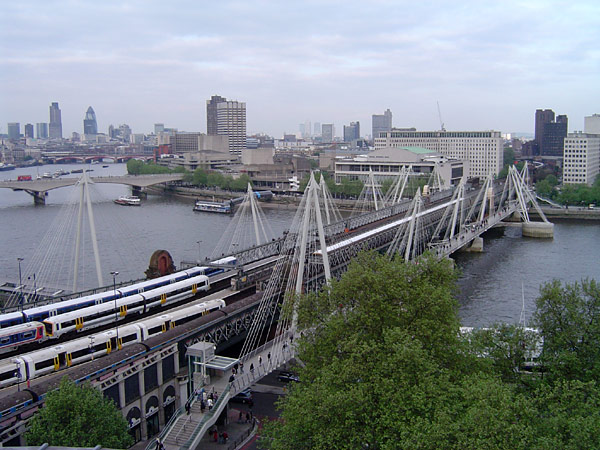
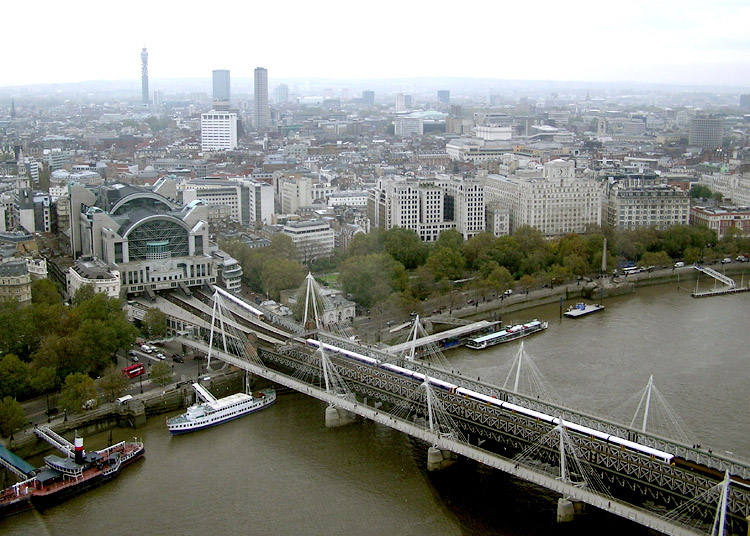
Hungerford Bridge is a railway bridge that spans the River Thames in central London, carrying tracks from Charing Cross station across to the south bank near Waterloo station. It is commonly called Charing Cross Bridge in everyday usage. The rail deck is flanked on both sides by pedestrian promenades, which together are widely known as the Golden Jubilee Bridges. These separate walkways provide a direct, scenic route between the Strand and the South Bank cultural zone.
Image gallery
7 Images


Design and structure
The central span that carries trains is a practical, utilitarian steel structure; its material and appearance reflect 19th- and 20th-century railway engineering rather than ornamental bridge architecture. The pedestrian routes on either side were added and modernised to improve access and safety. Each footpath is supported by tensioned cables and distinctive slender masts, forming cable-stayed elements that visually contrast with the heavy rail bridge. Steps and accessible lifts allow level change at both ends, ensuring the bridges work for commuters, residents, and visitors alike; lifts are provided to link the walkways with the riverbank and transport interchanges (lift access).
History and development
The crossing at this location has evolved through several phases. An early version designed by Isambard Kingdom Brunel opened in the mid-19th century; that structure and later arrangements were altered as railway needs changed. Over time the original forms were replaced or rebuilt to support heavier tracks and to adapt to increased river traffic and urban development. At the turn of the 21st century, major refurbishment created the modern pedestrian spans—named the Golden Jubilee Bridges—to celebrate a national anniversary and to improve a heavily used pedestrian link between the north bank and the South Bank arts precinct.
Location and surroundings
The bridge complex sits between Waterloo Bridge and Westminster Bridge, making it a popular vantage point for views up and down the river. On the north bank the bridge meets the Victoria Embankment and is closely connected to Charing Cross station and river piers; on the south bank it provides direct pedestrian access to cultural landmarks including County Hall, the Royal Festival Hall and the London Eye. The embankment and riverside promenades nearby are part of a larger network of civic spaces that link theatres, museums and transport hubs (Victoria Embankment).
Use, significance and notable facts
Today the site combines heavy rail use with a high-capacity pedestrian route. The railway corridor remains an important commuter artery into Charing Cross, while the Golden Jubilee footpaths are among the most frequented pedestrian bridges over the Thames, valued for both daily commuting and tourism. The juxtaposition of the functional steel rail bridge and the lighter, cable-supported footbridges is often cited as an example of how historic transport infrastructure can be adapted to modern urban needs. The crossing also serves as a clear orientation point between central transport nodes such as Waterloo station and riverside cultural venues.
Quick facts and visitor notes
- Alternative name: Charing Cross Bridge (informal).
- Position: between Waterloo Bridge and Westminster Bridge.
- North terminus: Charing Cross station; south terminus near Waterloo station and cultural venues.
- Accessibility: steps and lifts connect the walkways to the riverbank.
The Hungerford and Golden Jubilee Bridges illustrate layered urban infrastructure: a 19th-century transport route adapted with 21st-century pedestrian engineering to meet contemporary movement, accessibility and aesthetic goals.
Questions and answers
Q: What is Hungerford Bridge also known as?
A: Hungerford Bridge is also known as Charing Cross Bridge.
Q: Where does the bridge cross the River Thames?
A: The bridge crosses the River Thames in London from Charing Cross station across to the south, near Waterloo station.
Q: Are there any pedestrian bridges alongside the railway bridge?
A: Yes, there are two more recent pedestrian bridges on either side of the railway bridge. These were named the Golden Jubilee Bridges, but are really just footpaths alongside the railway bridge. Each footpath has steps and lift access.
Q: Where is located at one end of Hungerford Bridge?
A: The north end of Hungerford Bridge is located at Charing Cross station, which is near Embankment Pier and Victoria Embankment.
Q: What can be found at the other end of Hungerford Bridge?
A: At the south end of Hungerford Bridge lies Waterloo station, County Hall, Royal Festival Hall and London Eye.
Q: Who designed the first version of this bridge?
A: The first version of this bridge was designed by Isambard Kingdom Brunel and opened in 1845.
Q: Has this bridge been reworked or expanded over time?
A: Yes, both the bridge and walkways have been reworked and expanded at various times since it was originally built in 1845.
Related articles
Author
AlegsaOnline.com Hungerford Bridge and the Golden Jubilee Bridges Leandro Alegsa
URL: https://en.alegsaonline.com/art/45750
Sources
- thames.me.uk : Where Thames Smooth Waters Glide