
Human skin colour
An overview of human skin colour: biological basis, evolutionary drivers, geographic patterns, health effects, and the social meanings attached to pigmentation differences.
Human skin colour is one of the most visible human traits and varies along a continuous spectrum from very dark brown to very light pinkish tones. The variation seen among individuals and populations is produced mainly by differences in skin pigment, structure, and the way blood vessels show through the skin. Rather than a single categorical attribute, skin colour reflects multiple biological processes and evolutionary responses to environmental conditions.
Image gallery
10 Images





Biological basis and mechanisms
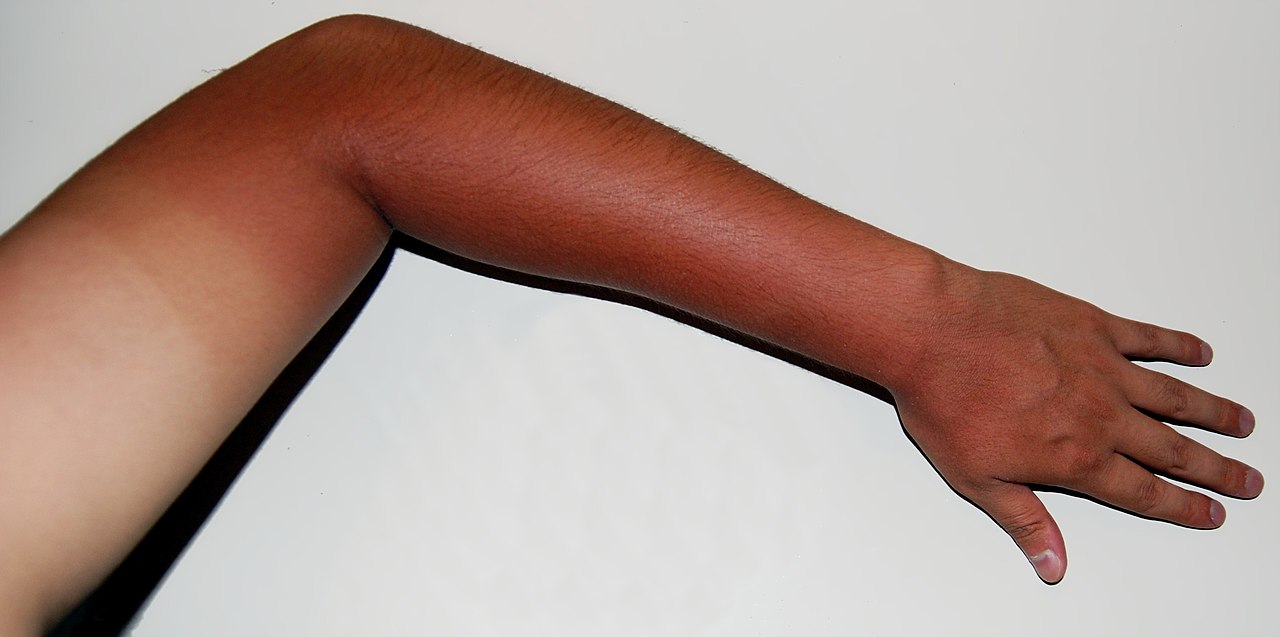
The principal pigment that determines human skin colour is melanin, a complex polymer produced by specialised cells called melanocytes located in the epidermis. Two broad classes of melanin are commonly distinguished: eumelanin, which is brown to black, and pheomelanin, which is reddish to yellow. The amount, type and distribution of melanin granules, and how they are transferred to surrounding skin cells, together shape visible pigmentation. Short-term changes such as tanning reflect increased melanin production and dispersion in response to ultraviolet (UV) radiation. Other contributors to skin appearance include the underlying blood supply (which can impart a reddish or bluish tone) and the thickness and composition of the outermost skin layers.
Geographic distribution and evolutionary explanations
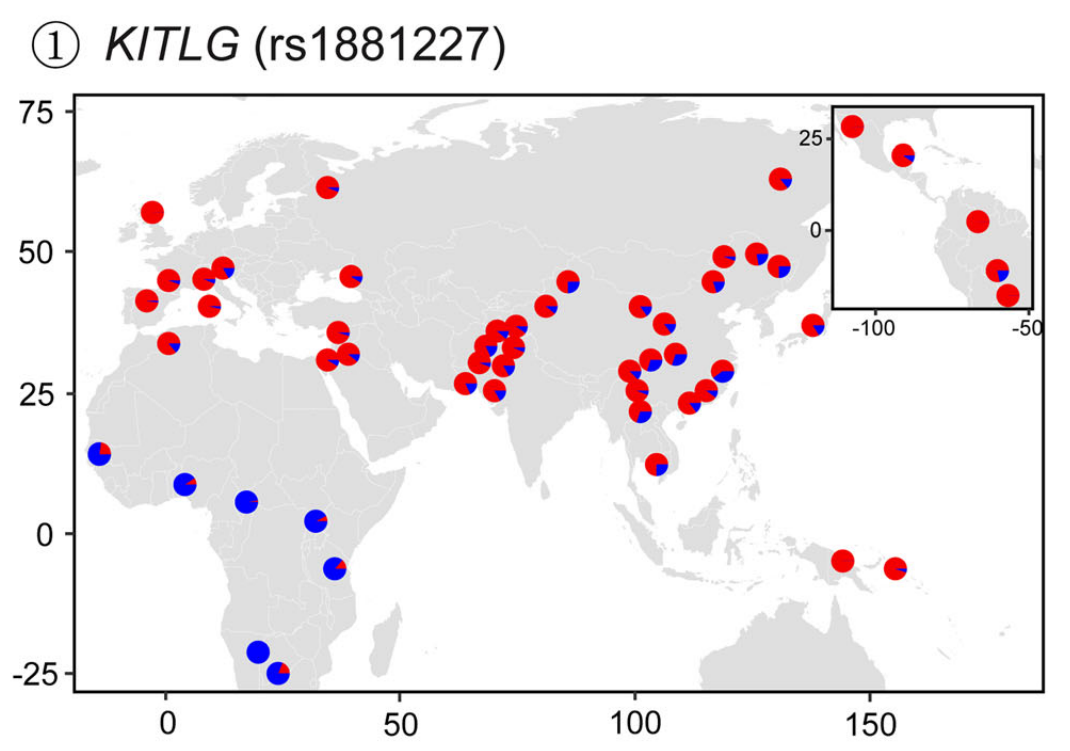
Worldwide patterns of skin colour are strongly correlated with long-term exposure to ultraviolet radiation. Populations indigenous to equatorial regions tend to have darker skin, while groups native to higher latitudes are typically lighter. Scientists interpret these patterns as outcomes of natural selection operating over many generations. Darker pigmentation protects against the damaging effects of intense UV radiation, including DNA damage and the breakdown of important compounds such as folate. Conversely, lighter skin at higher latitudes is thought to facilitate the production of vitamin D in conditions of lower UV intensity, supporting bone health and reproductive fitness. Human migrations out of Africa and subsequent local adaptations produced much of the present-day diversity in pigmentation, with additional changes where populations moved back into zones of stronger UV exposure.
Health, physiology and life stages
Skin pigmentation influences a number of physiological processes. Melanin partly shields skin cells from ultraviolet-induced DNA damage, reducing but not eliminating the risk of skin cancers. At the same time, UVB radiation catalyses the cutaneous synthesis of vitamin D, an essential nutrient for calcium metabolism; insufficient vitamin D synthesis can cause health problems if not offset by diet or lifestyle. Short-term responses such as tanning and longer-term developmental differences (including modest sex differences—adult females often exhibit slightly lighter pigmentation than males in many populations) reflect complex trade-offs between protection from UV and the need to maintain adequate vitamin D and other photolabile nutrients across the life cycle.
Uses, social meaning and cultural variation
Beyond biology, skin colour has had profound social and cultural significance. Many societies have used pigmentation as one basis for social categories, status distinctions or discriminatory practices. Standards of beauty, perceptions of health, and social hierarchies related to colour have varied across time and place. Contemporary discussions about race, identity and inequality often centre on the social consequences of visible pigmentation differences rather than on biological categories alone. Scientific and public health communication increasingly emphasises both the biological complexity of pigmentation and the need to challenge prejudiced or simplistic views.
Important distinctions and notable facts
- Skin colour is a continuous, polygenic trait—many genes contribute modestly rather than a single gene dictating a single outcome.
- Melanin provides protection but does not fully prevent UV damage; sunscreen and behavioural strategies still matter in high-UV settings.
- Apparent differences in skin tone can change with age, health, hormonal status, and environmental exposure.
- Medical care and public health guidance should consider pigmentation because some conditions and responses to treatment vary with skin type.
Further reading and resources
- Overview of human pigmentation and selection
- Melanin: chemistry and biological roles
- Ultraviolet radiation and skin biology
- Types of melanin and their effects
- Melanocytes and pigment production
- Physiological responses to exercise and skin colour appearance
- Nervous system effects on skin tone (flushing, pallor)
- Blood flow and skin colour variation
- Latitude, climate and pigmentation patterns
- UV-induced DNA damage and repair
- Epidemiology of skin cancer and pigmentation
- Vitamin D synthesis and health
- Hypotheses on selection for lighter skin
- Sex differences in skin pigmentation
- Gender variation and biological context
- Calcium metabolism and reproductive needs
- Pregnancy, skin changes and nutrient demand
- Lactation, maternal nutrition and skin physiology
- Historical links between skin colour and social status
- Skin colour, discrimination and contemporary issues
Because skin colour results from a mix of genetics, environment and culture, it is best approached as a topic that bridges biology, medicine, anthropology and social studies. For practical questions about sun safety, vitamin D, or dermatological care, professional medical advice should be sought.
Questions and answers
Q: What is the main factor that determines human skin colour?
A: The single most important substance deciding human skin colour is the pigment melanin.
Q: How does UV radiation affect skin pigmentation?
A: There is a direct relationship between UV radiation (UVR) and the distribution of indigenous skin pigmentation around the world. Areas that have more UVR also have darker-skinned populations, while areas that are far from the tropics and closer to the poles have lower concentration of UVR, and lighter-skinned populations.
Q: How did humans evolve to have lighter skin as they moved away from Africa?
A: Human populations have changed from dark-skinned to light-skinned as they left Africa about 100,000 years ago, and some have changed back to darker skin as they returned to higher UV zones. Natural skin colour can also darken as a result of tanning due to exposure to sunlight. The leading theory is that skin colour adapts to intense sunlight in order to provide partial protection against ultraviolet radiation which damages DNA of the skin cells and so produces mutations.
Q: Why do females usually have lighter skins than males?
A: Adult human females are usually lighter in skin pigmentation than males because females need more calcium during pregnancy and lactation. The body synthesizes vitamin D from the action of sunlight on the skin, which helps with calcium absorption; therefore, females evolved to have lighter skins so their bodies absorb more calcium.
Q: What are two possible reasons why white skins may be an advantage in colder climates?
A: Researchers suggest two reasons why white skins may be an advantage in colder climates; firstly, at a given temperature, a white skin radiates less heat than a black one; secondly, in weaker sunlight the body tends to produce less vitamin D - there is a hypothesis that selection for lighter skins was due to this need for higher vitamin D production when people moved north out of Africa.
Q: How has social significance varied regarding differences in human'sskin color across cultures over time?
A: The social significance of differences in human'sskin color has varied across cultures over time; it has been demonstrated with regard to social status and discrimination throughout history.
Related articles
Author
AlegsaOnline.com Human skin colour Leandro Alegsa
URL: https://en.alegsaonline.com/art/45671
Sources
- doi.org : 10.1016/j.pbiomolbio.2006.02.004
- pubmed.ncbi.nlm.nih.gov : 16766240
- personal.psu.edu : "Why human skin comes in colors"
- ncbi.nlm.nih.gov : "Colloquium Paper: Human skin pigmentation as an adaptation to UV radiation"
- ui.adsabs.harvard.edu : 2010PNAS..107.8962J
- doi.org : 10.1073/pnas.0914628107
- pubmed.ncbi.nlm.nih.gov : 20445093
- faculty.washington.edu : "The evolution of human skin coloration"
- doi.org : 10.1006/jhev.2000.0403
- pubmed.ncbi.nlm.nih.gov : 10896812