
Human-powered aircraft: design, history, and significance
Aircraft propelled wholly or partly by human muscle power; covers design principles, engineering challenges, historic milestones, and modern examples and uses.
A human-powered aircraft is an airplane that relies on the muscle power of one or more people for propulsion, either exclusively or with limited mechanical assistance. These aircraft are usually experimental, built to explore the limits of lightweight design, sustainable flight, and athletic endurance. They have been constructed for recreation, scientific research, and to win inducement prizes that reward long, controlled flights by human power alone. Overview and basic concept.
Image gallery
4 Images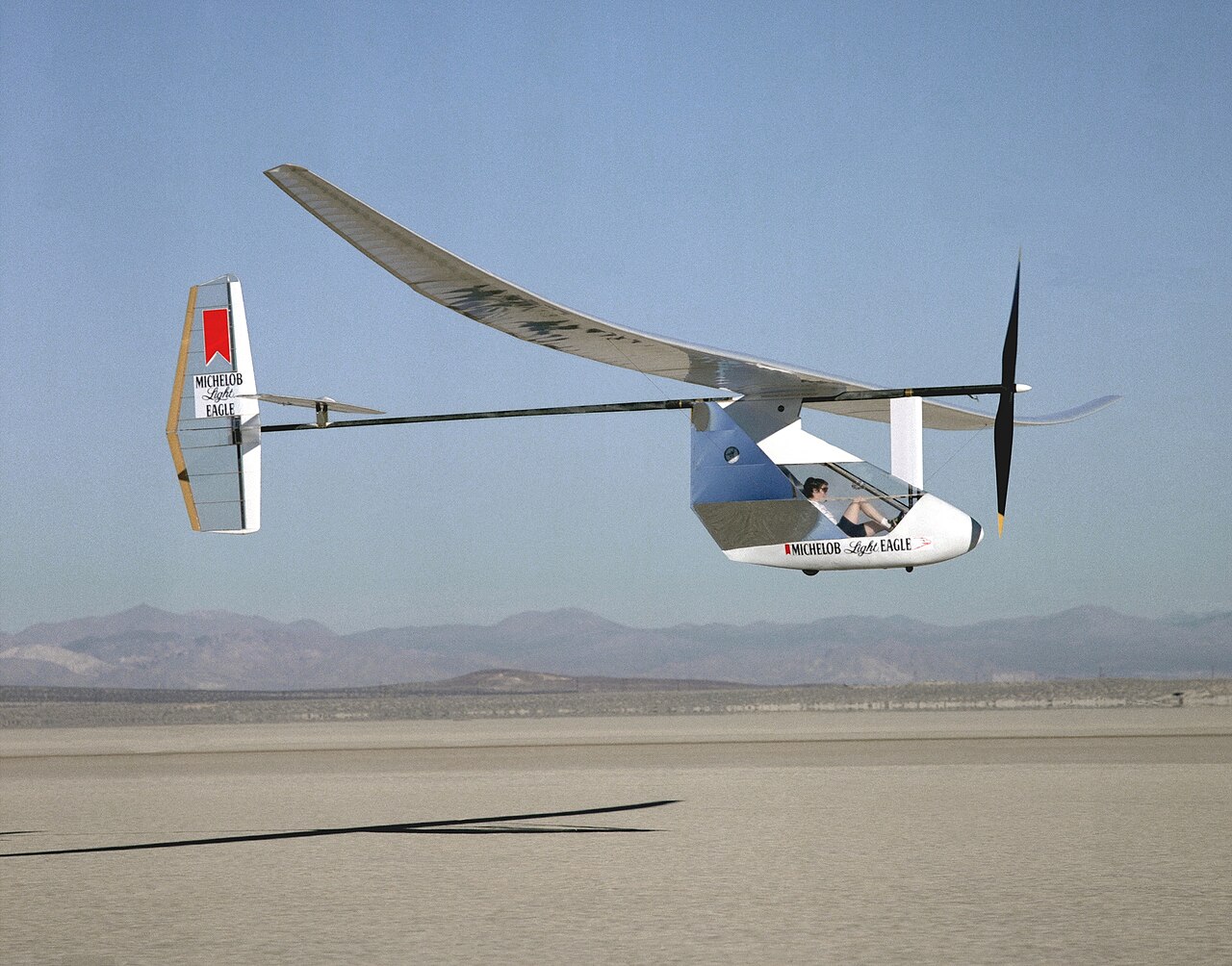


Design and key components
Because available continuous human power is modest, successful designs prioritize extreme lightness and high aerodynamic efficiency. Typical features include very large wingspans for low wing loading, efficient slow-speed airfoils, highly optimized propellers or rotors, and a minimal fuselage. Structural elements are commonly made from advanced lightweight materials to carry the loads without excessive mass. The pilot or pilots are positioned to deliver power through pedals, cranks or hand mechanisms and often lie in a streamlined recumbent posture to reduce drag. See further description of the role of the pilot(s) in powering and controlling the aircraft.
Engineering challenges
Designers must reconcile conflicting needs: absolute minimal weight, sufficient structural strength to withstand aerodynamic and landing loads, and an efficient transmission from human muscles to propulsive thrust. Low-speed aerodynamics presents unique issues — flow behavior, control effectiveness, and susceptibility to gusts differ markedly from conventional aircraft. Contemporary projects often use composite materials such as carbon fiber and lightweight skins to achieve the needed stiffness and lightness, and experimental construction techniques to trim grams wherever possible. Composite materials and modern construction methods are central to most designs.
History and notable achievements
Interest in human-powered flight has combined technical challenge with public spectacle. The Kremer Prizes spurred many teams to attempt sustained, controlled human-powered flights; early landmark wins demonstrated that a person could sustain flight over useful distances. Famous milestone aircraft include the Gossamer Condor, which achieved practical controlled flight and won the original prize, and the Gossamer Albatross, which crossed the English Channel. Later achievements by university teams and dedicated groups produced longer endurance and distance flights. These successes encouraged further academic and hobbyist work and fostered richer understanding of lightweight aerostructures and pilot endurance. Many efforts are recreational or competitive in nature (recreation and sport), while prizes and competitions continue to catalyze innovation (prizes and awards).
Modern examples and ongoing projects
Universities and specialized teams still design and build experimental human-powered aircraft as student projects and research platforms. Examples include a Virginia Tech project known as the Iron Butterfly (Iron Butterfly), and an initiative at Pennsylvania State University associated with the name Zephyrus (Penn State, Zephyrus). These programs serve multiple purposes: hands-on education in aeronautics, testing of ultralight structural techniques, and public outreach.
Uses, limitations and significance
Human-powered aircraft are not practical for routine transport but are valuable as experimental platforms. They advance lightweight materials and gentle-flight aerodynamics, contribute to human performance research, and inspire engineering students. They also highlight how narrow performance margins and human physiology constrain design, making each successful flight a notable interdisciplinary achievement.
- Typical goals: longest sustained flight, distance, or maneuverability under human power.
- Common materials: ultralight composites, thin polymer skins, and slender structural members.
- Typical settings: university labs, dedicated clubs, and competition arenas.
Questions and answers
Q: What is a human powered aircraft?
A: A human powered aircraft is an aircraft that is powered entirely or partly by the pilot(s).
Q: Why is designing a successful human-powered aircraft difficult?
A: Designing a successful human-powered aircraft is difficult because a very large power to weight ratio must be achieved.
Q: What materials are commonly used in the construction of human-powered aircraft?
A: Many of these aircraft use advanced composite materials in their construction.
Q: Have any human-powered aircraft been constructed in the past 30 years?
A: Yes, several human-powered aircraft have been constructed in the past 30 years for recreation or to win prizes.
Q: What is the Iron Butterfly?
A: The Iron Butterfly is an aircraft being built by Virginia Tech University which is powered entirely or partly by the pilot(s).
Q: What is the Zephyrus?
A: The Zephyrus is an aircraft being built by Pennsylvania State University which is powered entirely or partly by the pilot(s).
Q: Are there currently human-powered aircraft being designed and made?
A: Yes, there are human-powered aircraft being designed and made now.
Related articles
Author
AlegsaOnline.com Human-powered aircraft: design, history, and significance Leandro Alegsa
URL: https://en.alegsaonline.com/art/45660
Sources
- humanpoweredflying.propdesigner.co.uk : History of man-powered flight
- teamicarus.com : Chronology and pictures
- bluefalkor.tudelft.nl : Blue Falkor Human Powered Aircraft project at TU Delft The Netherlands