
Human Be‑In (San Francisco, January 1967)
A mass gathering in Golden Gate Park on January 14, 1967 that crystallized the 1960s hippie counterculture and helped spark the Summer of Love in San Francisco.
Overview
The Human Be-In was a large public gathering held on January 14, 1967, in Golden Gate Park in San Francisco. It brought together poets, activists, musicians and thousands of young people in an event that emphasized communal experience, consciousness expansion and cultural alternatives to the mainstream. The meeting is widely credited with helping to launch the Summer of Love, spreading the hippie lifestyle and popularizing the term psychedelic in everyday American discourse. It also helped make the Haight‑Ashbury neighborhood synonymous with the emerging counterculture.
Image gallery
1 Image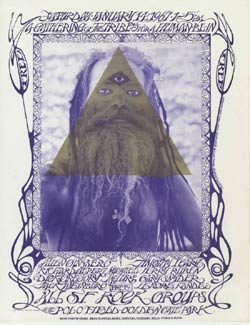
Background and influences
The gathering drew on two main currents in mid‑20th century American youth culture. One was the wave of student activism motivated by concerns about civil rights and U.S. foreign policy: college protesters who were critical of treatment of African Americans in the South and of the Vietnam War. The other major influence came from the literary and artistic energy of the Beat Generation, including experimental poets and jazz musicians who had questioned conventional values. Throughout the early 1960s, civil‑rights tactics such as opposition to segregation and sit‑ins taught many young activists how to organize and protest; simultaneously, a growing youth scene in San Francisco embraced alternative music, communal living and experimentation with drugs and new forms of music.
The event
Organized as "A Gathering of the Tribes for a Human Be‑In," the event was announced in the San Francisco Oracle and attracted a wide array of speakers and performers. Key voices included psychologist and advocate for psychedelic use Timothy Leary, who famously urged people to "Turn on, tune in, drop out," and Richard Alpert, later known as Ram Dass. Poets such as Allen Ginsberg led chants and mantras, while writers like Gary Snyder contributed to the event's spiritual and literary tone. The comedian and civil‑rights figure Dick Gregory also spoke, and groups with rough reputations such as the Hells Angels appeared as part of the scene.
- Local rock bands provided music; performers included the Grateful Dead and members of the expanding San Francisco sound.
- Sound and logistics were shaped by figures like Owsley "Bear" Stanley, who produced large quantities of LSD and played a controversial role in the scene.
Significance and immediate aftermath
The Human Be‑In served as both a cultural statement and a catalyst. Media coverage amplified the event's ideas and images, drawing young people from across the country to San Francisco over the following months. By the summer of 1967 tens of thousands of visitors had arrived for the Summer of Love, seeking music, communal living and new social norms. The suffix "-In" became a recognizable label for gatherings and protests, and popular culture soon adopted the form: the television program Laugh‑In debuted on television on NBC a year later, illustrating how countercultural language entered mass entertainment.
Notable participants and cultural effects
The Human Be‑In blended political dissent, spiritual searching and artistic experimentation. Participants included activists, writers, musicians and entertainers who had come to symbolize alternative values. The event helped normalize public discussion of consciousness, Eastern spirituality, collective gatherings and experimental music. It also highlighted tensions within the movement—between political organizing and cultural expression, between recreational drug use and spiritual practice, and between local residents and newcomers drawn by media attention.
Legacy and distinctions
Historically, the Human Be‑In is remembered as a defining moment of 1960s youth culture: compact in time but expansive in influence. It transformed a local scene in the Haight‑Ashbury into a national phenomenon, introduced many Americans to new vocabulary and imagery of the counterculture, and demonstrated how a single organized gathering could reshape public perceptions. While the hopes and ideals associated with the event played out unevenly in subsequent years, the Human Be‑In remains a key reference point for discussions about the 1960s, social movements, and the interplay between cultural experimentation and political activism.
Questions and answers
Q: What was the Human Be-In?
A: The Human Be-In was an event held in San Francisco's Golden Gate Park on January 14, 1967. It was a gathering of people from different backgrounds and cultures to celebrate peace and love, and it is credited with starting the Summer of Love.
Q: What were the two main sources of the hippie movement?
A: The two main sources of the hippie movement were college students who were not happy about how African Americans were being treated in the South or how young men were being drafted to fight in the Vietnam War, and members of the 'Beat Generation' (poets and jazz hipsters).
Q: Who spoke at the Human Be-In rally?
A: Speakers at the Human Be-In rally included Timothy Leary, Richard Alpert (soon to be more widely known as 'Ram Dass'), Allen Ginsberg, Gary Snyder, Dick Gregory, Lenore Kandel, and Jerry Rubin.
Q: What did Timothy Leary say during his speech?
A: During his speech at the Human Be-In rally, Timothy Leary famously said "Turn On, Tune In, Drop Out".
Q: How did Rowan & Martin's Laugh-In relate to this event?
A: Rowan & Martin's Laugh-In was a television comedy series that began airing just one year after the Human Be-in on January 22nd 1968. This show helped popularize some aspects of counterculture life that had been introduced by events like this one.
Q: How many people traveled to San Francisco for what became known as “The Summer of Love”?
A: Estimates suggest that between 100 000 and 200 000 people traveled to San Francisco for what became known as “The Summer of Love”.
Related articles
Author
AlegsaOnline.com Human Be‑In (San Francisco, January 1967) Leandro Alegsa
URL: https://en.alegsaonline.com/art/45639