
Howler monkey (Alouatta): loud, arboreal New World primates
Howler monkeys (genus Alouatta) are large, primarily leaf-eating New World primates known for extremely loud vocalizations, prehensile tails, and a distribution from southern Mexico through Central and South America.
Overview
Howler monkeys belong to the genus Alouatta and are among the largest of the New World monkeys. Taxonomists commonly recognize about 15 species, though the exact count can vary with new studies. They are diurnal, largely arboreal primates that inhabit tropical and subtropical forests from southern Mexico through Central America into much of South America. Howlers are most notable for their powerful, far-carrying calls and their adaptation to a folivorous and frugivorous diet.
Image gallery
10 Images




Physical characteristics and vocal anatomy
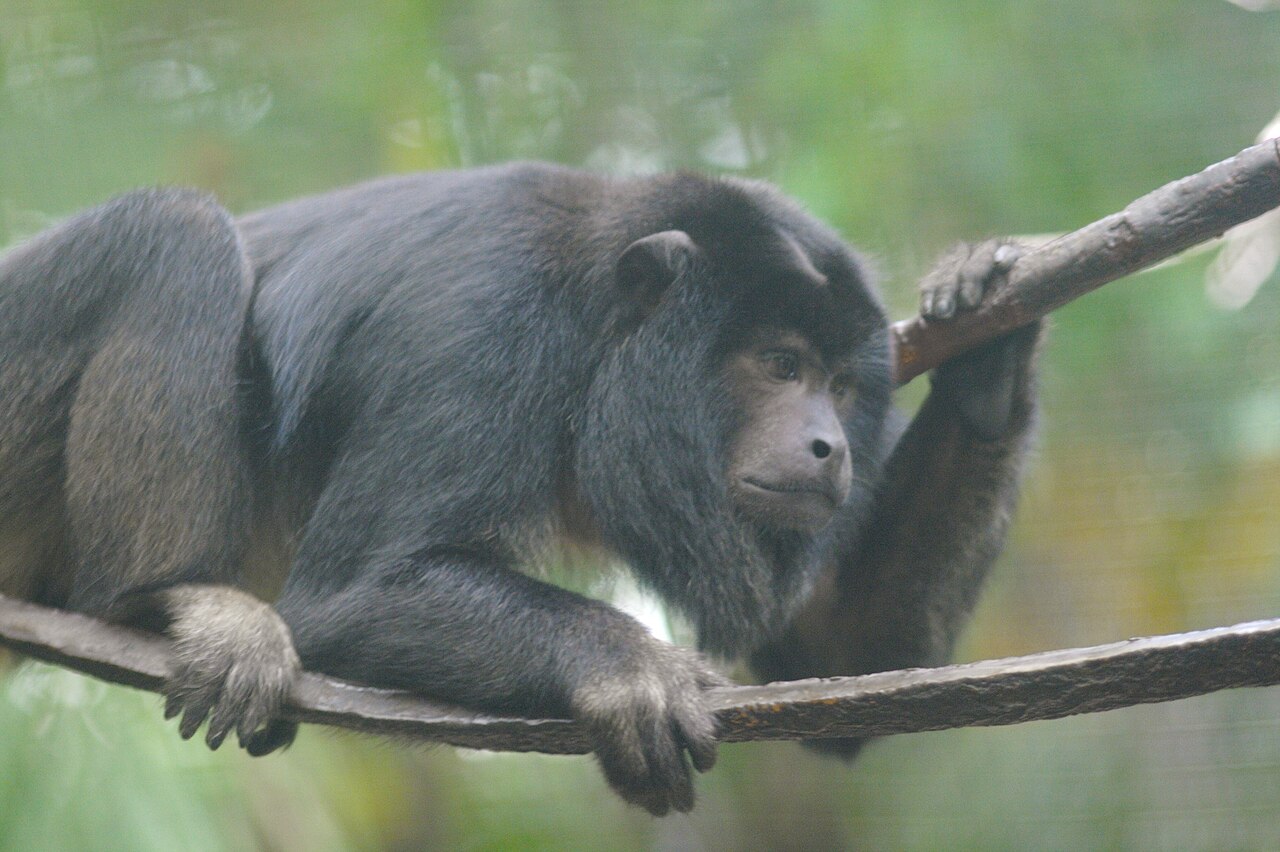
Howler monkeys are robust, with a heavy body, strong limbs, and a fully prehensile tail used as a fifth limb when moving among branches. Many species show modest sexual dimorphism; males are sometimes larger than females. A defining feature is an enlarged hyoid bone and modified larynx that amplify vocalizations. These adaptations enable male and group chorus calls that are among the loudest of any land mammal; under favorable conditions the calls have been reported to travel for kilometers. The vocal behavior serves territorial and social functions.
Diet, locomotion and social structure
Howlers eat a mix of young leaves, mature leaves, fruits and flowers; leaf-eating makes them relatively sedentary and conserves energy compared with more frugivorous primates. Their digestive systems are adapted to break down foliage, and activity levels are often low to moderate. Social groups vary in size and composition: some populations live in multi-male, multi-female groups while others form small groups with a dominant male. Typical group life includes coordinated ranging, resting periods, and communal calling at dawn and dusk.
Distribution and notable species
Howler monkeys occupy forested habitats across a broad latitudinal range. Countries with native populations include Venezuela, Colombia, Ecuador, Guyana, Brazil, parts of northern Argentina and Bolivia, as well as Central American nations. Well-known species include the mantled howler, the black howler and the red howler. Local habitat preferences differ by species, from lowland rainforests to seasonal woodland and riverine forests.
Behavioral role of calls and communication
Howling is a central element of howler social life. Groups typically call at dawn and again at dusk; calls can also occur during the day. Vocalizations help maintain intergroup spacing, advertise group size and identity, and may reduce costly physical confrontations. Researchers examining the howls emphasize the importance of the enlarged hyoid and laryngeal structures. Studies exploring the function of calls consider both territorial defense and social cohesion. Because of their volume, howler calls have attracted popular attention and are sometimes described as among the loudest primate sounds.
Conservation, threats and importance
Howler monkeys can live roughly one to two decades in the wild, depending on species and local conditions. Many populations are threatened by habitat fragmentation and habitat loss, especially where forests are cleared for agriculture or development. Other pressures include hunting, disease and capture for the pet trade. Conservation status varies by species; some are of least concern while others are classified as vulnerable or endangered. Preserving contiguous forest, maintaining corridors and reducing hunting are common conservation priorities. For further general information and species accounts consult regional primate resources and conservation organizations (genus overview, species lists).
Quick facts
- Genus: Alouatta
- Number of species: approx. 15
- Range: from southern Mexico through Central America to many parts of South America (Venezuela, Colombia, Ecuador, Guyana, Brazil, Bolivia, northern Argentina)
- Diet: leaves, fruits, flowers
- Distinctive features: powerful vocalizations, prehensile tail, enlarged hyoid
For deeper reading on taxonomy, behavior and conservation status, consult specialized primate guides and regional studies (South America overview, Central America overview).
Questions and answers
Q: What are howler monkeys?
A: Howler monkeys are one of the largest New World monkeys with 15 different species.
Q: Where are howler monkeys native to?
A: Howler monkeys are native to South and Central American forests.
Q: Why are howler monkeys famous?
A: Howler monkeys are famous for their loud howls which can travel up to three miles through dense forest.
Q: Are howler monkeys the loudest monkey?
A: Yes, howler monkeys are the loudest monkey and may even be the loudest land animal.
Q: When do group males call?
A: Group males call at dawn and dusk, as well as at times during the day.
Q: What is the function of howling in howler monkeys?
A: The function of howling may relate to intergroup spacing and territory protection.
Q: Why are howler monkeys in decline?
A: Howler monkeys are in decline due to a loss of habitat.
Related articles
Author
AlegsaOnline.com Howler monkey (Alouatta): loud, arboreal New World primates Leandro Alegsa
URL: https://en.alegsaonline.com/art/45450
Sources
- nationalzoo.si.edu : Dunn, Terry at Smithsonian National Zoological Park