
Horst‑Wessel‑Lied
The Horst-Wessel-Lied was the anthem of the Nazi Party and, from 1933 to 1945, a co-national anthem of Germany; written by SA member Horst Wessel and later proscribed as a Nazi symbol.
Overview
The Horst‑Wessel‑Lied, often referred to by its opening words "Die Fahne hoch" ("The flag on high"), was adopted as the anthem of the German Nazi Party. Written by Horst Wessel, a member of the Sturmabteilung (SA) who was killed in 1930 and subsequently elevated to martyr status by Nazi propaganda, the song became one of the most recognizable musical emblems of the movement. Its role extended beyond party ritual into public ceremonies and state functions during the Nazi era.
Image gallery
7 Images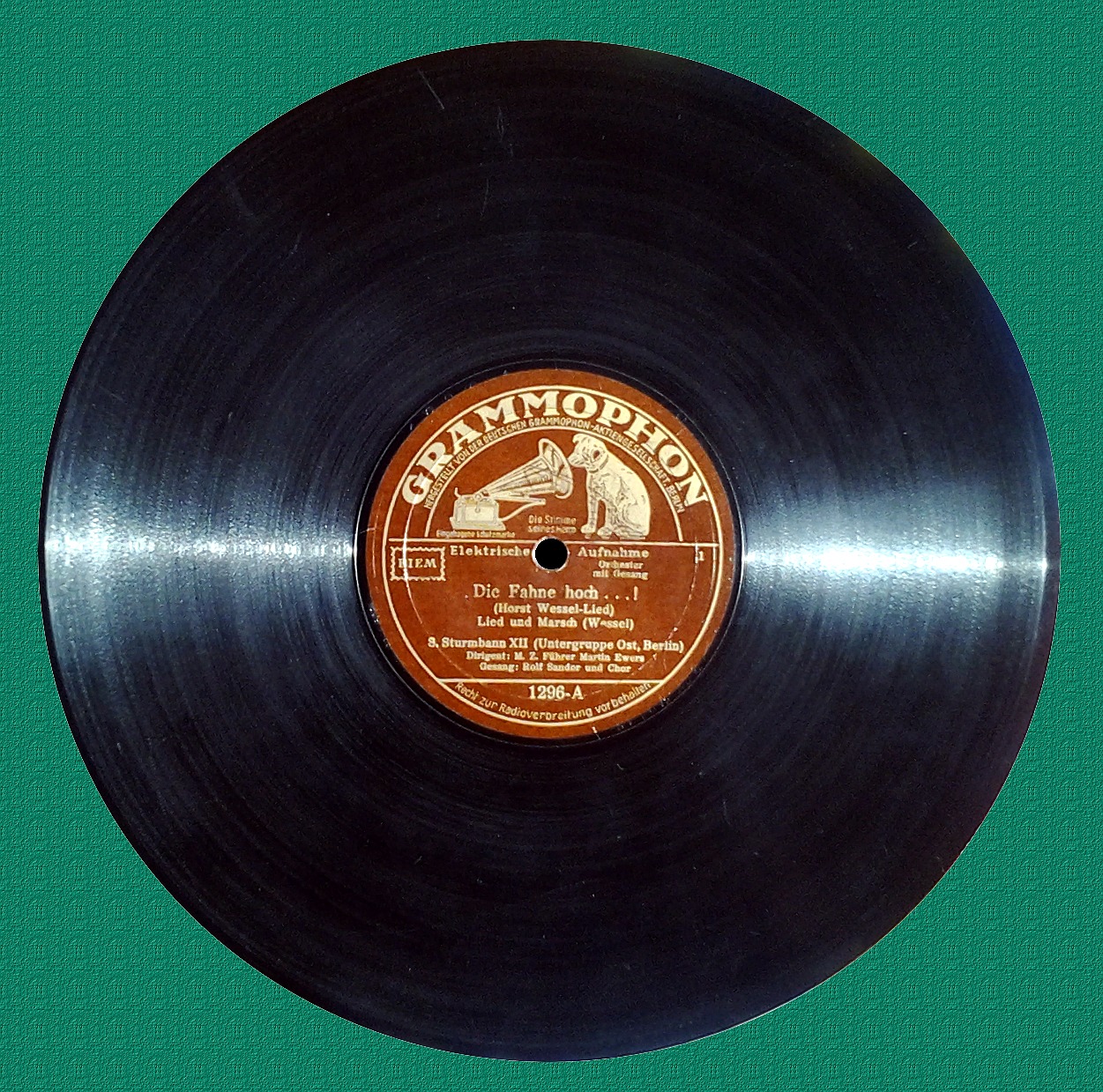





Origins and composition
The lyrics are attributed to Horst Wessel; the tune is a march‑like melody that was arranged for party use and repeated in instrumental and vocal forms. The precise musical sources are debated, and the melody was adapted into various official and informal settings to accompany uniforms, rallies, and processions. After Wessel's death the party promoted the song as a symbol of sacrifice and loyalty.
Adoption and official use
From 1930 the song served as the anthem of the Nazi Party. When the regime took power in 1933 it was placed alongside the traditional German anthem as a co‑national anthem and used at state events, in schools, and on radio. Its presence in public life was one feature of the wider program of symbolism and ritual that the regime used to consolidate authority and project unity across the country (Germany).
Content, symbolism and variants
The lyrics celebrate militant activism and display paramilitary imagery tied to the SA; they call for rallying under the party banner and praise comradeship and struggle. Instrumental arrangements and abridged versions were produced so the melody could be played in marches, broadcasts and film. Because the song functioned as both a political hymn and a piece of propaganda, it carried strong ideological connotations.
After 1945: ban and legal status
Following the defeat of Nazism the Horst‑Wessel‑Lied was widely proscribed by occupying authorities and by postwar German law. In contemporary Germany, Austria and several other countries public performance, distribution or display of the song in ways that promote Nazism is forbidden under statutes that bar symbols and propaganda of unconstitutional organizations; it is therefore treated as a criminal act rather than an artistic work in public contexts. The tune and lyrics survive primarily in historical scholarship, documentation and criminal investigations of extremist activity.
Legacy and controversy
- The song is a frequent subject in studies of propaganda, political ritual and memory of the Nazi period.
- Its use by neo‑Nazi groups after 1945 has kept it controversial and legally fraught.
- Historic recordings and references appear in research and documentary contexts under restricted conditions to prevent promotion of extremist ideology.
For general background on related symbols and legal approaches to extremist propaganda, see discussions of national anthems and prohibitions on extremist symbols in historical and legal literature (national anthem).
Questions and answers
Q: Who wrote the Horst-Wessel-Lied?
A: The song was written by Nazi Party member Horst Wessel.
Q: What is another name for the Horst-Wessel-Lied?
A: It is also known as Die Fahne hoch ("The flag on high").
Q: When did it become the anthem of the Nazi Party?
A: It became the anthem of the Nazi Party in 1930.
Q: How long was it part of Germany's national anthem?
A: From 1933 to 1945, it was part of Germany's national anthem.
Q: What is the opening line of "Die Fahne hoch"?
A: The opening line is "The flag on high".
Q: What political party used this song as its anthem? A: The Nazi Party used this song as its anthem.
Related articles
Author
AlegsaOnline.com Horst‑Wessel‑Lied Leandro Alegsa
URL: https://en.alegsaonline.com/art/45180
Sources
- george-broderick.de : here
- eri.ca : MP3 with a fanfare introduction,at www.eri.ca