
Horseshoe crab
Marine arthropods related to spiders, known for a hard carapace, long tail spine and blue blood used in medicine; found in coastal and estuarine habitats and important ecologically and biomedically.
Overview
Horseshoe crabs are marine arthropods sometimes called "king crabs" or horseshoe crabs, but they are not true crabs. They belong to the chelicerate group and are more closely related to spiders and scorpions than to crustaceans (arachnid relatives).
Image gallery
10 Images




Characteristics
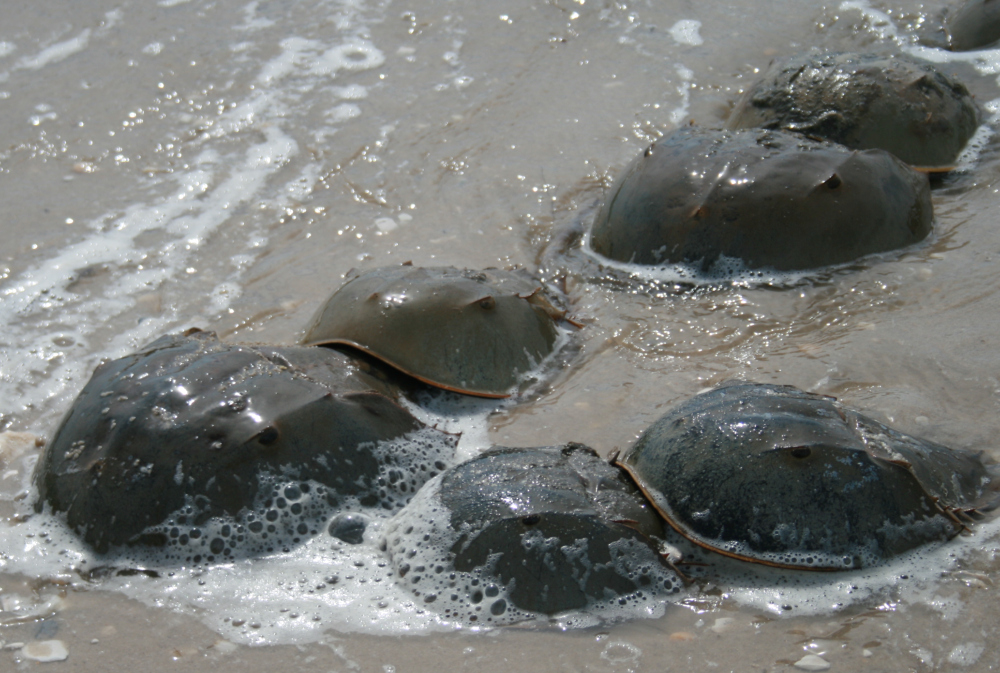
These animals have a hard, rounded carapace, a jointed underside with multiple pairs of legs, and a long, pointed telson (tail spine) used for righting themselves. They breathe with book gills and possess copper-based blood that is blue in color; the blood contains clotting cells important to biomedical testing. Well-known species include Limulus polyphemus and several Asian species.
- Domed carapace and dorsal shield
- Telson (tail spine) for maneuvering
- Book gills for respiration and locomotion on the seafloor
- Blue hemolymph used in medical assays (Limulus polyphemus)
Habitat and behaviour
Horseshoe crabs are primarily benthic: they crawl on sandy or muddy bottoms in shallow coastal waters and estuaries. Typical habitats include sheltered bays and tidal flats. Many populations come ashore at high tides to spawn on sandy beaches and river mouths, linking marine and shoreline ecosystems (coastal, intertidal, estuarine).
Life cycle and ecological role
Spawning usually occurs in seasonal, often nocturnal, mass events. Females deposit thousands of eggs in nests on beaches; eggs provide a critical food resource for migrating shorebirds and other coastal wildlife. Juveniles hatch as small, trilobite-like larvae and grow through a series of molts before reaching adult form.
Uses, importance and conservation
Horseshoe crabs play a dual role: they are keystone ecological species in many coastal food webs and a source of biomedical material—cells from their blood are used to detect bacterial endotoxins. At the same time they are harvested for bait and biomedical use, and face threats from habitat loss, coastal development and climate change. Conservation efforts include regulated harvests, monitoring, and research into synthetic alternatives to reduce pressure on wild populations.
For more detailed information, see species accounts and conservation resources linked to taxonomic and habitat references (species overview, common name note, taxonomic context).
Questions and answers
Q: What is the horseshoe crab?
A: The horseshoe crab is a benthic or bottom-dwelling creature that is not a crab, but rather a relative of the arachnids.
Q: Where does the horseshoe crab mainly live?
A: The horseshoe crab mainly lives in coastal areas and river estuaries.
Q: What is the most well-known species of horseshoe crab?
A: The most well-known species of horseshoe crab is Limulus polyphemus.
Q: Is the horseshoe crab a type of crab?
A: No, the horseshoe crab is not a crab, but rather a relative of the arachnids.
Q: What type of environment does the horseshoe crab prefer?
A: The horseshoe crab prefers a benthic or bottom-dwelling environment in coastal areas and river estuaries.
Q: How many species of horseshoe crab are there?
A: There are four species of horseshoe crab.
Q: Why is the horseshoe crab important?
A: Horseshoe crabs have importance in the scientific and medical fields, as their blue blood contains unique blood cells that are used to test for bacterial endotoxins in vaccines and other medical equipment. They also play a crucial role in the ecosystem as a food source for migratory shorebirds.
Related articles
Author
AlegsaOnline.com Horseshoe crab Leandro Alegsa
URL: https://en.alegsaonline.com/art/45172
Sources
- horseshoecrab.org : "The Horseshoe Crab natural history: crab species"
- oldwww.wii.gov.in : "In-house research seminar: The status of horseshoe crab in east coast of India"
- newyorker.com : BLUE BLOODS; The horseshoe crab is half a billion years old, but its existence may be threatened
- horseshoecrab.org : Medical uses
- helsinki.fi : "Xiphosura - Horseshoe crabs"
- nature.com : nature.com/articles/nature09038?error=cookies_not_supported&code=df276b55-00db-41f4-a228-…
- books.google.com : The variety of life: a survey and a celebration of all the creatures that have ever lived
- biomedcentral.com : "The colonization of land by animals: molecular phylogeny and divergence times among arthropods"
- doi.org : 10.1186/1741-7007-2-1
- ncbi.nlm.nih.gov : 333434