
Hornblende: a common amphibole-group rock-forming mineral name
Hornblende is a dark, complex amphibole-group silicate name applied to several closely related minerals. Common in many igneous and metamorphic rocks, it is important for petrology and rock identification.
Overview — Hornblende is a field name used for a group of dark amphibole minerals rather than for a single, formally recognized mineral species. It refers to a series of related inosilicate compositions within the amphibole family and is frequently employed by geologists in hand-sample descriptions and field notes. The term traces to older mineralogical nomenclature and remains useful as a practical label in many geologic contexts. More on amphiboles and classification details.
Composition and structure — Members identified as hornblende are complex solid solutions of calcium, sodium, iron, magnesium and aluminium silicates. Typical compositional end‑members include calcium–iron–magnesium silicates, aluminium‑bearing iron‑magnesium silicates, and other iron‑magnesium variants; their structures are double chains of SiO4 tetrahedra characteristic of amphiboles. Chemical variability affects color and density, so geochemical analysis is used to distinguish specific amphibole species where precision is needed. Structure overview and chemical variants.
Physical properties — Hornblende typically appears dark green to brown or black and is often opaque. Its Mohs hardness ranges around 5–6 and specific gravity commonly sits between about 2.9 and 3.4. Amphiboles show two prominent cleavage directions that intersect at oblique angles (roughly 56° and 124°), and many hornblendes are pleochroic, showing different colors when viewed from different directions under polarized light. These diagnostic traits help separate hornblende from look‑alikes. hardness, density, cleavage.
Occurrence and formation — Hornblende commonly occurs in intermediate to felsic igneous rocks such as diorite and andesite, in some granitic suites, and in metamorphic rocks like amphibolites formed under moderate to high temperatures and pressures. It crystallizes from magmas richer in water and volatile components than pyroxenes, and it can also form by metamorphic reactions during regional metamorphism. Its presence provides clues to the conditions of rock formation and subsequent geologic history. igneous occurrences and metamorphic settings.
Uses and significance — While hornblende itself is not mined as an ore, it is significant in petrology and geology: its composition and zoning record metamorphic and magmatic processes, and hornblende-bearing rocks inform interpretations of tectonic settings and metamorphic grade. Hornblende geothermobarometry (comparing composition with coexisting minerals) is a standard tool for estimating temperature and pressure in metamorphic studies. It also helps in petrographic identification of rock types in the field and thin section. petrologic applications and geothermobarometry.
Similar minerals and identification tips — Hornblende can be mistaken for other dark rock-forming minerals such as augite (a pyroxene) and biotite mica because all can appear black in hand sample. Key distinctions include cleavage angles (pyroxenes have nearly orthogonal cleavages near 90°), the platy habit and basal cleavage of biotite, and pleochroism and cleavage angles of amphiboles. When precision is required, thin-section petrography or chemical analysis separates hornblende from closely related amphiboles and other mafic minerals. identification guide.
Image gallery
5 Images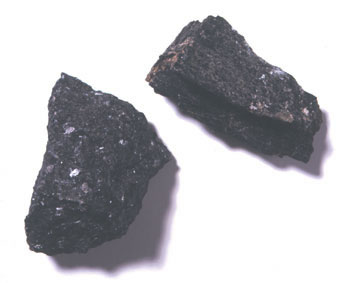
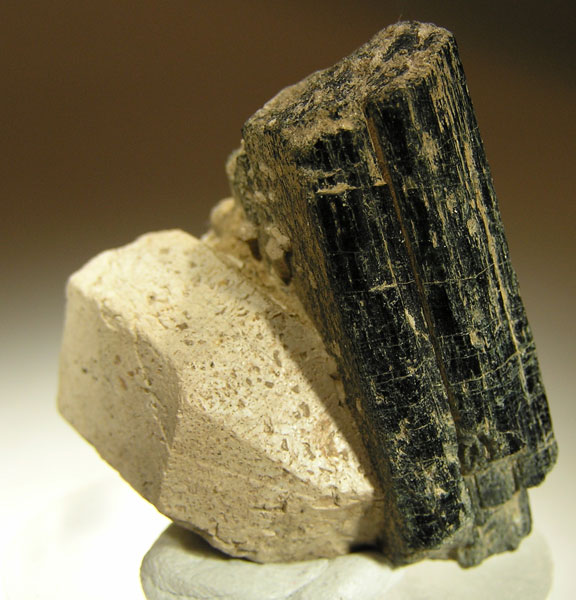


Questions and answers
Q: What is hornblende?
A: Hornblende is a complex series of silicate minerals, which is not a recognized mineral in its own right but is used as a general or field term to refer to a dark amphibole.
Q: What are the three molecules that make up hornblende?
A: The three molecules that make up hornblende are a calcium-iron-magnesium silicate, an aluminium-iron-magnesium silicate, and an iron-magnesium silicate.
Q: What is the hardness of hornblende?
A: The hardness of hornblende is 5-6.
Q: What is the specific gravity of hornblende?
A: The specific gravity of hornblende is 2.9-3.4.
Q: What colors can hornblende be?
A: Hornblende is typically an opaque green, greenish-brown, brown, or black color.
Q: What minerals is hornblende often confused with?
A: Hornblende is often confused with the minerals augite and biotite mica, both of which are black and can be found in granite.
Q: Is hornblende a recognized mineral in its own right?
A: No, hornblende is not a recognized mineral in its own right.
Related articles
Author
AlegsaOnline.com Hornblende: a common amphibole-group rock-forming mineral name Leandro Alegsa
URL: https://en.alegsaonline.com/art/45126
Sources
- mindat.org : mindat.org/min-8789.html
- mindat.org : Mindat
- geology.neab.net : Scandinavian mineral gallery
- galleries.com : Table Info