
Hoplite — the citizen-soldier of ancient Greece
Hoplites were heavily armed infantry who fought in dense phalanx formations in ancient Greek city-states. This article explains their equipment, tactics, social role, and historical development.
A hoplite was a heavily armed infantryman who served as a citizen-soldier in many ancient Greek city-states. The term originally referred to soldiers who carried a particular round shield, but in later use it came to mean any armoured infantryman regardless of exact kit. Hoplites were central to Greek warfare from the Archaic period through the classical era, and their style of fighting shaped politics, society and military practice across the Greek world.
Image gallery
10 Images
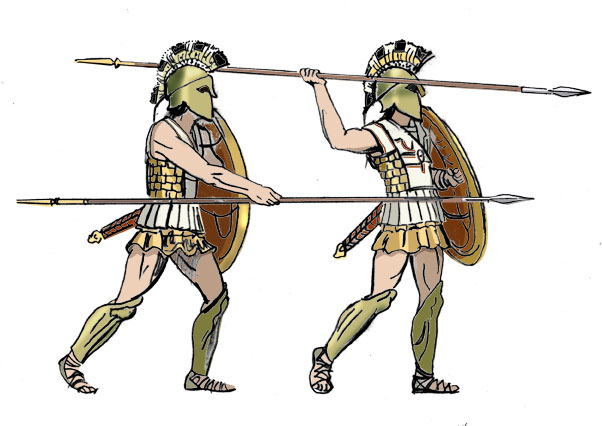


Equipment and appearance
A hoplite’s battlefield identity was defined by a core set of arms and armour. Typical items included:
- Shield (aspis or hoplon) — the large, concave round shield that gave the hoplite its name and provided protection for both bearer and neighbour; see shield.
- Spear (doru) — the primary offensive weapon, used for thrusting from several ranks; see spear.
- Helmet — usually made of bronze, often covering the face and head; see helmet.
- Body armour — cuirass of bronze or layered linen/ leather (linothorax) to protect the torso.
- Greaves and sword — shin protection and a short sword for close fighting; see sword.
Tactics: the phalanx and how hoplites fought
Hoplites fought together in a tight formation called the phalanx. Soldiers stood shoulder to shoulder, shields overlapping, and advanced in disciplined ranks often eight files deep or more. The front ranks thrust with spears while rear ranks supported by presenting theirs and by applying pressure with shields to maintain cohesion. The phalanx was strongest as a collective unit rather than as individuals; its success relied on training, morale and mutual protection.
Because each man’s right arm was less protected—his shield covered the left side—phalanxes often tended to drift to the right during battle as soldiers sought cover behind the shield of their neighbour. To compensate, commanders placed experienced fighters on the vulnerable right flank. Cohesion, timing of advances, and terrain were crucial to phalanx effectiveness.
Social role and recruitment
Hoplites were generally free citizens who supplied their own equipment, which tied military service to property and status. Citizens in many Greek cities underwent basic military training and could be called up for campaigns; service fostered a strong link between civic duty and land-holding. Some states developed distinctive practices: Sparta is famous for lifelong, professionalized military training for males (Sparta), while other states, such as Athens, combined citizen military service with naval responsibilities and civic life.
History, development and legacy
The hoplite system emerged during the Archaic period as bronze equipment became more common and as heavy infantry tactics replaced earlier light-armed skirmishing in many regions. Over time armour and weapons evolved (bronze gave way to iron; linen armour gained use) and variations in style appeared among regions. Famous engagements involving hoplite armies include battles of Marathon and Thermopylae, where citizen infantry played decisive roles.
In later centuries legionary and combined-arms tactics reduced the dominance of the classical phalanx, but the hoplite remains a symbol of Greek military and civic identity. The term itself broadened in later texts to mean any armoured foot soldier, and modern study of hoplites informs scholarship on ancient society, warfare and political organization. For further general context, see entries on Greek city-states and military history sources.
Scholars continue to refine details about equipment, tactics and recruitment from literary, archaeological and iconographic evidence. For introductions and visual examples consult broader surveys and museum catalogues: see a general overview (overview), iconography guides (phalanx images), and region-specific studies (armament, weapons, Spartan practice).
Questions and answers
Q: What was the main weapon of a hoplite?
A: The main weapon of a hoplite was their spear.
Q: How did hoplites fight in battle?
A: Hoplites fought close together in what was called a phalanx formation. In this formation, each man's shield protected himself and also gave some protection to the right arm of the man on his left.
Q: What type of armour did a hoplite wear?
A: A hoplite wore helmet with face covered shield, body armour, greaves (leg armour), sword and spear.
Q: Who supplied their own armour and weapons?
A: A hoplite usually supplied their own armour and weapons.
Q: How were Spartans renowned for their military prowess?
A: The citizens of Sparta were renowned for their lifelong combat training and military prowess.
Q: How did the phalanx work as a team in battle?
A: The first row would stab at their opponents while trying to maintain close formation. The ranks behind would support them with their spears and gently push them with their shields, not to force them into the enemy but to keep them steady and in position. Upon command of an officer, the phalanx would take a certain number of steps forward.
Q: Why were experienced hoplites placed on the right side of the phalanx?
A: Experienced hoplites were often placed on the right side of the phalanx because it was more vulnerable than the left due to being unprotected by neighboring shields.
Related articles
Author
AlegsaOnline.com Hoplite — the citizen-soldier of ancient Greece Leandro Alegsa
URL: https://en.alegsaonline.com/art/45079