
Hong Kong–Zhuhai–Macau Bridge
A 55 km sea crossing linking Hong Kong, Zhuhai and Macau. A combination of bridges, an undersea tunnel and artificial islands, it is a major engineering project and transport link in the Pearl River Delta.
Overview
The Hong Kong–Zhuhai–Macau Bridge is a large-scale transport link in the Pearl River Delta that connects Hong Kong, Zhuhai and Macau. The entire crossing spans roughly 55 kilometres and traverses busy shipping channels such as Lingdingyang and Jiuzhouyang. Built to improve road connectivity in the region and to support the development of the Greater Bay Area, it is commonly described as one of the longest sea crossings in the world.
Image gallery
10 Images




Structure and main components
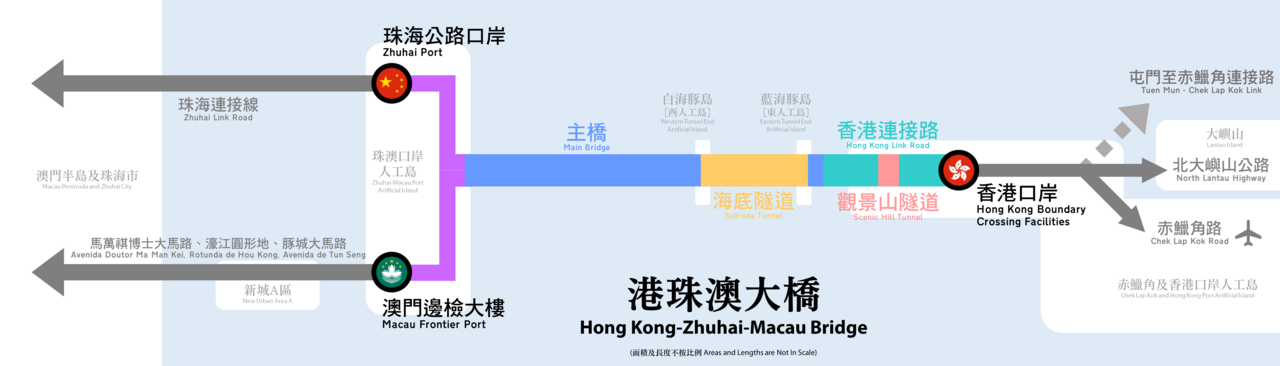
The project combines several different types of engineering to balance traffic needs with maritime navigation. Its principal components are:
- Three long bridge sections that traverse open water and shallow channels.
- An immersed undersea tunnel that preserves key shipping lanes by routing vehicles beneath busy channels.
- Four purpose-built artificial islands that house the tunnel portals and service facilities — these are constructed landforms used to link the bridges and tunnel together (artificial islands).
- Supporting viaducts, approach roads and interchange structures on each shore.
History and construction
Developed as part of a long-term plan to strengthen regional economic ties, the bridge was financed by a combination of public and commercial sources. Funding came from the governments involved and from banking partners, reflecting cooperation among the administrations of mainland China, Hong Kong and Macau (governments and financial backers). The overall cost rose substantially during planning and construction, reaching about 126.9 billion yuan from earlier estimates. Construction was completed in early 2018 and the link officially opened to traffic on 24 October 2018; the physical works were declared finished on 6 February 2018.
Operation, travel and border arrangements
The crossing carries road vehicles — private cars, cross‑border buses and freight — rather than rail. To streamline cross-border movement, a co-location and joint clearance arrangement was implemented so that travelers may clear immigration and customs for departure and arrival within shared terminals. This arrangement is a distinctive operational feature and was a major part of the project planning. The bridge has shortened journeys between the three cities compared with earlier ferry routes and longer land detours, facilitating daily travel and logistics across the mainland–special administrative region boundary.
Impact, controversies and notable facts
Proponents argue the bridge advances regional integration, reduces travel time and supports economic development across the Pearl River Delta. Critics pointed to the dramatic rise in costs from initial budgets, environmental concerns during construction, safety incidents reported in the work period, and questions about traffic levels versus early projections. The design life of the crossing is intended to be long-term — planners cite an expected lifespan of around 120 years — and the combination of long-span bridges with an immersed tunnel is cited as an engineering response to the demands of heavy maritime traffic and complex local conditions.
Records and distinctions
Besides its length, the crossing is notable for integrating multiple civil-engineering types into a continuous route over open sea and for the use of large artificial islands to join tunnel and bridge elements. It remains a high-profile example of 21st-century infrastructure designed to knit together adjacent cities and support regional transport and commerce.
For further context and official documents consult entries from the participating administrations and technical reports on the design and environmental assessments (Macau, Zhuhai, Hong Kong, government sources, island construction, mainland authorities).
Questions and answers
Q: What is the Hong Kong–Zhuhai–Macau Bridge?
A: The Hong Kong–Zhuhai–Macau Bridge is a group of bridges and tunnels in the Pearl River Delta that connect Hong Kong, Zhuhai, and Macau.
Q: What is the length of the Hong Kong–Zhuhai–Macau Bridge?
A: The Hong Kong–Zhuhai–Macau Bridge is 55 kilometers long.
Q: What is the Hong Kong–Zhuhai–Macau Bridge made up of?
A: The Hong Kong–Zhuhai–Macau Bridge is made up of three bridges, one tunnel, and four artificial islands.
Q: Where do the bridges cross?
A: The bridges cross the Lingdingyang and Jiuzhouyang sea channels.
Q: How long is the bridge supposed to last?
A: The bridge is supposed to last for 120 years.
Q: How much did the bridge cost?
A: The cost of the bridge was about 126.9 billion yuan ($18.77 billion USD), although it was originally supposed to cost 51.1 billion yuan ($7.56 billion USD).
Q: When did the Hong Kong–Zhuhai–Macau Bridge officially open?
A: The Hong Kong–Zhuhai–Macau Bridge officially opened on 24 October 2018, although construction had finished on 6 February 2018.
Related articles
Author
AlegsaOnline.com Hong Kong–Zhuhai–Macau Bridge Leandro Alegsa
URL: https://en.alegsaonline.com/art/45005
Sources
- channelnewsasia.com : "The Hong Kong-Zhuhai-Macau bridge: 6 things to know about the engineering marvel"
- gov.cn : "港珠澳大桥主体工程完成交工验收 具备通车试运营条件"
- xinhuanet.com : "Xinhua Headlines: World's longest cross-sea bridge opens, integrating China's Greater Bay Area"
- scmp.com : "Hong Kong-Zhuhai-Macau Bridge passes first real test as it opens to Pearl River Delta traffic"
- scmp.com : Chinese President Xi Jinping declares Hong Kong-Zhuhai-Macau Bridge open
- bbc.com : "World's longest sea crossing: Hong Kong-Zhuhai bridge opens"
- hongkongfp.com : "Explainer: Hong Kong's troubled mega-bridge – counting the human, environmental and financial cost"
- edition.cnn.com : "The $20 billion 'umbilical cord': China unveils the world's longest sea-crossing bridge"
- asia.nikkei.com : "Hong Kong-Zhuhai-Macau Bridge construction set to finish this year"
- chinadaily.com.cn : "Main structure of Hong Kong-Zhuhai-Macao Bridge is completed"
- scmp.com : "Property tycoon Gordon Wu's 35-year dream of massive bridge connecting Hong Kong with Pearl River Delta cities finally realised"
- hzmb.org : "Introduction to Hong Kong-Zhuhai-Macao Bridge"
- wsj.com : "China Builds Bridge to Link Southern Cities"
- arup.com : "The ground breaking ceremony for the Hong Kong–Zhuhai–Macao Bridge (Zhuhai waters section) took place on 15 December 2009"