
Honey badger (ratel) — Mellivora capensis
The honey badger or ratel (Mellivora capensis) is a hardy mustelid found across Africa, the Middle East and South Asia, known for its bold behavior, varied diet and loose, thick skin that aids its defenses.
Overview
The honey badger, also called the ratel and scientifically known as Mellivora capensis, is a member of the mustelid family, the same broad group that includes weasels, otters and badgers. It is widespread across sub-Saharan Africa, parts of the Middle East and the Indian subcontinent. Despite its common name, the honey badger differs in appearance and habits from the true badgers and is often described as more weasel-like in build and behavior. For general information on its classification see mustelid family notes.
Image gallery
10 Images




Appearance and adaptations
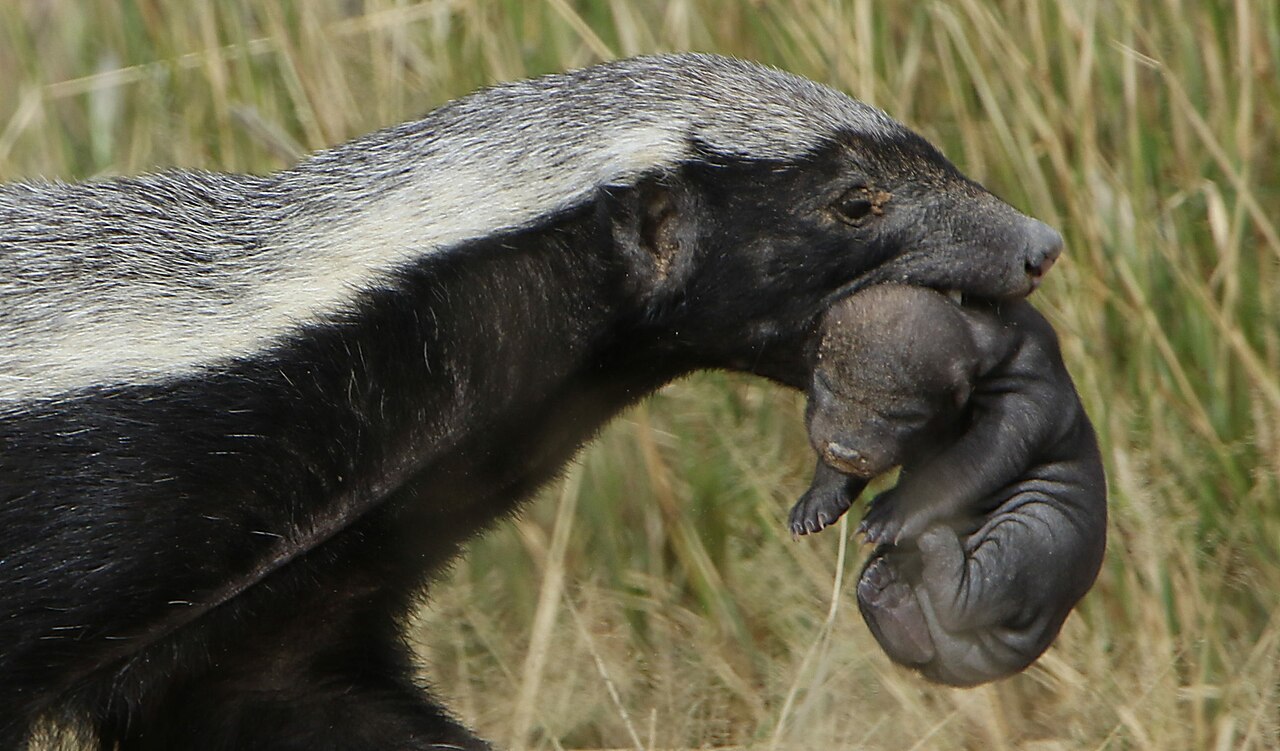
Honey badgers have a stocky body with short, powerful legs and long claws for digging. Their skin is unusually thick and loose, especially around the neck, which allows them to twist and bite if grabbed by a predator. A characteristic pale stripe or band runs along the back of many individuals, contrasting with darker flanks and belly. These physical traits contribute to a reputation for toughness and make predation on adults difficult. For comparisons with other species sometimes labelled as badgers, see badger comparisons and weasel relatives.
Distribution, habitat and history
Honey badgers occupy a variety of environments from dry savanna and scrub to rocky hills and some woodland edges. Their historic range has long included large parts of Africa and extended eastward into the Middle East and India. They are adaptable animals that can exploit diverse food sources and shelter types, including burrows abandoned by other species, crevices and thickets. For regional distribution details see links on Africa and Asia: Africa, Middle East, Indian subcontinent.
Diet and behavior
Honey badgers are opportunistic feeders with a primarily carnivorous diet, but they are not strict predators. Common food items include small mammals, reptiles (including venomous snakes), birds, eggs, insects and carrion. They are famously known to raid beehives for honey and bee larvae, sometimes in association with the greater honeyguide, a bird species that leads mammals to hives. Typical food items are summarized below.
- Vertebrates: rodents, young ungulates, snakes and lizards
- Invertebrates: insects and grubs, especially those in nests or burrows
- Plant-derived items: honey, bulbs and occasional fruits
Defense, reproduction and social life
Honey badgers are largely solitary and are most active by night in hotter regions. Their main defenses are aggression, tenacity and a combination of strong jaws, sharp claws and protective skin. Mothers raise young in burrows and are protective until the offspring are independent. Encounters with larger predators are uncommon; when they do occur the badger's defenses often deter attacks. For further reading on diet tendencies see diet and feeding.
Human interactions and conservation
Across much of its range the species is not considered highly threatened and persists in a variety of habitats, though local declines occur where it is persecuted for raiding apiaries or killed as a perceived nuisance. It appears in local folklore and popular media as a symbol of stubborn courage. For conservation and range notes see regional resources and species summaries: weasel relatives (repeat), mustelid family notes (repeat), and Indian subcontinent (repeat).
Notable facts and distinctions
Although commonly called a badger, the honey badger stands apart from true badgers in both form and some aspects of behavior. Its association with honey and beehives inspired both the English name and the Afrikaans name "ratel." The species continues to interest researchers and the public for its bold temperament, broad diet and physical adaptations that reduce vulnerability to predators and stings.
For more general references and external overviews consult broad summaries and regional accounts: Africa overview, Middle East overview, and badger comparisons.
Questions and answers
Q: What is a honey badger?
A: The honey badger is a type of mustelid found in Africa, the Middle East, and the Indian subcontinent.
Q: Does the honey badger look like other types of badgers?
A: No, the honey badger does not look like other types of badgers. It looks more like a weasel.
Q: What is the honey badger's diet?
A: The honey badger mostly eats meat.
Q: What is unique about the honey badger's defensive ability?
A: The honey badger has thick skin and a tough defensive ability, which helps it to ward off predators.
Q: Does the honey badger have many predators?
A: No, the honey badger does not have many predators due to its tough defensive abilities and thick skin.
Q: Where can the honey badger be found?
A: The honey badger can be found in Africa, the Middle East, and the Indian subcontinent.
Q: What is another name for the honey badger?
A: Another name for the honey badger is ratel (Mellivora capensis).
Author
AlegsaOnline.com Honey badger (ratel) — Mellivora capensis Leandro Alegsa
URL: https://en.alegsaonline.com/art/44980
Sources
- iucnredlist.org : "Mellivora capensis"
- doi.org : 10.2305/IUCN.UK.2016-1.RLTS.T41629A45210107.en · archive.org
- books.google.com : East African Mammals: An Atlas of Evolution in Africa, Volume 3, Part A: Carnivores
- video.google.com : India, land of the Tiger
- jstor.org : Eaton R.L. 1976. A possible case of mimicry in larger mammals. Evolution 30:853–856.