
Holography: principles, history, techniques and applications
Holography records and reconstructs three-dimensional images by capturing interference patterns of coherent light; used in art, security, microscopy, metrology and data storage.
Overview
Holography is an imaging technique that records and reconstructs the full three-dimensional appearance of objects by capturing information about the amplitude and phase of light. Unlike ordinary photographs, which record only intensity, holograms preserve the wavefronts of light so that a reconstructed image appears to have depth and parallax. Modern holography most commonly uses a laser or other coherent light source to produce stable interference patterns for recording.
Image gallery
10 Images



Principles and components
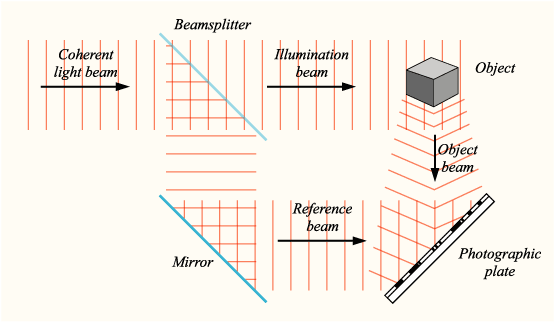
At the core of holography are interference and diffraction. A beam from a coherent source is usually split into two: an object beam that illuminates the subject and a reference beam that meets the light reflected from the object on a recording medium. Their interaction produces an interference pattern—microscopic variations in intensity—that encodes the three-dimensional information. The recording medium can be a photographic plate, a photopolymer, or a digital sensor combined with computational processing.
History and development
Theoretical foundations were laid in the mid-20th century and practical holography advanced after the invention of the laser. Dennis Gabor proposed the concept while working on electron microscopy, and later, coherent light sources made high-quality optical holograms possible. Over subsequent decades techniques diversified to include white-light viewable holograms, pulsed holography for moving objects, and computer-generated holography that synthesizes interference patterns numerically.
Types and techniques
- Transmission holograms: illuminated from behind and often viewed with a laser or strong white light.
- Reflection holograms: viewed in ordinary light; commonly used for display art and security foils.
- Pulsed holography: uses short light bursts to freeze motion.
- Digital and computer-generated: compute and display holographic patterns without an object.
Applications and examples
Holography has practical and artistic uses. In commerce and security it is used for anti-counterfeiting on banknotes, identification cards, and product labels. Scientific applications include holographic interferometry for precise measurements, microscopy for enhanced three-dimensional imaging, and data storage concepts that exploit volumetric recording. Artists and designers employ holograms for visual effects in exhibitions and packaging. Holographic display research aims to produce realistic, glasses-free 3D screens.
Notable distinctions and facts
Holography depends on the wave nature of light and the ability to record phase as well as intensity. It differs from conventional photography in that a single hologram can reproduce parallax and depth cues when viewed from different angles. Reconstruction can be optical or numerical: shining a suitable beam on the recorded interference pattern recreates the original light field, or algorithms can simulate it on displays. Practical limitations include sensitivity to vibration during recording and the need for coherent illumination, though some techniques reduce these constraints.
For more technical introductions and demonstrations, consult resources that explain coherence, interference geometry, and the materials used to record holograms. Basic optical concepts such as the behavior of light and diffraction are helpful starting points when studying holography further.
Questions and answers
Q: What is holography?
A: Holography is a technique used to create 3-D images with lasers.
Q: How is holography different from photography?
A: Holography produces a more accurate 3-D image than photography.
Q: What makes a holograph appear three-dimensional?
A: The holograph appears three-dimensional because it seems to move and change slightly.
Q: What does holography use for its operation?
A: Holography uses the wave aspect of light for its operation.
Q: How is a holograph made?
A: A holograph is made by using a laser to record the interaction of two beams of light.
Q: Can a holograph be viewed without special equipment?
A: No, special equipment such as a holographic viewer or a laser pointer is required to view a holograph.
Q: What are some advantages of using holography over other imaging techniques?
A: Holography produces a more accurate 3-D image and allows for the manipulation of the image.
Related articles
Author
AlegsaOnline.com Holography: principles, history, techniques and applications Leandro Alegsa
URL: https://en.alegsaonline.com/art/44808