
HM Prison Pentridge — Pentridge Prison, Coburg, Victoria
Former Melbourne prison established in 1850 in Coburg, Victoria. Closed in 1997. Noted for bluestone construction, its divisional layout, contested redevelopment and place in Australian penal history.
Overview
HM Prison Pentridge, commonly called Pentridge Prison, was a major colonial and later state gaol located in the suburb of Coburg in Victoria. Built of durable bluestone beginning in 1850, it received its first inmates the following year and remained in operation until its formal closure on 1 May 1997. Over its long existence the complex housed men of varying security classifications and became a prominent feature of Melbourne's penal system and urban landscape.
Image gallery
10 Images
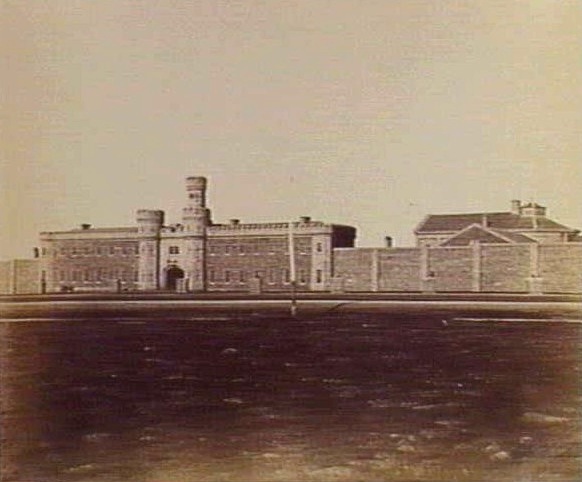


Design, layout and features
Pentridge was constructed with the typical Victorian-era emphasis on separation and control. High outer walls, cell blocks arranged into divisions, internal exercise yards and workshops characterised the site. The buildings were largely built from local bluestone, lending the complex its informal nicknames such as "The Bluestone College" or "Coburg College." Grounds and perimeter plantings were designed and modified over time; some landscaping work has been attributed to prominent local gardener Hugh Linaker, who contributed to several public and institutional gardens in the region.
History and development
The prison evolved across more than a century and a half, adapting to changing penal philosophies and overcrowding pressures. Its divisions separated prisoners by security rating and role, and it contained facilities for labour, punishment and rehabilitation as those concepts changed through the 19th and 20th centuries. Pentridge was the site of high-profile events in Australia’s criminal justice history, including notable executions; among these, the execution of Ronald Ryan in 1967—widely reported as the last legal execution in Australia—remains a significant and controversial chapter in the gaol's story.
Uses, closure and adaptive reuse
After closure in 1997 the extensive precinct presented both heritage opportunities and development pressures. Parts of the site have been demolished, while other historic buildings have been conserved and repurposed. Developers and heritage authorities proposed and implemented a variety of uses: residential apartments, retail and hospitality outlets, cultural spaces and limited public access for tours and exhibitions. A number of projects were presented under names such as Pentridge Village and other development consortia, producing a mixed-use precinct that combines new construction with altered or retained prison fabric.
Controversies, heritage and public memory
Redevelopment has been contested. Heritage organisations and community groups have objected to some approvals that allowed removal of sections of the outer walls, insertion of modern apartment buildings between historic blocks, or demolition of lesser-listed structures. Heritage Victoria, private developers and the National Trust have been involved in negotiations and disputes over what elements should be preserved, modified or lost. These debates reflect broader tensions between urban redevelopment, real estate demand and efforts to maintain the physical record of penal history.
Legacy and significance
Pentridge remains important for historians, former inmates and local residents as a symbol of changing penal policy, urban growth and heritage practice in Victoria. Interpretive programs, adaptive reuses and occasional public events aim to balance commercial reuse with remembrance of the people and events associated with the site. For further contextual information about the complex and its suburb, see local histories and heritage listings and follow institutional links for official documentation and visitor information.
- Established: construction in 1850, first prisoners 1851.
- Closed to operations: 1 May 1997.
- Notable fact: site of high-profile executions, including Ronald Ryan in 1967.
- Post-closure: partial demolition, mixed-use redevelopment and heritage debates.
More details and official records can be sought through heritage authorities and local archives; online summaries and guided tours provide accessible introductions to the site's complex past.
Questions and answers
Q: When was HM Prison Pentridge built?
A: HM Prison Pentridge was built in 1850.
Q: When did the first prisoners arrive at HM Prison Pentridge?
A: The first prisoners arrived at HM Prison Pentridge in 1851.
Q: When was HM Prison Pentridge closed?
A: HM Prison Pentridge was closed on 1 May 1997.
Q: What were some of the nicknames for HM Prison Pentridge?
A: Some of the nicknames for HM Prison Pentridge were "The Bluestone College", "Coburg College", or the "College of Knowledge".
Q: What has happened to much of HM Prison Pentridge since its closure?
A: Since its closure, much of HM Prison Pentridge has been pulled down to make way for a housing development.
Q: Who is developing the northern section of HM Prison Pentridge?
A: The northern section of HM Prison Pentridge is being developed by Valad Property Group.
Q: Why does the National Trust not like the development plans approved by Heritage Victoria for HM Prison Pentridge?
A: The National Trust does not like the development plans approved by Heritage Victoria for HM Prison Pentridge because the plans include taking down sections of the outside walls and building apartments between the historic prison buildings.
Related articles
Author
AlegsaOnline.com HM Prison Pentridge — Pentridge Prison, Coburg, Victoria Leandro Alegsa
URL: https://en.alegsaonline.com/art/44569
Sources
- books.google.com : Melbourne
- heritage.gov.au : "Australian Heritage Places Inventory - Record"
- theage.com.au : "Pentridge tower gets nod"
- books.google.com : The History of Australian Corrections
- theage.com.au : "Private life, public service"
- heraldsun.com.au : "Ned Kelly's bones found"
- nla.gov.au : "Offence against girl"
- nla.gov.au : "Trailed Sodeman— retires soon"
- nla.gov.au : "Vicarage murder"
- nla.gov.au : "Murderer hanged"
- nla.gov.au : "Murderer hanged"
- nla.gov.au : "Alfred Bye executed"
- nla.gov.au : "Leonski hanged in Melbourne"
- nla.gov.au : "Three to be hanged today"
- smh.com.au : "Ronald Ryan, last man executed, may be exhumed"