
History of Ireland: Prehistory, invasions, cultural change and modern states
Concise survey of Ireland’s history from early settlement and Gaelic society through Viking and Norman influence, union with Britain, the 20th‑century partition, and contemporary political and cultural developments.
Overview
The history of Ireland is a long and layered story of settlement, cultural exchange and political change. The island is today divided between the Republic of Ireland in the south and Northern Ireland, which remains part of the United Kingdom. Despite the political division, people on the island share many cultural traditions and a common historical memory that reaches back into prehistory.
Image gallery
10 Images




Prehistory and Gaelic society
Human presence in Ireland dates to the Paleolithic and Mesolithic periods, with farming established in the Neolithic. Bronze and Iron Age societies developed complex metalworking, ritual monuments and trade contacts. Around the first millennium BCE groups associated in later sources with the Celts brought linguistic and artistic influences that contributed to the Gaelic language and social forms. Over many centuries Ireland was organised into a patchwork of small kingdoms or túatha, with kingship, legal traditions and rich oral literature forming the backbone of medieval Gaelic society.
Christianity and the early medieval era
From about the 5th century, Christian missionaries and monastic founders established churches and monasteries that became centers of learning, script production and artistic endeavour. Monastic schools attracted students from the island and beyond, producing illuminated manuscripts and carved stonework. These institutions preserved classical and native learning through the early medieval period and played a central role in religious and cultural life.
Vikings, towns and the Norman arrival
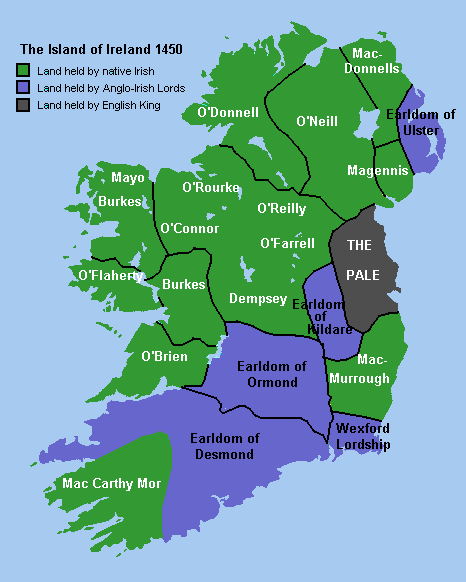
From the late 8th century maritime raiders known as the Vikings began to attack and later settle along Ireland’s coasts. They founded trading towns such as Dublin, Waterford and Limerick which later grew into urban centres. In the late 12th century forces associated with the Normans intervened in local rivalries, initiating a process by which parts of Ireland came under Anglo-Norman influence during the Middle Ages. Over following centuries control waxed and waned between Gaelic lords and Anglo-Norman or English authorities.
Early modern transformations and union
From the 16th century onward English crowns sought to extend control throughout the island through plantation schemes, legal changes and military campaigns. Religious divisions grew sharper after the Reformation as Protestant settlers and Anglican establishment institutions contrasted with the largely Catholic Gaelic population. These differences, together with land settlement policies, contributed to recurring conflict. By the late 18th and early 19th centuries Ireland's political relationship with Britain evolved toward a formal union with Great Britain and the United Kingdom, which reshaped governance and economic ties.
Famine, emigration and the rise of nationalism
The 19th century brought profound economic and social change. A catastrophic crop failure in the mid-19th century led to mass illness, death and emigration, altering Ireland’s population and accelerating movement overseas. The century also saw campaigns for land reform, cultural revival and varying forms of political nationalism, ranging from constitutional Home Rule movements to more radical republican ideas.
Partition and the birth of modern states
In the early 20th century political tensions, armed rebellion and negotiations culminated in the creation of a largely self-governing Irish state in the 1920s while six northeastern counties remained part of the United Kingdom as Northern Ireland. That partition produced two distinct jurisdictions on one island, with long-term implications for identity, governance and community relations.
Conflict and peace in the late 20th century
The second half of the 20th century was marked in Northern Ireland by sustained communal and political conflict, commonly called the Troubles, involving republican and loyalist paramilitaries, state security forces and civilians. After decades of violence, sustained negotiation and local and international mediation produced the 1998 Good Friday Agreement, which established new institutions for shared governance and a framework for political cooperation and human rights protections.
Contemporary Ireland
Since the late 20th century the Republic of Ireland has developed as a sovereign European state with a modern, internationally oriented economy and a vibrant cultural life. The republic’s membership of European institutions influenced its economic policies and social change. Northern Ireland remains part of the United Kingdom, while ongoing political arrangements allow for cross-border cooperation. Debates about identity, language revival, migration and constitutional futures continue to shape public life.
Characteristics and legacy
- Languages and culture: Irish (Gaeilge) and English coexist in public life; literature, music and the arts have global reach.
- Religion and society: Religious differences have been a historical fault line but secularisation and pluralism have increased in recent decades.
- Diaspora: Emigration has created widespread Irish communities abroad that have influenced international perceptions of Ireland.
- Archaeology and sites: Neolithic monuments, monastic ruins and medieval towns offer evidence of layered historical development.
This overview sketches major phases and themes: prehistoric settlement and early Gaelic culture; the impact of Christianity and monastic learning; Viking urban foundations and Norman integration into European politics; early modern state-building and sectarian tensions; famine and demographic change; the 20th‑century partition and the later peace process; and the contemporary states that share the island. For more specialised study consult archaeological reports, primary documents and detailed histories focused on each period.
Questions and answers
Q: When did people start farming in Ireland?
A: People began farming on Ireland thousands of years ago.
Q: Who were the Celts?
A: The Celts were a group of people who moved to Ireland about 2,500 years ago.
Q: What religion did most Irish people adopt when Christians arrived?
A: When Christians arrived, most Irish people became Christian.
Q: Who invaded Ireland during the Middle Ages?
A: During the Middle Ages, both the Vikings and Normans invaded Ireland.
Q: How did Ireland become part of the United Kingdom?
A: Eventually, through a series of political events, Ireland became part of the United Kingdom with Great Britain.
Q: When did most of Ireland become a separate country?
A: In the 1920s, most of Ireland became a separate country but Northern Ireland stayed in the United Kingdom.
Related articles
Author
AlegsaOnline.com History of Ireland: Prehistory, invasions, cultural change and modern states Leandro Alegsa
URL: https://en.alegsaonline.com/art/44471
Sources
- bbc.com : "Earliest evidence of humans in Ireland"
- lithicsireland.ie : "The Mesolithic and Mesolithic-Neolithic transition in Ireland chapter 3"
- worldcat.org : Landscapes of Neolithic Ireland
- microsites.museum.ie : "The Irish Bronze Age | National Museum of Ireland | Bronze Age Handling Box"
- worldcat.org : Treasures of the National Museum of Ireland : Irish antiquities
- irisharchaeology.ie : "Roman contacts with Ireland | Irish Archaeology"
- gutenberg.org : Phases of Irish History
- worldcat.org : Early medieval Ireland, 400-1200
- jstor.org : "Ireland in the Iron Age: A Basket Case?"
- worldcat.org : A new history of Ireland · archive.org