
History of Colonialism: Origins, Expansion, and Global Consequences
A concise overview of the history of colonialism: early examples, European overseas empires, 19th-century expansion, decolonization, and lasting global impacts and distinctions.
Colonialism broadly refers to the practice by which one polity exerts control over territory and populations beyond its own borders, often to extract resources, settle people, or extend strategic influence. Early forms of expansion that resemble colonial control appear in many eras and places: ancient states and civilizations sometimes established dependencies, trading outposts or governed distant provinces. For discussions of the concept in modern scholarship see colonialism.
Image gallery
10 Images




Early examples and distinctions
Long before the maritime empires of Europe, a range of societies engaged in actions that historians discuss in terms of imperial rule or colonization. The Hittites, for instance, established control over neighboring regions and client states (Hittites), while continental powers like the Persian and Roman polities extended provincial systems and settler layers (Roman Empire). Scholars often distinguish overland empires—frequently labeled imperialism—from overseas colonial systems. Examples of expansive continental polities include the Mongol Empire, which spanned from parts of the Western Pacific to Eastern Europe, the campaigns of Alexander the Great, and the early Islamic dominions such as the Umayyad Caliphate. Byzantine institutions and later the Ottoman state also combined administrative control and cultural influence in large territories (Byzantine Empire, Ottoman Empire).
European overseas expansion (15th–18th centuries)
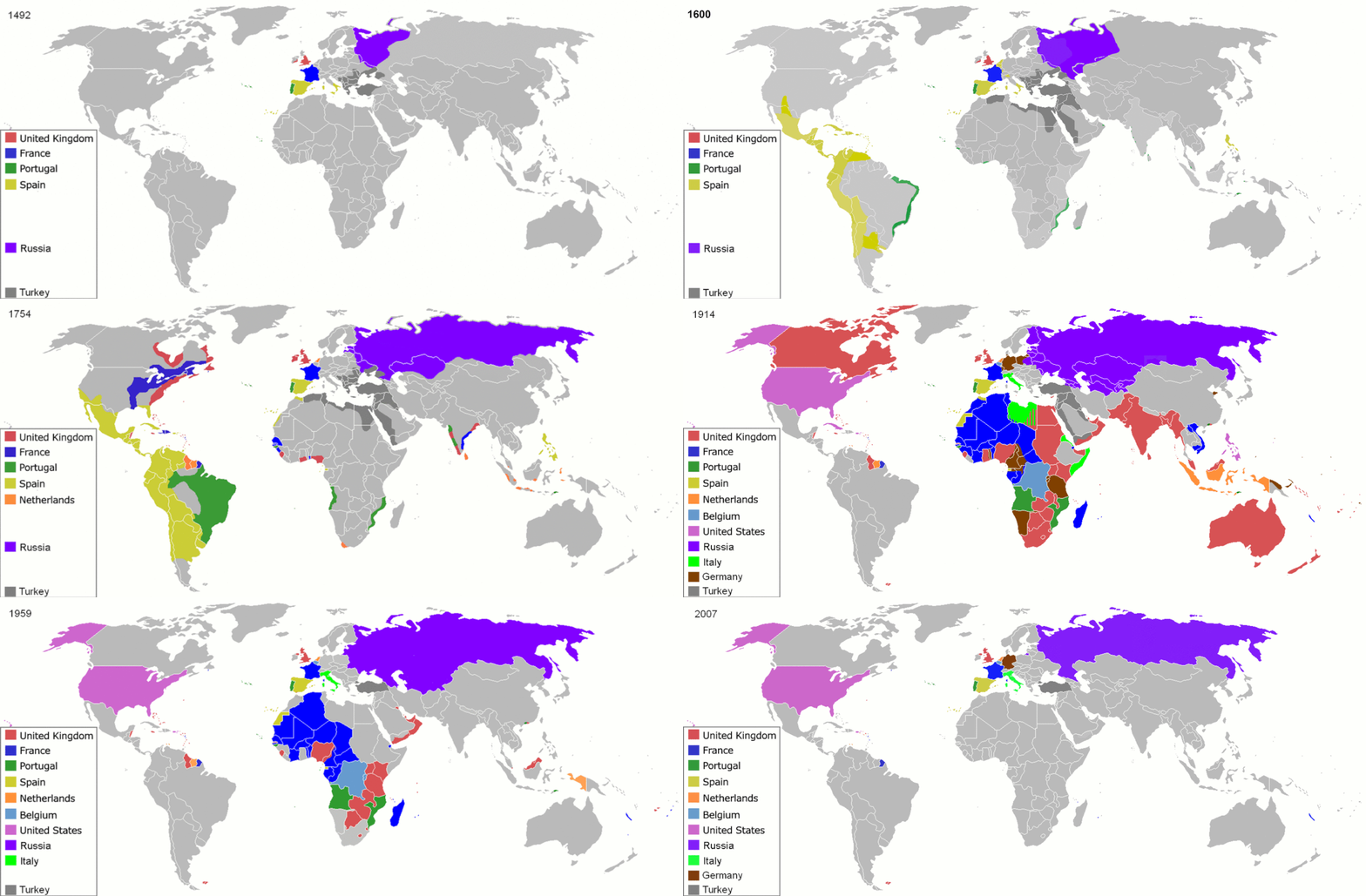
The phase most often meant by modern discussions of colonialism began in the fifteenth century, when Iberian kingdoms sponsored voyages to new maritime routes. Spanish and Portuguese voyages opened direct contact with the Americas and coastal regions of Africa and Asia (Spanish, Portuguese). These voyages established trading posts, settler colonies and systems of resource extraction across the coasts of Africa, the Middle East, India and parts of East Asia. Over the next two centuries other European states—England, France and the Dutch Republic—built their own overseas networks (England, France, Holland), establishing colonies in the Americas, Africa and Asia and creating long-distance trade circuits.
19th‑century expansion and the so‑called New Imperialism
After independence movements in the Americas reduced Iberian dominance, 19th-century Europe underwent industrial, military and demographic transformations that made new forms of territorial expansion possible. Britain (Britain), France and other powers directed imperial ambitions toward regions such as South Africa, the Indian subcontinent (India) and Southeast Asia. This era—sometimes called the era of New Imperialism—saw fast territorial acquisitions, commercial colonization and intense competition, culminating in events like the Scramble for Africa. Rivalries over colonies were factors in the tensions that contributed to World War I.
Decolonization and the 20th century
The two world wars reshaped international power and accelerated decolonization. Following World War I, some territories changed hands as defeated empires relinquished overseas possessions; after World War II a broad wave of independence movements, diplomatic pressure and changing global norms led most colonies to become sovereign states. European control over non-European territories waned across mid-20th century Asia and Africa; the transfer of Macau from Portugal back to the People’s Republic of China in 1999 is often cited as one of the last formal acts closing the long span of European overseas colonial administration (World War II and its aftermath were key turning points).
Characteristics, legacy and debate
Colonial systems varied widely: settler colonies imported large numbers of migrants and often displaced indigenous populations; trading empires relied on fortified ports and mercantile networks; direct-rule colonies imposed metropolitan institutions, while indirect-rule systems worked through local elites. The legacies of colonialism include altered economic patterns, linguistic and legal influences, demographic change, and contested memory. Historians and communities debate responsibility, restitution and how to understand long-term effects on development, governance and identity.
Related topics and further reading
- Colonialism: general concept
- Ancient Near Eastern empires
- Imperialism vs. colonialism
- Mongol Empire
- Eurasian reach
- Alexander the Great
- Early Islamic caliphates
- Roman governance
- Byzantine continuity
- Ottoman state
- North African regions
- Southern Europe
- Spanish voyages
- Portuguese exploration
- The Americas
- African coasts
- Middle Eastern contacts
- India and South Asia
- East Asian interactions
- England and the empire
- France and its colonies
- Dutch overseas networks
- New World colonies
- British imperial history
- South African colonial history
- Scramble for Africa
- World War I and colonies
- World War II and decolonization
- Macau transfer
- China and late colonial legacies
Questions and answers
Q: What is colonialism?
A: Colonialism is the taking over of one country by another.
Q: When did European colonialism begin?
A: European colonialism began in the fifteenth century when the Spanish and Portuguese began exploring the Americas, and the coasts of Africa, the Middle East, India, and East Asia.
Q: What was known as the era of New Imperialism?
A: The nineteenth century was known as the era of New Imperialism due to Europe undergoing industrialisation, an increase in population size, more organised armies with better weapons produced in factories.
Q: Who were some ancient peoples involved in colonialism?
A: Ancient peoples such as Hittites and Incas were involved in colonialism.
Q: How did Europe's colonies become independent after World War II?
A: After World War II Europe's colonies started to become independent as countries who had lost during World War I had to give up their colonies to those who won.
Q: What are examples of land-based empires?
A: Examples of land-based empires include The Mongol Empire, The Empire of Alexander The Great, The Umayyad Caliphate, The Persian Empire, The Roman Empire and The Byzantine Empire.
Q: When did Portugal return its last colony in Asia to China?
A: Portugal returned its last colony in Asia (Macau) to China in 1999 ending an era that had lasted five hundred years.
Related articles
Author
AlegsaOnline.com History of Colonialism: Origins, Expansion, and Global Consequences Leandro Alegsa
URL: https://en.alegsaonline.com/art/44462